



Close Menu

    Subscribe to Updates

    Get the latest creative news from FooBar about art, design and business.

    What's Hot

    Dell security advisory (AV26-322) – Canadian Centre for Cyber Security

    April 11, 2026

    Scattered Spider Infrastructure May Signal Oil & Gas Targeting

    April 11, 2026

    Debian DSA-6206-1 gdk-pixbuf Important Code Exec DoS Risk

    April 11, 2026
    Facebook X (Twitter) Instagram
    • Demos
    • Technology
    • Gaming
    • Buy Now
    Facebook X (Twitter) Instagram Pinterest Vimeo
    Canadian Cyber WatchCanadian Cyber Watch
    • Home
    • News
    • Alerts
    • Tips
    • Tools
    • Industry
    • Incidents
    • Events
    • Education
    Subscribe
    Canadian Cyber WatchCanadian Cyber Watch
    Home»News»Google Chrome adds infostealer protection against session cookie theft
    News

    Google Chrome adds infostealer protection against session cookie theft

    adminBy adminApril 11, 2026No Comments3 Mins Read
    Share Facebook Twitter Pinterest LinkedIn Tumblr Reddit Telegram Email
    Share
    Facebook Twitter LinkedIn Pinterest Email


    Google Chrome adds infostealer protection against session cookie theft

    Google has rolled out Device Bound Session Credentials (DBSC) protection in Chrome 146 for Windows, designed to block info-stealing malware from harvesting session cookies.

    macOS users will benefit from this security feature in a future Chrome release that has yet to be announced.

    The new protection has been announced in 2024, and it works by cryptographically linking a user’s session to their specific hardware, such as a computer’s security chip – the Trusted Platform Module (TPM) on Windows and the Secure Enclave on macOS.

    Wiz

    Since the unique public/private keys for encrypting and decrypting sensitive data are generated by the security chip, they cannot be exported from the machine.

    This prevents the attacker from using stolen session data because the unique private key protecting it cannot be exported from the machine.

    “The issuance of new short-lived session cookies is contingent upon Chrome proving possession of the corresponding private key to the server,” Google says in an announcement today.

    Without this key, any exfiltrated session cookie expires and becomes useless to an attacker almost immediately.
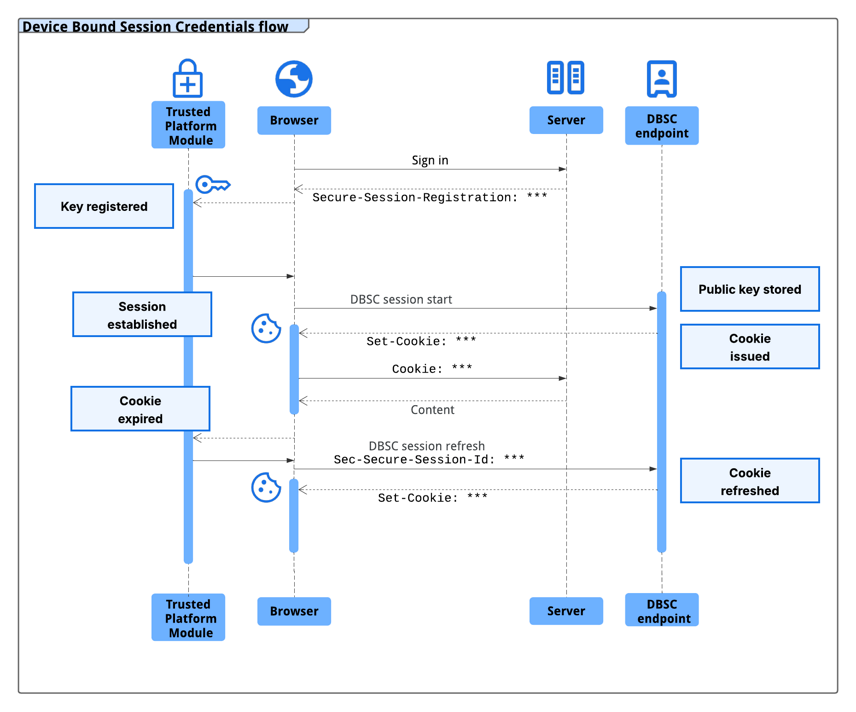
    The Device Bound Session Credentials (DBSC) flow
    Browser-server interaction in the context of the DBSC protocol
    source: Google


    A session cookie acts as an authentication token, typically with a longer validity time, and is created server-side based on your username and password.

    The server uses the session cookie for identification and sends it to the browser, which presents it when you access the online service.

    Because they allow authenticating to a server without providing credentials, threat actors use specialized malware called infostealer to collect session cookies.

    Google says that multiple infostealer malware families, like LummaC2, “have become increasingly sophisticated at harvesting these credentials,” allowing hackers to gain access to users’ accounts.

    “Crucially, once sophisticated malware has gained access to a machine, it can read the local files and memory where browsers store authentication cookies. As a result, there is no reliable way to prevent cookie exfiltration using software alone on any operating system” – Google

    The DBSC protocol was built to be private by design, with each session being backed by a distinct key. This prevents websites from correlating user activity across multiple sessions or sites on the same device.

    Additionally, the protocol enables minimal information exchange that requires only the per-session public key necessary to certify proof of possession, and does not leak device identifiers.

    In a year of testing an early version of DBSC in partnership with multiple web platforms, including Okta, Google observed a notable decline in session theft events.

    Google partnered with Microsoft for developing the DBSC protocol as an open web standard and received input “from many in the industry that are responsible for web security.”

    Websites can upgrade to the more secure, hardware-bound sessions by adding a dedicated registration and refresh endpoints to their backends without sacrificing compatibility with the existing frontend.

    Web developers can turn to Google’s guide for DBSC implementation details. Specifications are available on the World Wide Web Consortium (W3C) website, while an explainer can be found on GitHub.


    tines

    Automated pentesting proves the path exists. BAS proves whether your controls stop it. Most teams run one without the other.

    This whitepaper maps six validation surfaces, shows where coverage ends, and provides practitioners with three diagnostic questions for any tool evaluation.


    Source link

    Share. Facebook Twitter Pinterest LinkedIn Tumblr Email
    Previous ArticleSSA-392859 V1.2 (Last Update: 2025-12-09): Local Arbitrary Code Execution Vulnerability in Siemens Engineering Platforms before V20
    Next Article Mozilla security advisory (AV26-323) – Canadian Centre for Cyber Security
    admin
    • Website

    Related Posts

    News

    The Oldest Octopus Fossil Ever Isn’t An Octopus At All, Scientists Discover

    April 11, 2026
    News

    Google rolls out Gmail end-to-end encryption on mobile devices

    April 11, 2026
    News

    CIS Benchmarks Monthly Update September 2025

    April 11, 2026
    Add A Comment

    Comments are closed.

    Demo
    Top Posts

    Global Takedown of Massive IoT Botnets Halts Record-Breaking Cyberattacks

    March 20, 202619 Views

    Catchy & Intriguing

    March 17, 202619 Views

    The Grandparent Scam: How AI Voice Technology Makes This Old Con Deadlier Than Ever

    March 18, 202617 Views
    Stay In Touch
    • Facebook
    • YouTube
    • TikTok
    • WhatsApp
    • Twitter
    • Instagram
    Latest Reviews
    85
    Featured

    Pico 4 Review: Should You Actually Buy One Instead Of Quest 2?

    January 15, 2021 Featured
    8.1
    Uncategorized

    A Review of the Venus Optics Argus 18mm f/0.95 MFT APO Lens

    January 15, 2021 Uncategorized
    8.9
    Editor's Picks

    DJI Avata Review: Immersive FPV Flying For Drone Enthusiasts

    January 15, 2021 Editor's Picks

    Subscribe to Updates

    Get the latest tech news from FooBar about tech, design and biz.

    Demo
    Most Popular

    Global Takedown of Massive IoT Botnets Halts Record-Breaking Cyberattacks

    March 20, 202619 Views

    Catchy & Intriguing

    March 17, 202619 Views

    The Grandparent Scam: How AI Voice Technology Makes This Old Con Deadlier Than Ever

    March 18, 202617 Views
    Our Picks

    Dell security advisory (AV26-322) – Canadian Centre for Cyber Security

    April 11, 2026

    Scattered Spider Infrastructure May Signal Oil & Gas Targeting

    April 11, 2026

    Debian DSA-6206-1 gdk-pixbuf Important Code Exec DoS Risk

    April 11, 2026

    Subscribe to Updates

    Get the latest creative news from FooBar about art, design and business.

    Facebook X (Twitter) Instagram Pinterest
    • Home
    • Technology
    • Gaming
    • Phones
    • Buy Now
    © 2026 ThemeSphere. Designed by ThemeSphere.

    Type above and press Enter to search. Press Esc to cancel.