



Close Menu

    Subscribe to Updates

    Get the latest creative news from FooBar about art, design and business.

    What's Hot

    Canadian employees targeted in payroll pirate attacks

    April 11, 2026

    HPE security advisory (AV26-333) – Canadian Centre for Cyber Security

    April 11, 2026

    CVE-2026-5809 | THREATINT

    April 11, 2026
    Facebook X (Twitter) Instagram
    • Demos
    • Technology
    • Gaming
    • Buy Now
    Facebook X (Twitter) Instagram Pinterest Vimeo
    Canadian Cyber WatchCanadian Cyber Watch
    • Home
    • News
    • Alerts
    • Tips
    • Tools
    • Industry
    • Incidents
    • Events
    • Education
    Subscribe
    Canadian Cyber WatchCanadian Cyber Watch
    Home»News»CPUID hacked to deliver malware via CPU-Z, HWMonitor downloads
    News

    CPUID hacked to deliver malware via CPU-Z, HWMonitor downloads

    adminBy adminApril 11, 2026No Comments3 Mins Read
    Share Facebook Twitter Pinterest LinkedIn Tumblr Reddit Telegram Email
    Share
    Facebook Twitter LinkedIn Pinterest Email


    CPUID hacked to deliver malware via CPU-Z, HWMonitor downloads

    Hackers gained access to an API for the CPUID project and changed the download links on the official website to serve malicious executables for the popular CPU-Z and HWMonitor tools.

    The two utilities have millions of users who rely on them for tracking the physical health of internal computer hardware and for comprehensive specifications of a system.

    Users who downloaded either tool reported on Reddit recently that the official download portal points to the Cloudflare R2 storage service and fetches a trojanized version of HWiNFO, another diagnostic and monitoring tool from a different developer.

    Wiz

    The name of the malicious file is HWiNFO_Monitor_Setup, and running it launches a Russian installer with an Inno Setup wrapper, which is atypical and highly suspicious.

    Users reported that downloading the clean hwmonitor_1.63.exe from the direct URL was still possible, indicating that the original binaries were intact, but the distribution links appear to have been poisoned.

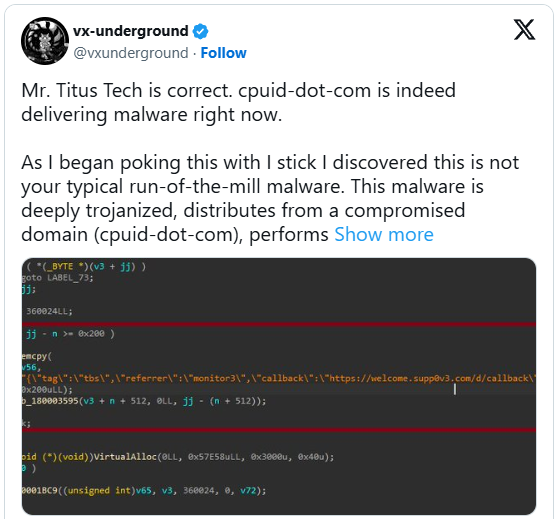
    The externalized download chain was also confirmed by Igor’s Labs and @vxunderground, who reported that a fairly advanced loader using known techniques, tactics, and procedures (TTPs) is involved.

    “As I began poking this with a stick, I discovered this is not your typical run-of-the-mill malware,” stated vxunderground.

    “This malware is deeply trojanized, distributes from a compromised domain (cpuid-dot-com), performs file masquerading, is multi-staged, operates (almost) entirely in-memory, and uses some interesting methods to evade EDRs and/or AVs such as proxying NTDLL functionality from a .NET assembly.”
    Tweet

    The researcher claims that the same threat group targeted users of the FileZilla FTP solution last month, suggesting that the attacker is focusing on widely used utilities.

    The downloaded ZIP is flagged by 20 antivirus engines on VirusTotal, although not clearly identified. Some classify it as Tedy Trojan, and others as Artemis Trojan.

    Some researchers on Virustotal say that the fake HWiNFO variant is an infostealer malware.

    BleepingComputer has contacted CPUID to learn more about what happened, the date of the compromise, the affected versions, and what impacted users should do. A spokesperson has provided the following statement.

    “Investigations are still ongoing, but it appears that a secondary feature (basically a side API) was compromised for approximately six hours between April 9 and April 10, causing the main website to randomly display malicious links (our signed original files were not compromised). The breach was found and has since been fixed.” – CPUID

    The same person told us that the hackers hit them at a time when the main developer was away on holiday.

    Currently, it appears that CPUID has fixed the problem and now serves clean versions for both CPU-Z and HWMonitor.


    tines

    Automated pentesting proves the path exists. BAS proves whether your controls stop it. Most teams run one without the other.

    This whitepaper maps six validation surfaces, shows where coverage ends, and provides practitioners with three diagnostic questions for any tool evaluation.


    Source link

    Share. Facebook Twitter Pinterest LinkedIn Tumblr Email
    Previous ArticleQuote: Denis Waitley “Expect the best, plan for the worst, and prepare….”
    Next Article CVE-2026-5809 | THREATINT
    admin
    • Website

    Related Posts

    News

    Canadian employees targeted in payroll pirate attacks

    April 11, 2026
    News

    Analysis of one billion CISA KEV remediation records exposes limits of human-scale security

    April 11, 2026
    News

    Behind the Blog: Smoking the Whole Carton

    April 11, 2026
    Add A Comment

    Comments are closed.

    Demo
    Top Posts

    Global Takedown of Massive IoT Botnets Halts Record-Breaking Cyberattacks

    March 20, 202619 Views

    Catchy & Intriguing

    March 17, 202619 Views

    The Grandparent Scam: How AI Voice Technology Makes This Old Con Deadlier Than Ever

    March 18, 202617 Views
    Stay In Touch
    • Facebook
    • YouTube
    • TikTok
    • WhatsApp
    • Twitter
    • Instagram
    Latest Reviews
    85
    Featured

    Pico 4 Review: Should You Actually Buy One Instead Of Quest 2?

    January 15, 2021 Featured
    8.1
    Uncategorized

    A Review of the Venus Optics Argus 18mm f/0.95 MFT APO Lens

    January 15, 2021 Uncategorized
    8.9
    Editor's Picks

    DJI Avata Review: Immersive FPV Flying For Drone Enthusiasts

    January 15, 2021 Editor's Picks

    Subscribe to Updates

    Get the latest tech news from FooBar about tech, design and biz.

    Demo
    Most Popular

    Global Takedown of Massive IoT Botnets Halts Record-Breaking Cyberattacks

    March 20, 202619 Views

    Catchy & Intriguing

    March 17, 202619 Views

    The Grandparent Scam: How AI Voice Technology Makes This Old Con Deadlier Than Ever

    March 18, 202617 Views
    Our Picks

    Canadian employees targeted in payroll pirate attacks

    April 11, 2026

    HPE security advisory (AV26-333) – Canadian Centre for Cyber Security

    April 11, 2026

    CVE-2026-5809 | THREATINT

    April 11, 2026

    Subscribe to Updates

    Get the latest creative news from FooBar about art, design and business.

    Facebook X (Twitter) Instagram Pinterest
    • Home
    • Technology
    • Gaming
    • Phones
    • Buy Now
    © 2026 ThemeSphere. Designed by ThemeSphere.

    Type above and press Enter to search. Press Esc to cancel.