



Welcome back to the Abstract! These are the studies this week that ate well, moved mountains, grew brains, and saved medieval texts.
First, scientists set out to understand why Venus doesn’t have a moon and discover even more unnerving stuff about this delightfully nightmarish planet. Then: a hidden range of primordial supermountains, a literal brain-space, and evidence of Tudor-era subterfuge.
As always, for more of my work, check out my book First Contact: The Story of Our Obsession with Aliens, or subscribe to my personal newsletter the BeX Files.
I’m so hungry I could eat my own moon
Venus is a bizarro world with a year that is shorter than its day, a surface shaped by diabolical heat and pressure, and skies soaked in sulfuric acid. Frankly, this planet is metal enough as it is, but scientists have now suggested that Venus is also a moon-eater.
For years, researchers have pondered why Venus lacks a moon, in contrast to all other planets except Mercury. One possibility is that Venus was once orbited by a primordial satellite that it ultimately tore apart and swallowed, according to a new study. And honestly, that sounds like something Venus would do. It’s in character.
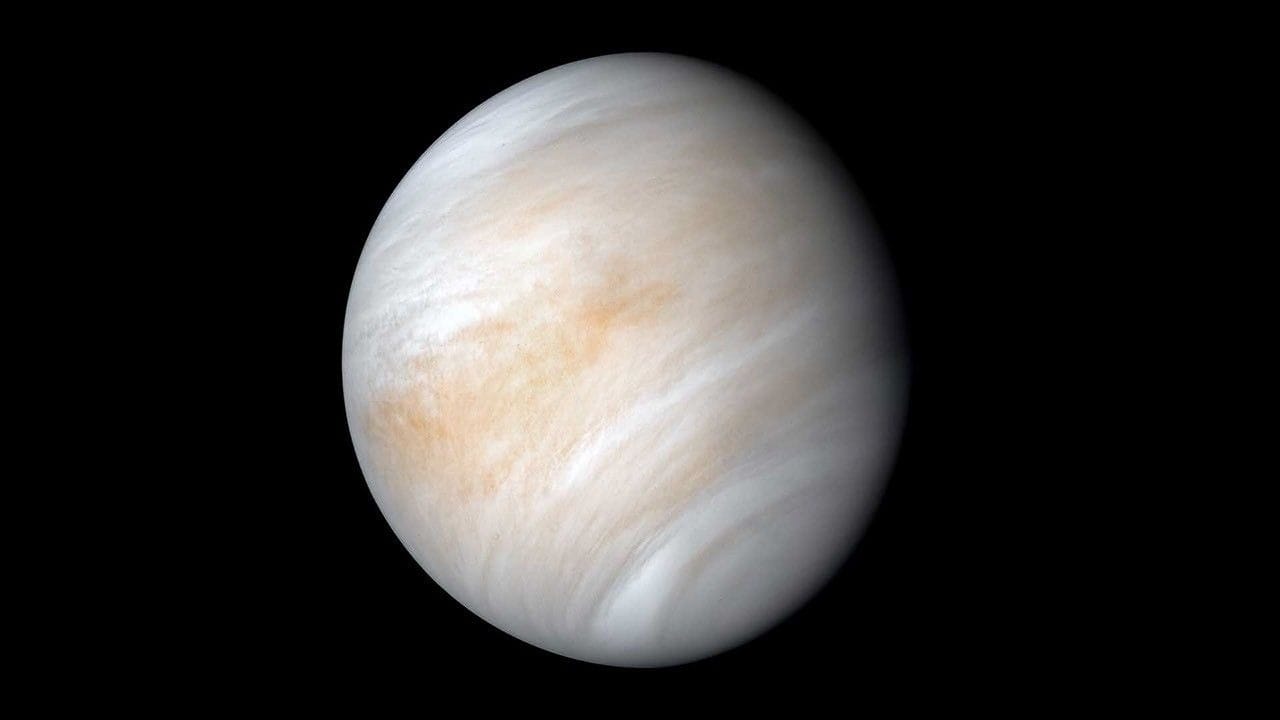
To reach this conclusion, scientists ran simulations of Venusian moons ranging from half to ten times as massive as Earth’s Moon. Because Venus has a very slow rotation rate equal to 243 Earth days, most of the modeled satellites were drawn inward, ultimately crashing into Venus. Earth’s fast rotation rate, in contrast, has pushed the Moon to recede farther from our world, at a rate of about 1.5 inches each year.
“The absence of a Venusian satellite can be understood as a natural consequence of tidal evolution alone,” said researchers led by Stephen Kane of the University of California, Riverside. The researchers added that the obliteration of a past moon around Venus may offer one reason why the planet became so aggressively inhospitable, while Earth evolved into a comfy haven for life.
“The fate of a Venus moon carries direct implications for early Venus habitability,” the team said. “The eventual destruction of the moon…would deliver a massive energy pulse to the Venusian surface and atmosphere, with potential implications for the loss of surface water and the onset of a runaway greenhouse state.”
It’s possible that NASA’s DAVINCI orbiter, which is due for launch to Venus in 2029, could search for the chemical signatures of an ancient obliterated moon, according to the study. In the meantime, my takeaway is that Majora’s Mask is based on a true Venusian story.
In other news…
If it’s not Gondwana, I don’t wanna
Shout out to my fellow Gondwana-heads! Just a week after a study came out minting Gondwana as a bonafide “supercontinent,” another work has probedthe remnants of Himalaya-scale “Gondwana supermountains” buried deep under Antarctica’s ice sheet.
Both studies argue that the geological upheaval associated with Gondwana’s formation directly led to the Cambrian “explosion” of complex life that began about 538 million years ago. But the new study focuses on the role of Gondwana’s colossal mountain range and the massive submarine “fan” system underneath it.
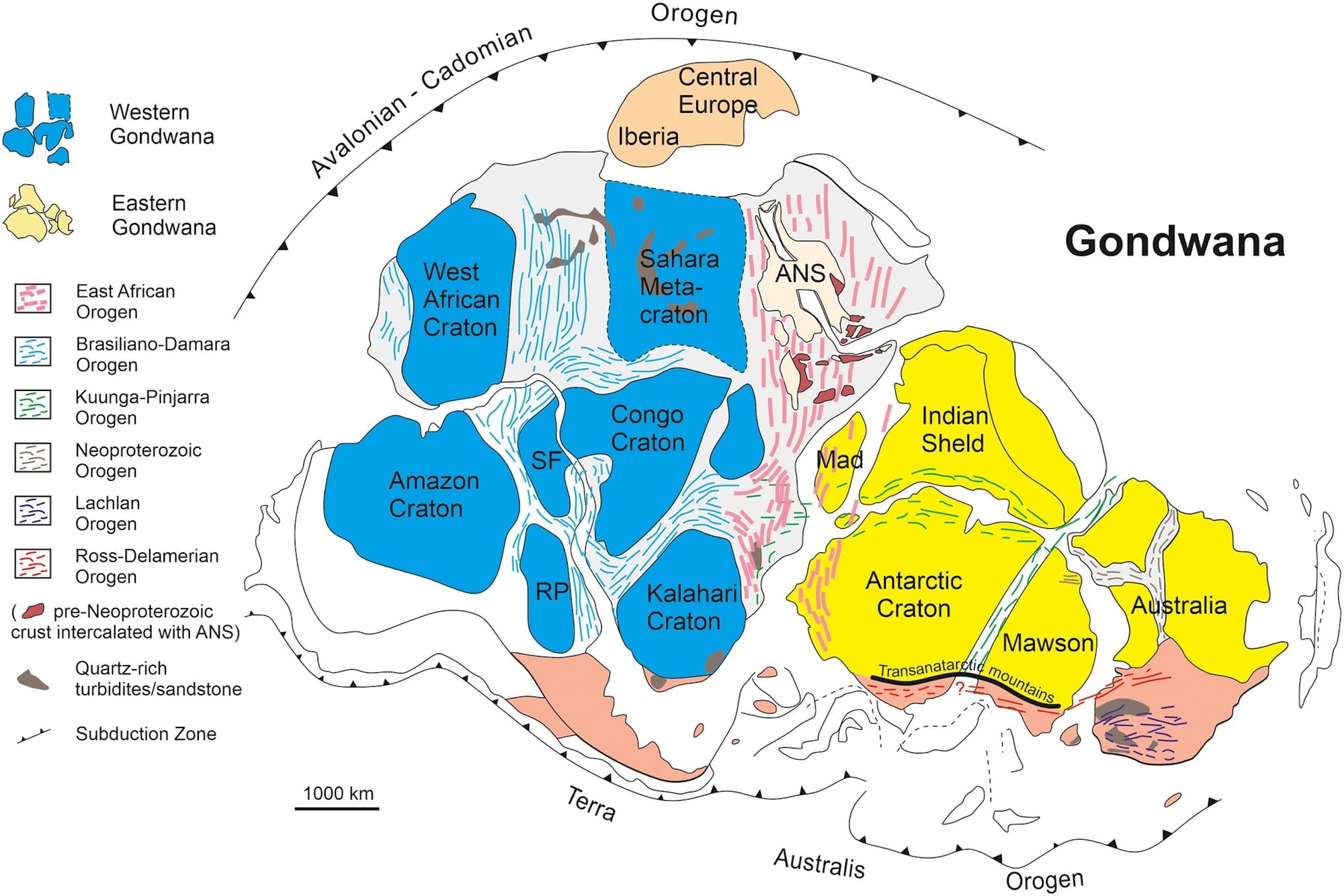
“It is unlikely to be a coincidence that Earth’s most dramatic period of evolution correlates with the planet’s most important period of mountain building: the formation and erosion of the Gondwana Supermountains,” said authors Bei Chen and Ian H. Campbell of the Australian National University.
By studying 1,700 zircons—hardy minerals that can be used to reconstruct continental timelines—the researchers found a disproportionate spike in Antarctic zircons dating from 650 and 450 million years ago, consistent with the formation of Gondwana. The supermountains and their underlying fan systems provided the necessary nutrients for the meteoric rise of animals and other complex life in the Cambrian period, according to the study.
“Analyses of detrital zircons from Antarctica show that its tectonics were dominated by Himalayan-style mountains, the roots of which now underlie the ice sheet,” the team concluded.
Gondwana broke apart during the age of dinosaurs, but as these studies show, its body parts live on, scattered under ice and dispersed across new continents. This has been Gondwana News.
Occupy Mouse Brain
Konstantin Kaganovsky, Kevin W. Kelley, Tilo Gschwind, Paul M. Harary et al.
“Developmental xenocortication using human-derived organoids in mice.” Nature.
It is notoriously challenging to study human brain tissue in vivo on both practical and ethical levels. It’s not as if you can just cut open someone’s noggin and rummage around in there like you’re Victor Frankenstein.
But scientists have now discovered a promising workaround by transplanting human brain “organoids”—lab-grown structures based on human stem cells—into the heads of mice that have been engineered to have open space in their brains instead of a cortex. Scientists who developed this new experimental technique of “xenocortication” report that the human organoids grew to occupy the cavities in the rodents’ heads, and showed analogous development to real brain tissues.
The xenocortical (abbreviated XCX, no relation to Charli) mice seemed to behave more or less normally, despite having millions of human-derived neurons in their heads.

“We envision that xenocortication will be useful for obtaining circuit- and behaviour-level readouts using human neurons to study neurodevelopment, model disease and develop therapeutics,” said researchers co-led by Konstantin Kaganovsky, Kevin W. Kelley, Tilo Gschwind, and Paul M. Harary of Stanford University.
“Generating XCX mice with more mature and canonical cortical organization will require early and proactive engagement to establish ethical guidance,” the team emphasized.
Talk about living rent-free in someone else’s head.
Hard to Gage his motivation
King Henry VIII, the English monarch notorious for disposing of wives and Catholic hegemony, relied on the courtier Sir John Gage to dissolve and plunder monasteries during his consequential reign.
But the discovery of long-lost pages that were once possessed by Gage reveals that this royal ally may have saved an outlawed manuscript from destruction, hinting at a dangerous act of subterfuge.
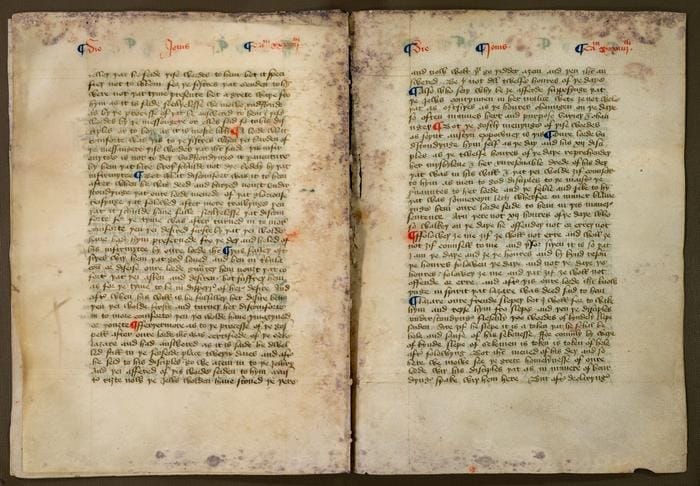
Katie Walter of the University of Sussex and James Wade of Girton College, Cambridge identified a six-page fragment of a popular medieval text that had been misplaced within Gage’s belongings. The fragment came from Nicholas Love’s Mirror of the Blessed Life of Jesus Christ, which was popular in the 15th century, but had fallen out of favor by Henry VIII’s reign. It seems that Gage nonetheless saved a copy, despite orders to destroy such texts.
“One consequence of this puzzle is that the fragment, hereafter referred to as The Keep fragment, has gone undescribed,” said Walter and Wade in their new study. “John Gage possibly acquired the book at the time of the dissolution of the monasteries” and it later became “hidden in plain sight” in his belongings.
And Gage would have gotten away with it too, if it weren’t for those meddling historians!
Thanks for reading! See you next week.
