


👋 Welcome to OSINT Tool Tuesday. This week we’re looking at Waybien; a web-based search engine designed to help you discover public groups and communities across platforms including Telegram, WhatsApp, Facebook, Discord, and Slack. Instead of searching each platform individually, Waybien provides a single interface for finding communities based on keywords, categories, geography, language and other attributes.
🚨 This tool has been added to the OSINT Resources for Community Discovery page on The OSINT Newsletter for easy reference later. That list serves as a roadmap for new tutorials in the future. If there are any tools you’d like to see added to the list and covered, please reach out to jake@osint.news with details.
🪃 If you missed the last newsletter, here’s a link to catch up.
⚡ You Are the Leak: OSINT and Operational Security (OpSec)

Waybien is a community search engine that helps users discover groups and channels across multiple social and messaging platforms from a single interface. Current platform coverage includes Telegram, WhatsApp, Facebook, Discord, and Slack, with its own website showing thousands of indexed communities across these services.
🎩 H/T: Waybien Ltd. / Aden Joseph Ozsoy
The platform is especially useful when you need to identify relevant online communities, discover niche groups, or map where particular subjects are being discussed.
Important Note: Finding a group or channel through Waybien does not mean that every piece of information associated with that community is accurate, current, or attributable to its members. Make sure not to treat community membership and participation as evidence of an individual’s beliefs, behaviour or affiliation without additional corroboration.
In this guide, I’ll show you how to use Waybien, search for communities, narrow down results, and incorporate community discovery into your OSINT workflow.
Let’s get started! ⬇️
Waybien is one of those tools you can access directly through your web browser with no installation required. Simply visit the site and begin searching for communities.
The basic concept is simple: enter a keyword or phrase describing the community you’re looking for and Waybien will return relevant groups and channels from the platforms it indexes.
Waybien is designed around keyword-based community discovery.
Your starting search should generally reflect the subject, organisation, location, language or topic you’re investigating.
For example: OSINT, Cybersecurity, Ukraine, Donald Trump, Crypto etc.
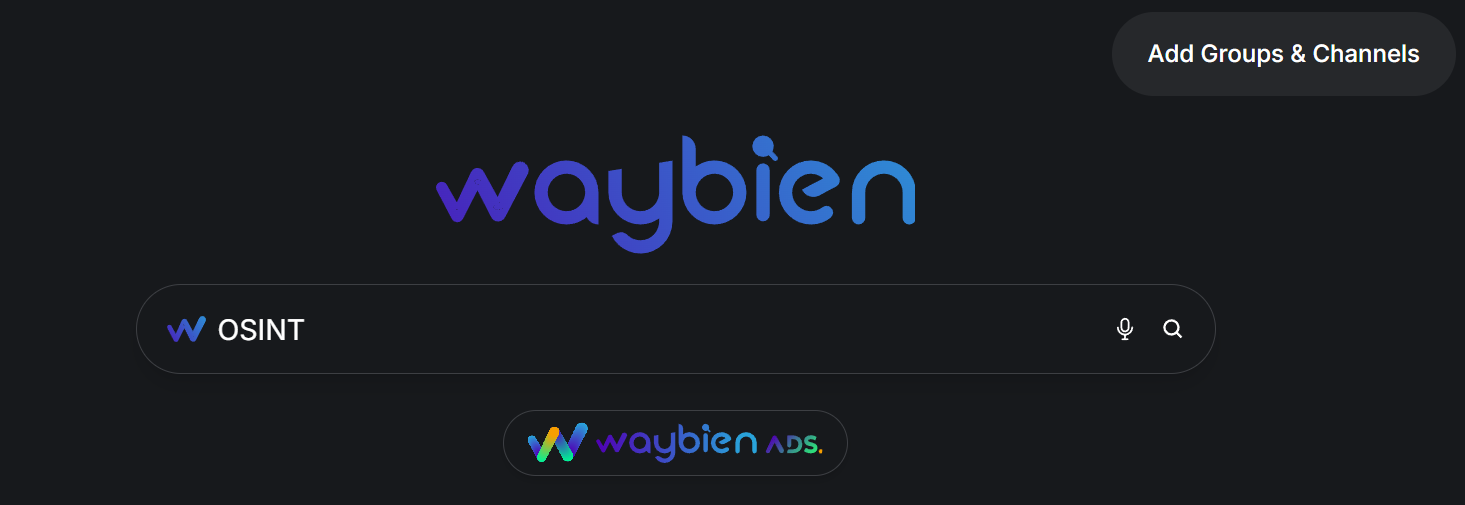
These are obviously broad search terms, but the results can then be refined to help find relevant communities.
Let’s dive a little further into keyword searching to see what results you might find.
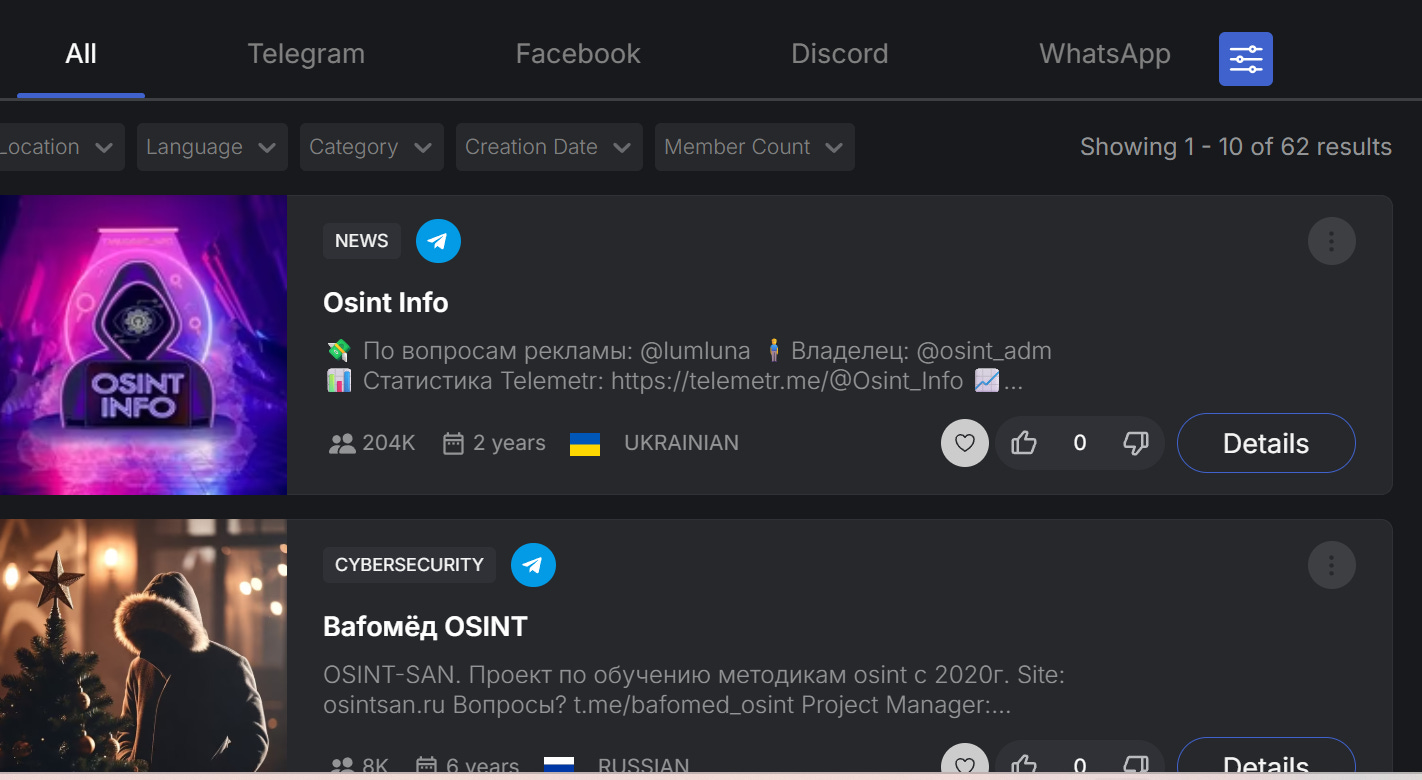
If we follow through with the search for OSINT, it could surface groups and channels related to open-source intelligence, investigations, research, intelligence analysis, and associated subjects including cybersecurity:
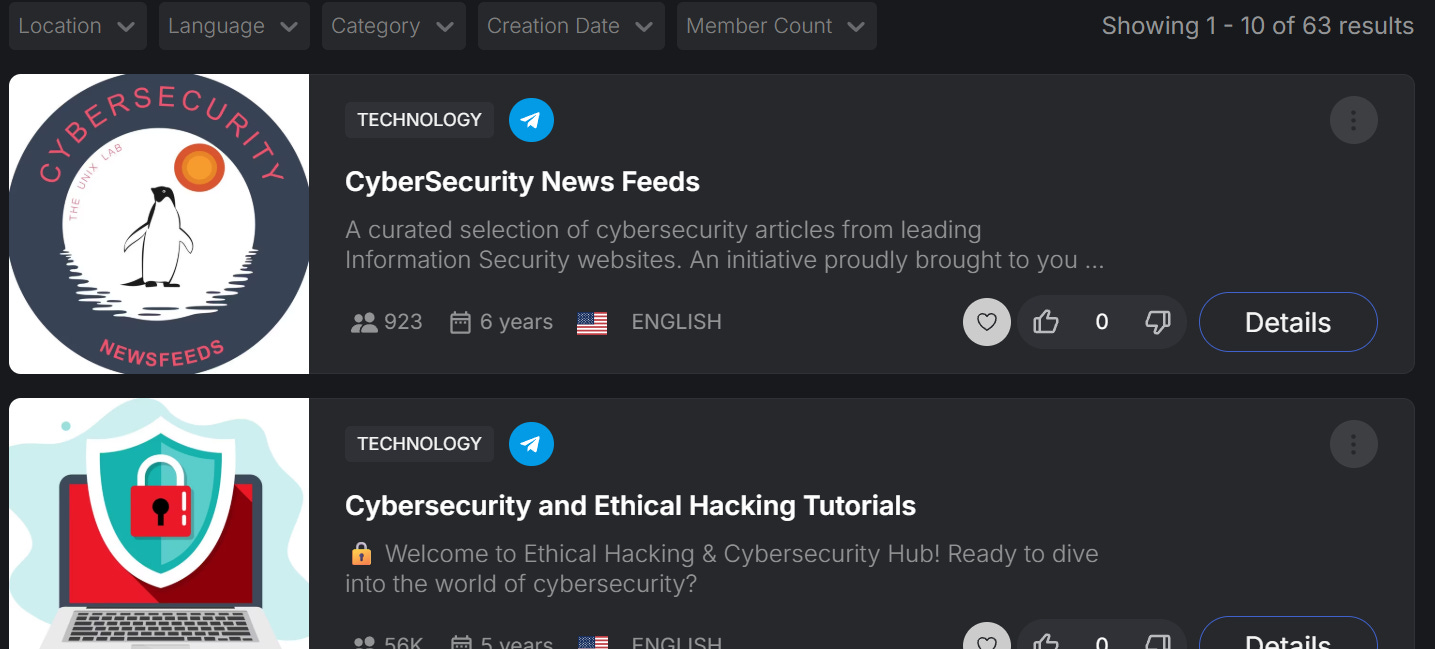
Likewise, a search for: Cybersecurity could help identify communities focused on technology, security research, incident response, penetration testing, and related topics.
🗒️Remember that Waybien is searching for communities rather than individual posts or messages.
This means your initial search can be viewed as a community discovery step rather than the end of the investigation.
Waybien can also help narrow community discovery geographically. For example, you could filter location results to ‘USA’:
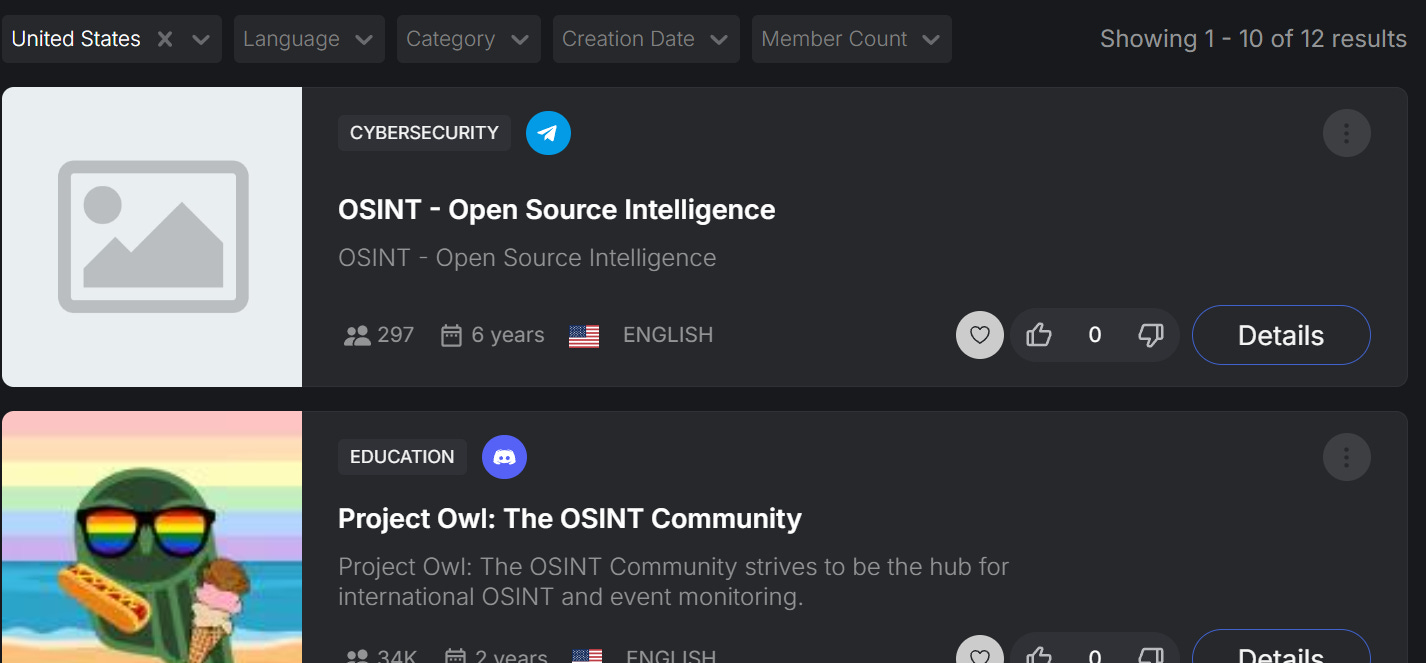
Where location information is available, filtering geographically can make it easier to identify communities that are likely to have a local focus. E.g. regional events, activism, protests, businesses etc.
🗒️ A group’s location or regional classification shouldn’t automatically be interpreted as proof that every member is located there. Treat it as a discovery signal rather than confirmed attribution.
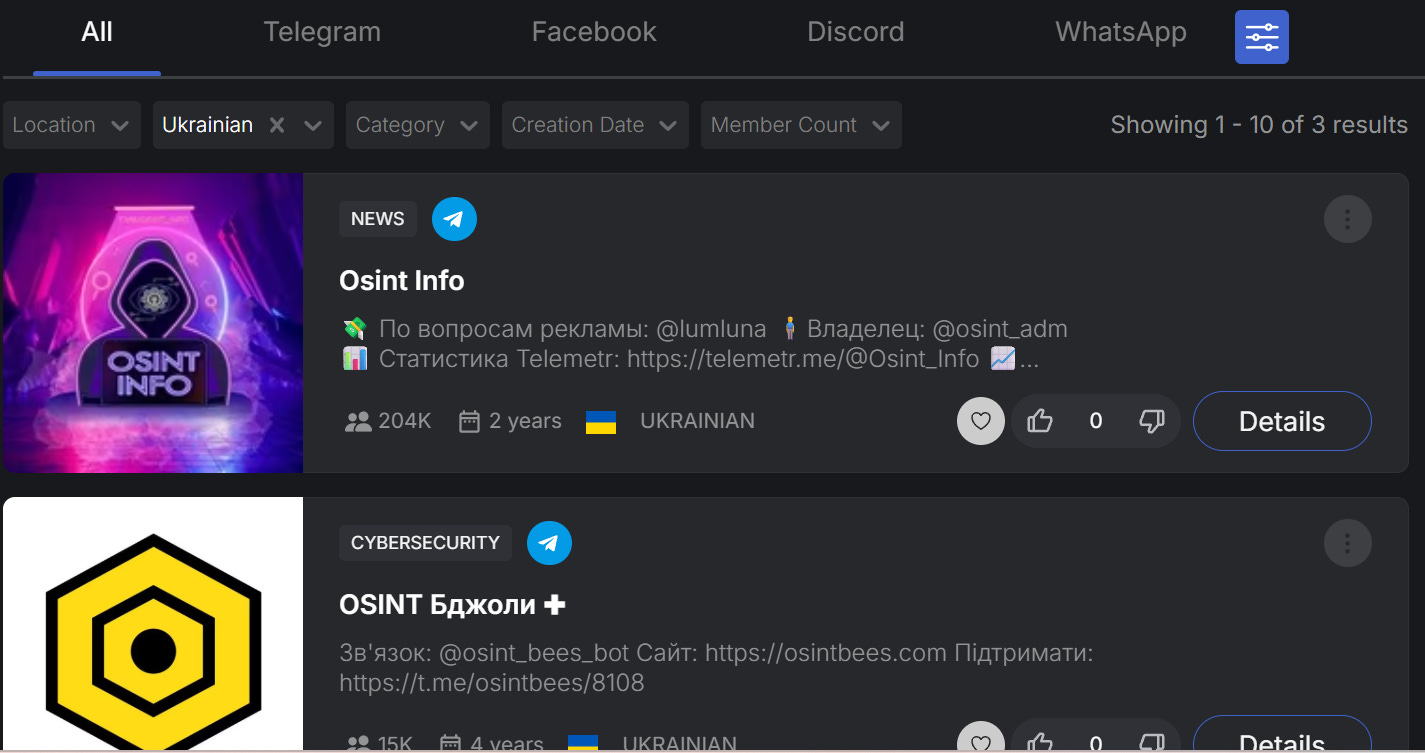
Language filtering provides another useful way of narrowing results.
If you’re researching a subject that spans multiple countries or linguistic communities, filtering by language can help identify groups that may otherwise be buried among a much larger set of results.
For example, we searched for Ukrainian language results:
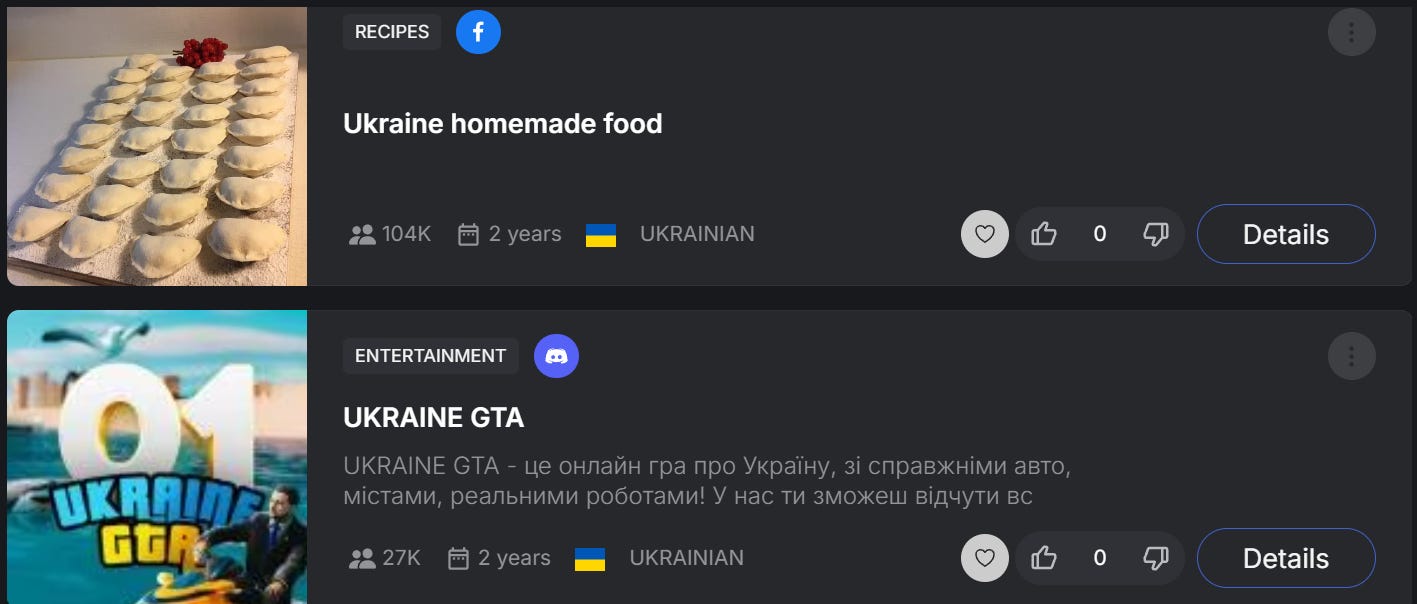
Waybien also provides category-based filtering, allowing you to narrow searches according to the general subject of the communities being returned.
Categories can be particularly useful when a broad keyword produces a large number of unrelated results. For example, if we do a broad search of ‘Ukraine’, we’re met with 194 results including categories of ‘receipes’, ‘entertainment’, ‘politics’, ‘news’, and ‘cybersecurity’ to name but a few:
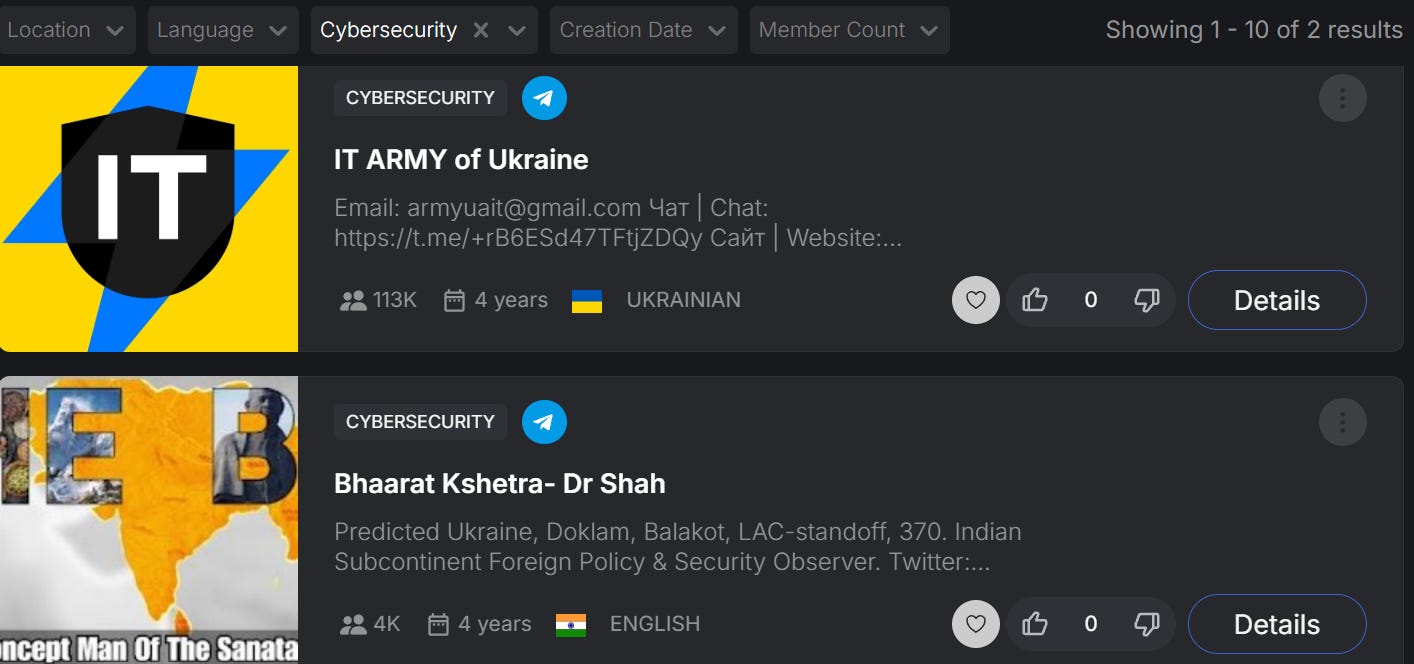
Narrowing this search result down to the category of ‘cybersecurity’ reduces us to 2 results:
Community size can also be useful during an investigation.
Large communities can be potentially useful for identifying major sources and widely discussed topics whereas small communities could find niche subjects, specialist interests, or highly focused communities.
For example, a small community search (0-50 members) for the search term, ‘OSINT’ produced 126 results:
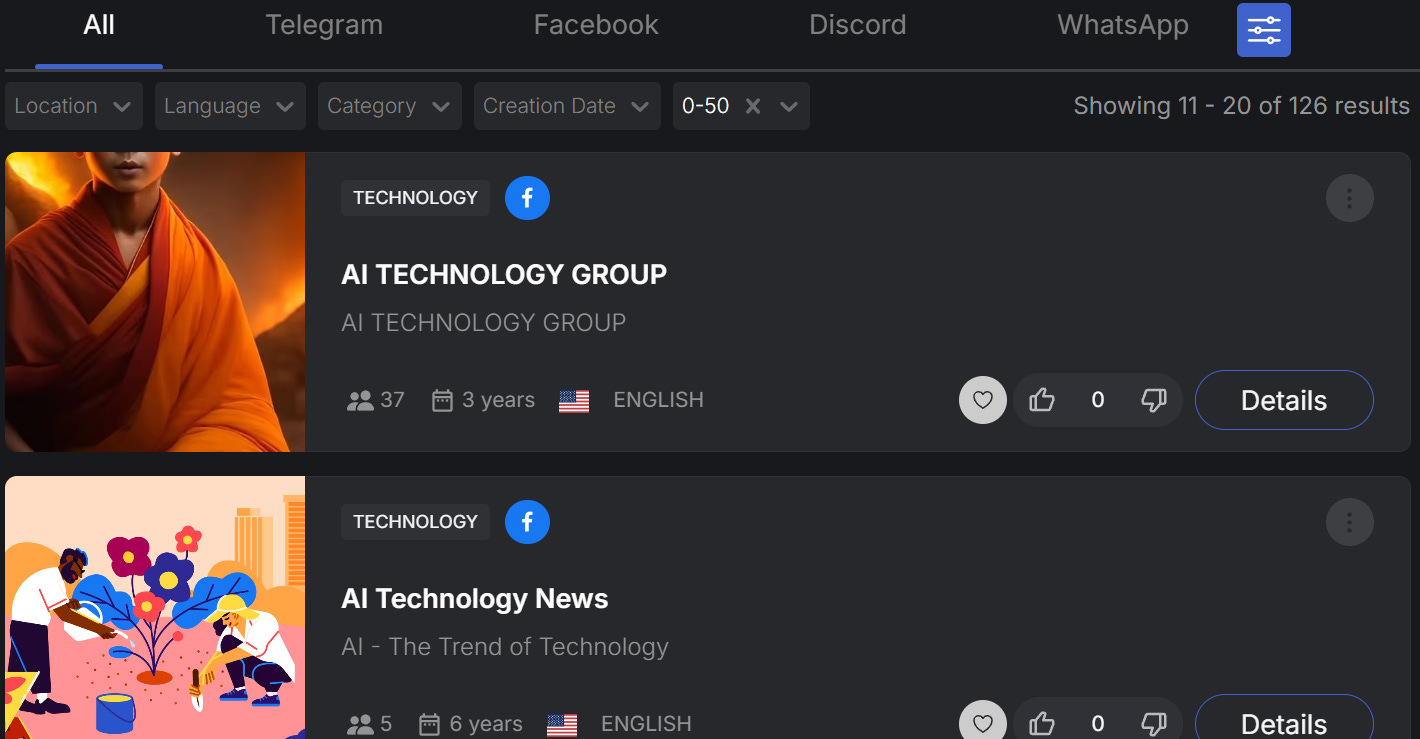
🗒️ Don’t equate size with importance. A small specialist community can sometimes be much more relevant to an investigation than a group containing thousands of members.
Waybien naturally fits into several OSINT and SOCMINT workflows.
One of the most obvious applications is simply finding communities that conventional search engines may not surface easily. A researcher investigating a particular subject can use Waybien to identify potentially relevant groups across multiple platforms. This creates a useful starting point for further research.
E.g. Keyword → Community → Platform → Further investigation
Instead of searching Telegram, Discord, Facebook and other platforms independently, Waybien can provide an initial cross-platform view.
Waybien can be particularly useful during social media intelligence investigations where the objective is to understand where a particular subject is being discussed. Once a potentially relevant group has been identified, the investigator can move to the underlying platform and examine publicly available information there.
This can help build an understanding of which platforms are being used, which communities discuss a particular subject, which communities are geographically relevant, how large particular communities are, and which groups may warrant further detective work.
Online communities can provide valuable context when researching emerging threats, cybercrime trends or suspicious activity. A researcher investigating a particular threat, malware family, campaign or actor-associated term could use Waybien to identify communities where related subjects may be discussed.
🗒️Community discovery should be treated as a lead-generation mechanism, not proof of involvement.
The geographic filtering capabilities make Waybien particularly interesting for investigations with a local or regional component. If you’re researching/reporting on a particular issue in a city/country, you can use a combination of keyword and location filtering to identify potentially relevant communities.
One of Waybien’s greatest strengths is its ability to generate new investigative leads. Each discovery can become a new pivot.
For example, you might begin with: OSINT. Waybien then returns a relevant Telegram community. That community provides a public username or link. You can then pivot that identifier into other search engines, social networks or OSINT tools.
Waybien is particularly useful because the same subject can exist across several different platforms. A community discovered on one platform e.g. Telegram may lead you towards related communities on Discord, Facebook, WhatsApp etc. This can help investigators identify whether a subject has a broader cross-platform presence.
🗒️ Similar names, logos, descriptions or topics do not necessarily mean two communities are connected. Confirm relationships using additional evidence rather than assuming that similarly named groups are operated by the same people.
Depending on your individual search term results, you may encounter information such as:
The amount of information you’ll find can vary quite a bit from one platform or community to another. Some groups give you plenty to work with, while others might reveal little more than a name and a short description.
That’s why it’s always worth heading over to the original platform for a closer look.
🗒️Where possible, record the date you discovered the community and preserve relevant URLs or screenshots. Online communities can change rapidly. Names, descriptions, membership counts and even the existence of a group can change over time.
Waybien is primarily a discovery tool, but the communities it identifies may contain sensitive or potentially harmful material.
-
Use Waybien and the underlying platforms in accordance with their terms of service and applicable law.
-
Avoid interacting with communities unnecessarily when passive observation is sufficient for the investigation.
-
Do not assume that a group member is responsible for everything posted within a community.
-
Do not treat membership of a group as evidence of ideological, criminal or political affiliation without corroborating evidence.
-
Consider the sensitivity of information contained within communities before recording, reproducing or publishing it.
-
Protect your own identity and investigative infrastructure when researching potentially hostile or adversarial communities.
-
Be particularly careful when moving from public community discovery into private, restricted or invitation-only spaces.
-
Verify important findings using independent sources before drawing conclusions.
Here’s a few ways to get more from Waybien:
-
Start broad, then narrow down. Begin with a distinctive keyword and use available filters to reduce irrelevant results.
-
Search multiple variations. Try alternative spellings, abbreviations, names, locations and terminology associated with your subject.
-
Search in multiple languages. If your investigation crosses borders, don’t limit yourself to English-language communities.
-
Look for related communities. Once you’ve identified one relevant group, search for the same terminology across other platforms.
-
Capture results promptly. Communities can change, disappear or become private, so document significant findings when you encounter them.
-
Don’t stop at Waybien. Use it as a discovery layer before moving into platform-specific research and independent verification.
-
Remember that indexing is incomplete. Waybien doesn’t discover every community on every platform, so a negative result does not prove that a relevant community does not exist.
💡 Remember OSINT != tools. Tools help you collect data, but the output of a tool is not intelligence. You must analyse, verify, receive feedback, refine your findings and produce a final, actionable product before it becomes intelligence.
✅ That’s all for this issue of The OSINT Newsletter. Thanks for reading and supporting this publication with a paid subscription.
By upgrading to paid, you’ll get access to the following:
👀 All paid posts in the archive. Go back and see what you’ve missed!
🚀 If you don’t have a paid subscription already, don’t worry. There’s a 7-day free trial. If you like what you’re reading, upgrade your subscription. If you can’t, I totally understand. Be on the lookout for promotions throughout the year.
🚨 The OSINT Newsletter offers a free premium subscription to all members of law enforcement. To upgrade your subscription, please reach out to LEA@osint.news from your official law enforcement email address.
