


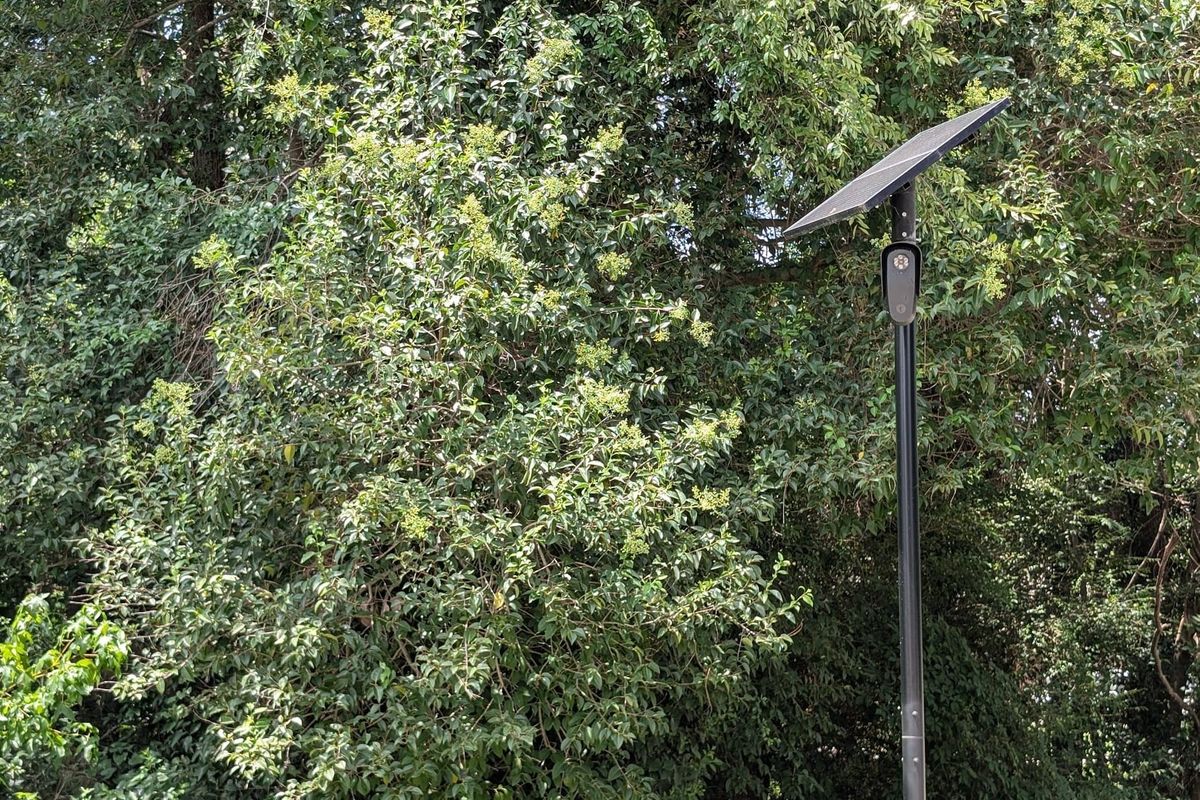
Norman, Oklahoma is a Flockless outpost on the outskirts of the Oklahoma City metro area. As you drive south down I-35 away from the big city and into Norman, coverage from the automated license plate readers (ALPR) dwindles. That’s because Norman has rejected Flock’s pitch multiple times.
“They’ve given us two presentations in the last three years at the request of our police department who wanted to implement them,” Stephen Tyler Holman, the mayor of Norman, told me. “They haven’t been back since I’ve been mayor.”
Norman is an outlier. When the surveillance company comes to a city or a town, the city often signs up. The city council in my small town of 12,000 people just voted to install 22 new Flock cameras despite overwhelming pushback from residents. A big centerpiece of Flock’s pitch was that it would help solve crimes. My town’s chief of police told a story about how Flock had been instrumental in arresting child predators.
Holman told me that Flock and the cops made the same pitch to Norman. “Crime prevention and helping the police more efficiently solve crime. That was their main point that they wanted to advocate for,” he said. “They really focused on amber alerts and silver alerts and ‘don’t you want to find kidnapped kids and elderly people that have wandered off who have Alzheimer’s?’”
But Norman’s leaders had questions about privacy and data security and they didn’t like Flock’s answers. “Those were some of the reasons why we ended up not doing it,” Holman said. “Questions about data storage and how long and who has access to it […] you’re gathering data on every single car vehicle that goes in and out of the city of Norman, regardless of if they’ve committed a crime or not, and then that’s stored for 30 days on some kind of database? Who has access to it? How secure is it? Those are the questions we have that were kind of deal breakers for us […] 30 days seemed like a long time to sit on that much data. There were some council members that were like, ‘It should only be an hour. Thirty minutes.’ Why do you need it any longer than that? Why would you need to keep it for 30 days? How is it accessed? How secure is it?”
All of the city council’s nine members said no to Flock. Since then, Holman has watched with some small satisfaction as other cities push back. Cops keep getting into trouble for using the cameras to stalk people, the system makes mistakes, and one of its ex-workers recently told 404 Media that the company lied to him about its business practices.
More than 80 cities across the country have cancelled Flock contracts. None of them are near Norman, which sits on the border of Oklahoma City — a city covered in Flock cameras. According to Holman, the company played this up in its most recent presentation saying that “people would find that out and they’d come to commit crime in Norman because they know that we don’t have Flock cameras.”
But Norman’s city council doesn’t control every square inch of Norman and its surroundings. Despite their best efforts, Flock cameras have gotten in. The city sits in Cleveland county and county leaders approved the installation of 20 cameras for use by the Cleveland County Sheriff’s Office. “There are numerous homeowners associations that use them too,” Holman said. “But the city of Norman government does not. We’re, I guess, the only ones around here that don’t.”
Holman said that Norman’s politics are difficult to explain. “It’s neither liberal nor conservative,” he said. “Our three state reps are Democrats but two of them represent Republican majority voter districts.” He said the tension between the major parties and a healthy swath of independent voters has made citizens engaged with local politics and that constituents have sent a clear anti-Flock message.
“Pretty much everywhere else around here absolutely would just roll over and approve something like this. Nobody would show up and protest it. And if they did, the councils probably wouldn’t care. But in Norman it’s a big deal and people can lose re-election over stuff like this and have,” he said.
Holman served on the city council for 12 years before becoming mayor last year. He said one of the issues that turned people against the previous mayor was the purchase of a Bearcat APC for the local police department. In the 20 years after the start of America’s wars in Afghanistan and Iraq, town and city police departments have purchased a lot of military surplus gear from the Pentagon. “Things like a Bearcat would be rubber stamp approved in most cities. In Norman it took them 10 years and [passed] barely by a five-four vote of our previous mayor who I ran against and beat,” Holman said. The APC is still causing controversy in Norman.
Buying an armored car for the police 10 years after it was fashionable to do so is one thing. Private companies installing police cameras is another. “There’s a lot of folks here who are weary about government surveillance, especially giving that over to a private company,” Holman said.
Holman told me he’d been watching the city council meetings like mine where mayors and representatives fight with the voting public about their concerns. “I would really encourage them to listen to the public, listen to the people they represent in their cities and the very valid concerns that folks have about this technology and the private company itself, Flock, and the issues that have arisen with them and why many cities have started to explore pulling out,” he said.
He said that concerned citizens have a right to be worried about the conduct and ethics of a company like Flock. “I always come back to the freedom versus safety thing, this conversation we’ve been having since our founding,” Holman said. “That conversation may not resonate with a mayor like yours. There seems to be a lot of folks that are completely willing to give up all freedom for perceived safety. Well, I guess all crime could be eliminated if you put cameras everywhere, surveillance everywhere, and had drones patrolling the skies. That seems to be the way some folks want to go but what life are we living then?

