



Close Menu

    Subscribe to Updates

    Get the latest creative news from FooBar about art, design and business.

    What's Hot

    FBI warns of fake FIFA websites running World Cup fraud schemes

    May 30, 2026

    CVE-2026-10162 | THREATINT

    May 30, 2026

    SSA-981975 V1.4 (Last Update: 2024-12-10): Information Disclosure Vulnerability in Intel-CPUs (CVE-2022-40982) Impacting SIMATIC IPCs

    May 30, 2026
    Facebook X (Twitter) Instagram
    • Demos
    • Technology
    • Gaming
    • Buy Now
    Facebook X (Twitter) Instagram Pinterest Vimeo
    Canadian Cyber WatchCanadian Cyber Watch
    • Home
    • News
    • Alerts
    • Tips
    • Tools
    • Industry
    • Incidents
    • Events
    • Education
    Subscribe
    Canadian Cyber WatchCanadian Cyber Watch
    Home»News»FBI warns of fake FIFA websites running World Cup fraud schemes
    News

    FBI warns of fake FIFA websites running World Cup fraud schemes

    adminBy adminMay 30, 2026No Comments3 Mins Read
    Share Facebook Twitter Pinterest LinkedIn Tumblr Reddit Telegram Email
    Share
    Facebook Twitter LinkedIn Pinterest Email


    FBI warns of fake FIFA websites running World Cup fraud schemes

    The FBI is warning of fake websites impersonating FIFA ahead of the 2026 World Cup, to steal personal and financial information, sell fake tickets and hospitality packages, and push other fraud related to the event.

    With the international soccer tournament set between June 11 and July 19 in the United States, Canada, and Mexico, threat actors prepared hundreds of phishing sites.

    According the the public service announcement from the FBI, the fake domains impersonate the official fifa.com, but rely on minor spelling changes that users are likely to miss, such as fiffa[.]com, and use alternative top-level domains (e.g., .org, .xyz, .live, .sale), along with fake employment portals like “jobs-fifa[.]com” or “fifa-hiring[.]com.”

    The agency notes that many of the fraudulent websites collect from visitors various types of data, including names, physical and email addresses, phone numbers, banking/payment details, which could be used to create fraudulent accounts, commit identity theft, or run financial scams.

    The scale of these campaigns is also reflected in reports from cybersecurity companies Group-IB and Bitdefender, whose researchers observed World Cup-related malvertising campaigns promoted through Google Search, Facebook ads, Telegram, and WhatsApp.

    A major operation that Group-IB researchers attributed to a Chinese threat actor tracked as Ghost Stadium, uses more than 300 phishing sites, clones of the real FIFA portal, for premium ticket fraud.

    Fake tickets portal
    Fake tickets portal
    Source: Group-IB

    Starting in February, Bitdefender observed fraudulent activity around the World Cup brand targeting users in the UK, Portugal, Spain, Algeria, the US, Canada, Mexico, Brazil, Germany, and Australia, with fake merchandise, kits and collectibles, streaming services, and Panini sticker offers.
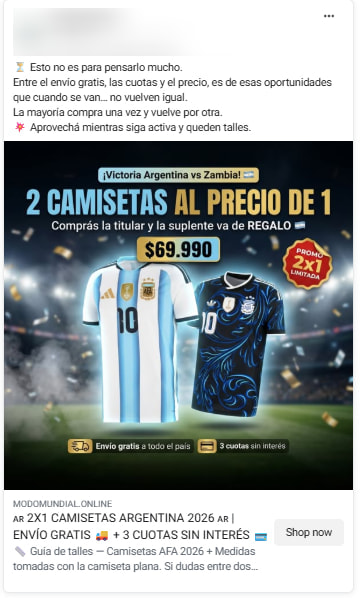
    Fake merchandise
    Ad for fake merchandise
    Source: Bitdefender

    How to protect

    As public interest in the World Cup surges, cybercriminals will try to take advantage through various lures, leading to fraudulent online portals designed to sell fake products or steal money and user data.

    Fans can steer away from these risks by following a simple set of recommendations from the FBI:

    • Manually type fifa.com into the browser
    • Avoid sponsored search ads or use an ad blocker
    • Verify the URL ends in .com
    • Using bookmarks for official FIFA sites
    • Avoid suspicious links sent via direct messages
    • Never enter sensitive data unless the site is verified authentic

    Users are encouraged to report incidents to the FBI’s Internet Crime Complaint Center (IC3) and include details such as the fake domain used, interaction history, and payment information, so the authorities can take action against the fraudulent portal.

    article image

    Automated pentesting tools deliver real value, but they were built to answer one question: can an attacker move through the network? They were not built to test whether your controls block threats, your detection rules fire, or your cloud configs hold.

    This guide covers the 6 surfaces you actually need to validate.

    Download Now


    Source link

    Share. Facebook Twitter Pinterest LinkedIn Tumblr Email
    Previous ArticleCVE-2026-10162 | THREATINT
    admin
    • Website

    Related Posts

    News

    BTMOB Android malware service generates custom phishing payloads

    May 30, 2026
    News

    Charter Communications data breach affects 4.9 million accounts

    May 30, 2026
    News

    US charges Google security engineer with Polymarket insider trading

    May 30, 2026
    Add A Comment

    Comments are closed.

    Demo
    Top Posts

    Catchy & Intriguing

    March 17, 202674 Views

    Defending Canada’s Digital Frontier: Combating Phishing, Social Engineering, Ransomware, and Malware

    March 23, 202629 Views

    The Essential Guide to Removing Computer Infections: Step-by-Step Remedies

    March 20, 202627 Views
    Stay In Touch
    • Facebook
    • YouTube
    • TikTok
    • WhatsApp
    • Twitter
    • Instagram
    Latest Reviews
    85
    Featured

    Pico 4 Review: Should You Actually Buy One Instead Of Quest 2?

    January 15, 2021 Featured
    8.1
    Uncategorized

    A Review of the Venus Optics Argus 18mm f/0.95 MFT APO Lens

    January 15, 2021 Uncategorized
    8.9
    Editor's Picks

    DJI Avata Review: Immersive FPV Flying For Drone Enthusiasts

    January 15, 2021 Editor's Picks

    Subscribe to Updates

    Get the latest tech news from FooBar about tech, design and biz.

    Demo
    Most Popular

    Catchy & Intriguing

    March 17, 202674 Views

    Defending Canada’s Digital Frontier: Combating Phishing, Social Engineering, Ransomware, and Malware

    March 23, 202629 Views

    The Essential Guide to Removing Computer Infections: Step-by-Step Remedies

    March 20, 202627 Views
    Our Picks

    FBI warns of fake FIFA websites running World Cup fraud schemes

    May 30, 2026

    CVE-2026-10162 | THREATINT

    May 30, 2026

    SSA-981975 V1.4 (Last Update: 2024-12-10): Information Disclosure Vulnerability in Intel-CPUs (CVE-2022-40982) Impacting SIMATIC IPCs

    May 30, 2026

    Subscribe to Updates

    Get the latest creative news from FooBar about art, design and business.

    Facebook X (Twitter) Instagram Pinterest
    • Home
    • Technology
    • Gaming
    • Phones
    • Buy Now
    © 2026 ThemeSphere. Designed by ThemeSphere.

    Type above and press Enter to search. Press Esc to cancel.