



Close Menu

    Subscribe to Updates

    Get the latest creative news from FooBar about art, design and business.

    What's Hot

    SSA-764417 V1.9 (Last Update: 2025-08-12): Weak Encryption Vulnerability in RUGGEDCOM ROS Devices

    May 4, 2026

    [Control systems] CISA ICS security advisories (AV26–417)

    May 4, 2026

    Weaver E-cology critical bug exploited in attacks since March

    May 4, 2026
    Facebook X (Twitter) Instagram
    • Demos
    • Technology
    • Gaming
    • Buy Now
    Facebook X (Twitter) Instagram Pinterest Vimeo
    Canadian Cyber WatchCanadian Cyber Watch
    • Home
    • News
    • Alerts
    • Tips
    • Tools
    • Industry
    • Incidents
    • Events
    • Education
    Subscribe
    Canadian Cyber WatchCanadian Cyber Watch
    Home»News»Weaver E-cology critical bug exploited in attacks since March
    News

    Weaver E-cology critical bug exploited in attacks since March

    adminBy adminMay 4, 2026No Comments3 Mins Read
    Share Facebook Twitter Pinterest LinkedIn Tumblr Reddit Telegram Email
    Share
    Facebook Twitter LinkedIn Pinterest Email


    Weaver E-cology critical bug exploited in attacks since March

    Hackers have been exploiting a critical vulnerability (CVE-2026-22679) in the Weaver E-cology office automation since mid-March to run discovery commands.

    The attacks started five days after the software vendor released a security update to address the issue, and two weeks before disclosing it publicly.

    Researchers at threat intelligence company Vega documented the malicious activity and reported that the attacks lasted roughly a week, each with several distinct phases.

    Weaver E-cology is an enterprise office automation (OA) and collaboration platform used for workflows, document management, HR, and internal business processes. The product is primarily used by Chinese organizations.

    CVE-2026-22679 is a critical unauthenticated remote code execution flaw affecting E-cology 10.0 builds prior to March 12.

    The flaw is caused by an exposed debug API endpoint that improperly allows user-supplied parameters to reach backend Remote Procedure Call (RPC) functionality without authentication or input validation.

    This lets attackers pass crafted values that are ultimately executed as system commands on the server, effectively turning the endpoint into a remote command execution interface.

    According to Vega, the attackers first checked for remote code execution (RCE) capabilities by triggering ping commands from the Java process to a Goby-linked callback, and then proceeded to multiple PowerShell-based payload downloads. However, all these were blocked by endpoint defenses.

    Next, they attempted to deploy a target-aware MSI installer (fanwei0324.msi), but this failed to execute properly, and no follow-up activity was observed.

    After those failed attempts, the attackers reverted to the RCE endpoint, using obfuscated and fileless PowerShell to repeatedly fetch remote scripts.

    Throughout all attack phases, the threat actors executed reconnaissance commands, such as whoami, ipconfig, and tasklist.
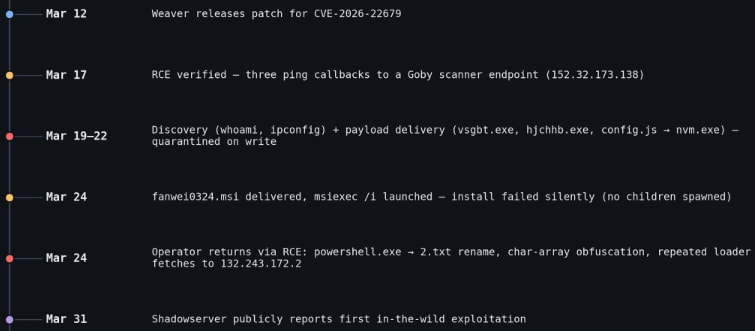
    Activity timeline
    Activity timeline
    Source: Vega

    Vega explains that although the attackers had the RCE opportunity by exploiting CVE-2026-22679, they never established a persistent session on the targeted host.

    Users of Weaver E-cology 10.0 are recommended to apply the security updates available through the vendor’s site as soon as possible.

    “Every attacker process we observed is parented by java.exe (Weaver’s Tomcat-bundled Java Virtual Machine), with no preceding authentication,” explained Vega, adding that “the vendor fix (build 20260312) removes the debug endpoint entirely.”

    No alternative mitigations or workarounds are listed in the official bulletin, so upgrading is the only recommendation.


    article image

    AI chained four zero-days into one exploit that bypassed both renderer and OS sandboxes. A wave of new exploits is coming.

    At the Autonomous Validation Summit (May 12 & 14), see how autonomous, context-rich validation finds what’s exploitable, proves controls hold, and closes the remediation loop.

    Claim Your Spot


    Source link

    Share. Facebook Twitter Pinterest LinkedIn Tumblr Email
    Previous ArticleZDI-26-170: GStreamer H.266 Codec Parser Out-Of-Bounds Write Remote Code Execution Vulnerability
    Next Article [Control systems] CISA ICS security advisories (AV26–417)
    admin
    • Website

    Related Posts

    News

    ‘Nature’ Retracts Paper on the Benefits of ChatGPT in Education

    May 4, 2026
    News

    InfoSec News Nuggets 05/04/2026

    May 4, 2026
    News

    Amazon SES increasingly abused in phishing to evade detection

    May 4, 2026
    Add A Comment

    Comments are closed.

    Demo
    Top Posts

    Catchy & Intriguing

    March 17, 202672 Views

    The Essential Guide to Removing Computer Infections: Step-by-Step Remedies

    March 20, 202620 Views

    The Grandparent Scam: How AI Voice Technology Makes This Old Con Deadlier Than Ever

    March 18, 202620 Views
    Stay In Touch
    • Facebook
    • YouTube
    • TikTok
    • WhatsApp
    • Twitter
    • Instagram
    Latest Reviews
    85
    Featured

    Pico 4 Review: Should You Actually Buy One Instead Of Quest 2?

    January 15, 2021 Featured
    8.1
    Uncategorized

    A Review of the Venus Optics Argus 18mm f/0.95 MFT APO Lens

    January 15, 2021 Uncategorized
    8.9
    Editor's Picks

    DJI Avata Review: Immersive FPV Flying For Drone Enthusiasts

    January 15, 2021 Editor's Picks

    Subscribe to Updates

    Get the latest tech news from FooBar about tech, design and biz.

    Demo
    Most Popular

    Catchy & Intriguing

    March 17, 202672 Views

    The Essential Guide to Removing Computer Infections: Step-by-Step Remedies

    March 20, 202620 Views

    The Grandparent Scam: How AI Voice Technology Makes This Old Con Deadlier Than Ever

    March 18, 202620 Views
    Our Picks

    SSA-764417 V1.9 (Last Update: 2025-08-12): Weak Encryption Vulnerability in RUGGEDCOM ROS Devices

    May 4, 2026

    [Control systems] CISA ICS security advisories (AV26–417)

    May 4, 2026

    Weaver E-cology critical bug exploited in attacks since March

    May 4, 2026

    Subscribe to Updates

    Get the latest creative news from FooBar about art, design and business.

    Facebook X (Twitter) Instagram Pinterest
    • Home
    • Technology
    • Gaming
    • Phones
    • Buy Now
    © 2026 ThemeSphere. Designed by ThemeSphere.

    Type above and press Enter to search. Press Esc to cancel.