


🌘
The remnants of a bizarre long-lost world that fell apart before our planet was fully formed are falling to Earth in the form of meteorites, according to a new study in Earth and Planetary Science Letters.
For decades, scientists have puzzled over the origin of angrites, a rare class of about 70 meteorites with unique volcanic compositions that suggest they were forged in a large ancient object with differentiated layers, including a metallic core and a magma ocean.
Scientists have long assumed that this object, the so-called angrite parent body (APB), was roughly a few hundred miles across, similar in size to the asteroid 4 Vesta. But researchers recently raised the tantalizing possibility that the APB might have been much larger, perhaps on the scale of Earth’s moon.
Now, a team led by Aaron Bell, an experimental petrologist and an assistant research professor at the University of Colorado, Boulder, has discovered “the first unequivocal evidence supporting the large angrite parent body hypothesis, which posits that the angrites are samples derived from a protoplanet that was catastrophically disrupted during the earliest evolutionary stages of the inner solar system,” according to the new study.
“It probably got destroyed in the early solar system, so [angrites] are remnants of a lost protoplanet,” Bell said in a call with 404 Media. “A few pieces broke off and are now in the asteroid belt, and a few of them have come to Earth, and we’ve picked them up.”
Angrites date back about 4.56 billion years, making them among the oldest known volcanic rocks. They belong to a class of stony “achondritic” meteorites that contain the crystalized signatures of melted rock, such as basalts, hinting that they originate in larger bodies that underwent some degree of planetary processing and layered differentiation, even if those early planetary embryos never accreted into full planets.
“Angrites are interesting in that they don’t have a known parent body,” Bell said. “It’s never been definitively identified, and that’s one of the mysteries.”
“There are a bunch of arguments about why angrites are so geochemically unusual,” he added. “They’re kind of this oddity.”
Most models of early planetary accretion predict that relatively small objects formed within the first few million years of the solar system, which is why the APB was assumed to be an asteroid-sized object, rather than a much larger nascent planet.
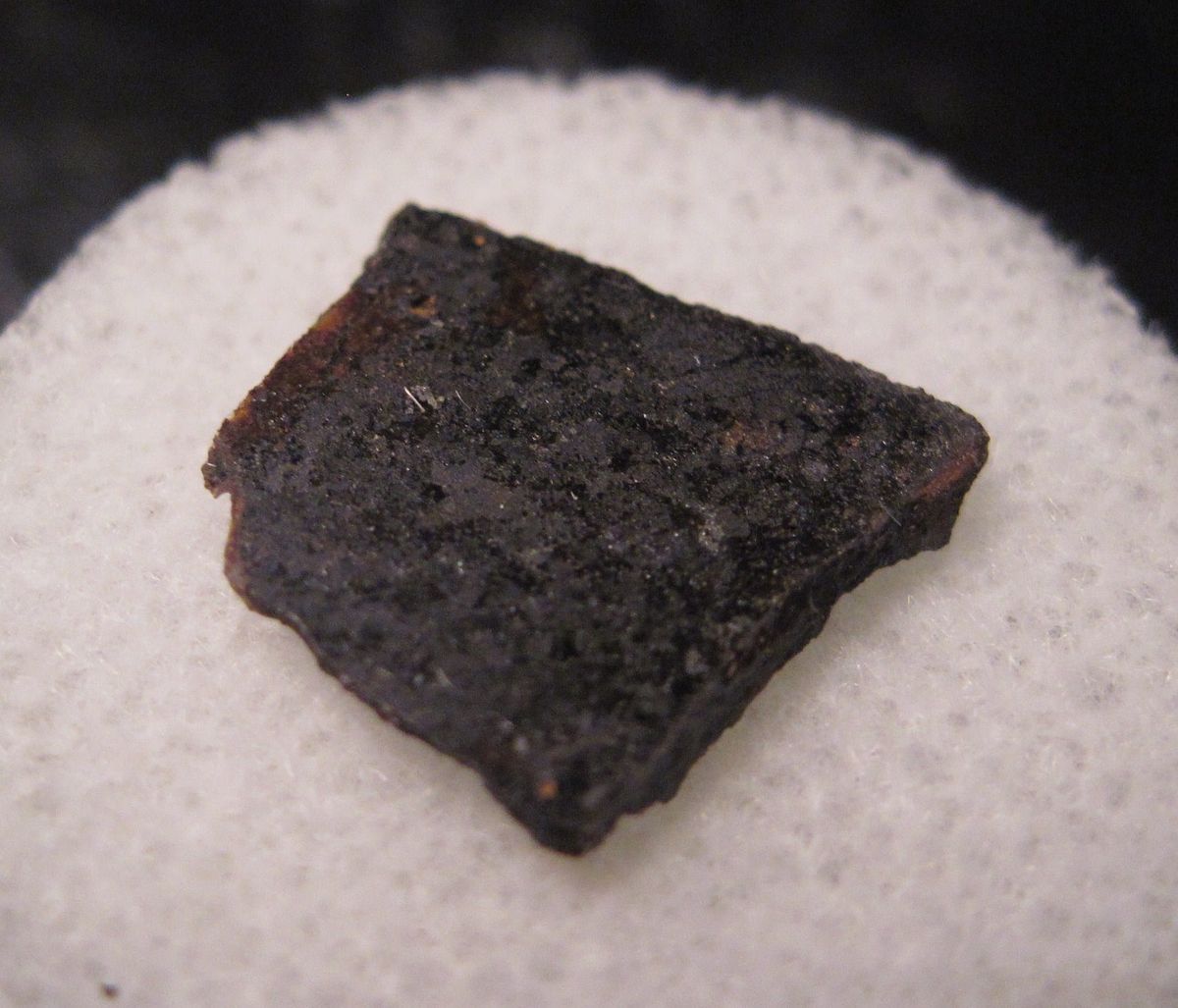
While working on a previous study, Bell became interested in an aluminum-rich angrite from Northwest Africa, known as NWA 12,774, which was classified in 2019. The meteorite is one of a handful of unusual primitive angrites that appear to have been crystallized at high pressure within the APB, indicating that it formed deep under the surface and therefore might shed light on the size of this bygone world.
“Even among angrites, there’s only four or five that have these primitive compositions,” Bell said, adding that the meteorite had “off-the-charts aluminum content, which is really very unusual.”
Bell and his colleagues developed a geobarometer—a tool that calculates the pressures at which rocks and minerals formed—-that estimated it would take at least 1.7 gigapascals to account for the rock’s special properties. This pressure corresponds to an object with a minimum radius of 620 miles (1,000 kilometers), which is just under the size of Pluto. The APB may even have been as large as the Moon, which has a roughly 1000-mile radius.
“Clearly, within the first few million years of solar system evolution, you could grow planetary embryos that were 1,000-plus kilometers” in radius, Bell said. “We’re talking within three million years of the condensation of the first solids in the solar system, so it’s right at the beginning.”
The discovery suggests that the APB may have been a first-generation protoplanet that coalesced and shattered millions of years before the familiar worlds of our solar system took full shape. Judging by the strange properties of angrites, the APB was also on track to be a very different kind of world than Earth and its neighbors, had it survived the chaotic environment of its infancy.
Angrites are “geochemically fundamentally different, and that’s why people were interested in the first place—because they were odd,” Bell said. “They don’t look like garden-variety
basalts you get from Mars or the Moon or Earth.”
“It’s sort of this path not taken—or maybe it was, but we just have a couple pieces of it that tell us something we didn’t know,” he concluded. “There were once large bodies that, maybe, didn’t look like the terrestrial planets.”
🌘
