


Welcome back to the Abstract! Here are the studies this week that sailed alien seas, beat the heat, went retro, and got caught in the food web.
First, scientists make the case that Saturn’s moon Enceladus could resolve one of humanity’s greatest questions—are we alone in the universe?—if only we would just send a spacecraft there already. Then: an amoeba in hot water, a backwards-ass planet, and the prandial ouroboros we call life on Earth.
As always, for more of my work, check out my book First Contact: The Story of Our Obsession with Aliens, or subscribe to my personal newsletter the BeX Files.
Aliens in the moon mist
In a double-whammy pair of studies, scientists have offered more proof that Enceladus—the tiny moon of Saturn—might host alien life, and that it would be relatively easy to find out for sure.
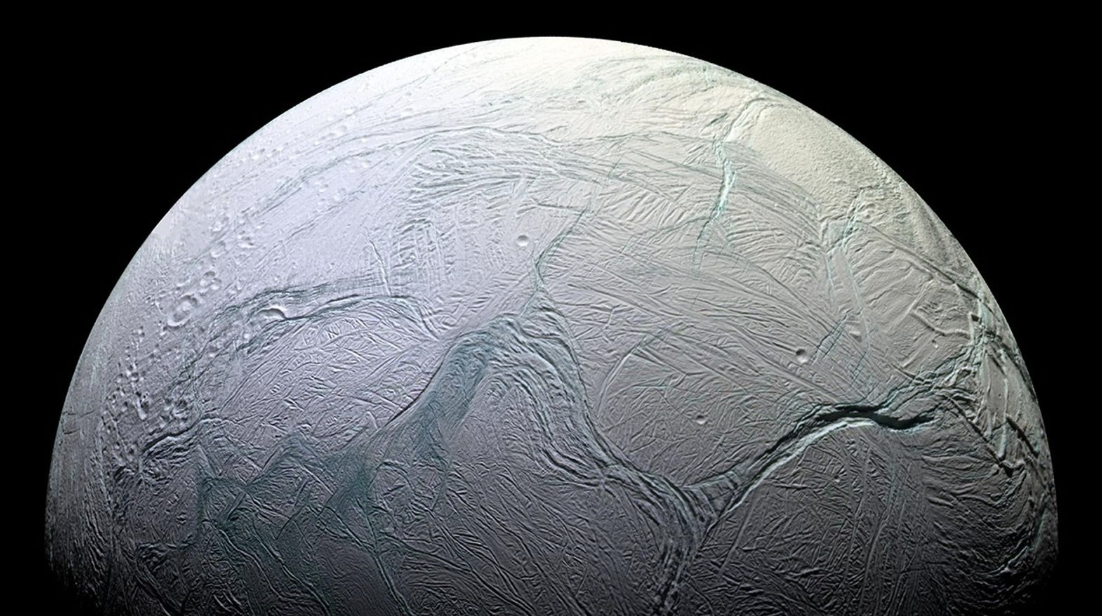
Enceladus is only 300 miles in diameter, but it contains marine multitudes. Underneath its outer ice shell, the moon hosts a subsurface ocean and hydrothermal vents on its seafloor, which are hotspots of life here on Earth.
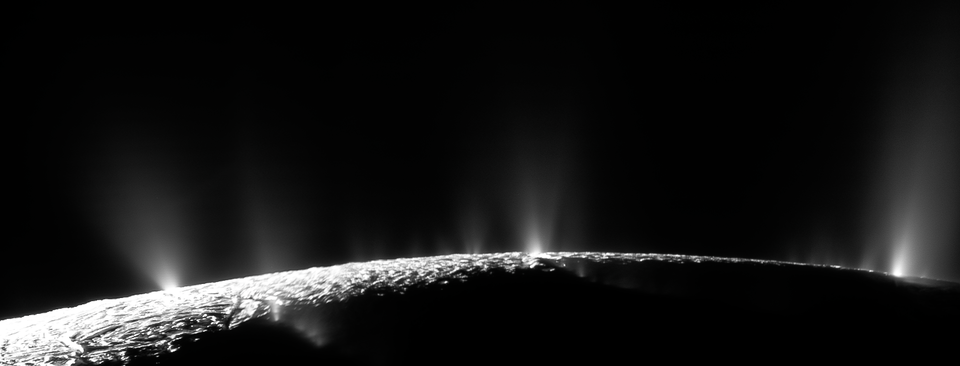
What’s more, Enceladus squirts out watery plumes from its ocean through geysers on the surface, which can be sampled by passing probes. Indeed, the Cassini spacecraft—which orbited Saturn from 2006 to 2017—ran through this space sprinkler several times, providing our first taste of an extraterrestrial sea. However, that mission was not equipped to detect signs of life, known as biosignatures.
In the first of two new studies, researchers created a simulated version of Enceladus’s “soda ocean” (meaning it is alkaline and carbonate-rich). The team then dropped the heat-loving microbe Methanothermococcus okinawensis to live in this earthly ersatz Enceladus. This species was selected because it lives on deep-sea hydrothermal vents on Earth.
It turned out that M. okinawensis fared even better in this habitat than expected, a discovery that potentially widens “the habitability window of Enceladus’ subsurface soda ocean,” said researchers led by Vanessa Helmbrecht of Ludwig-Maximilians-Universität München.
In the other study, a team revisited Cassini’s observations of ice grains sprayed out into space by Enceladus. They discovered that the ocean droplets freeze slowly in space, causing organic molecules to separate out into concentrations of similar compounds. If these droplets contain biosignatures, they may be conveniently pre-sorted for any instrument that captures them.
“In the plume grains, each separated compound can then be found at strongly elevated concentrations in a relatively small fraction of ice grains,” said researchers co-led by Frank Postberg and Zenghui Zou of Freie Universität Berlin. “This is good news for future plume sampling missions investigating Enceladus’ promising habitability provided that they can sample and analyze ice grains individually.”
For years, mission concepts to Enceladus have been floated but never formally greenlit, including NASA’s Enceladus Life Finder or the European Space Agency’s L4 mission. Hopefully, something gets off the drawing board and into space eventually, because Enceladus is low-hanging fruit, astrobiologically speaking.
In other news…
Some (amoebas) like it hot
Speaking of weird heat-loving microbes, meet Incendiamoeba cascadensis, a newly discovered amoeba that has shattered the heat tolerance record for eukaryotic life.
Scientists found this novel species simmering in water temperatures exceeding 64°C (147°F) inside Hot Springs Creek at Lassen Volcanic National Park in California (for reference, the average hot tub is around 100°F). While simple “procaryotic” organisms can survive much hotter water—the microbe Methanopyrus kandleri tops out at a balmy 252°F—the upper thermal limit for more complex “eukaryotic” lifeforms was previously thought to be 60°C (140°F).
“Incendiamoeba cascadensis proliferates at temperatures beyond what was thought possible for any eukaryote,” said researchers led by Beryl Rappaport of Syracuse University. “This discovery raises questions about the true maximum temperature a eukaryotic cell can endure.”
If a human were exposed to these water temperatures, they would suffer third-degree burns in seconds—so let the amoebas have their win and leave the deadly hot springs to them.
Go Your Own Way (exoplanet cover)
If you’ve been feeling like the vibes are off, it’s probably because the planet GJ 3090 b is in retrograde—permanently. This world, which is about 4.5 times as massive as Earth, is the “first planet on a retrograde orbit discovered around an M dwarf,” a type of small star more commonly known as a red dwarf, according to a new study.
In our solar system, the concept of a planet being “in retrograde” refers to the optical illusion of planets appearing to move backwards in their orbits from our perspective on Earth. But GJ 3090 b is actually orbiting in the opposite direction of the rotation of the star, which is located 60 light years away.
Exoplanets with similar retrograde orbits have been observed before, but GJ 3090 b is distinct because there is no massive object (a star or planet) in the system that seems to have set it into reverse. Most retrograde orbits are caused by gravitational disruptions from such colossal companions, but this exoplanet may have just been born this way—meaning that it formed from a disk of material that was out-of-whack from the jump.
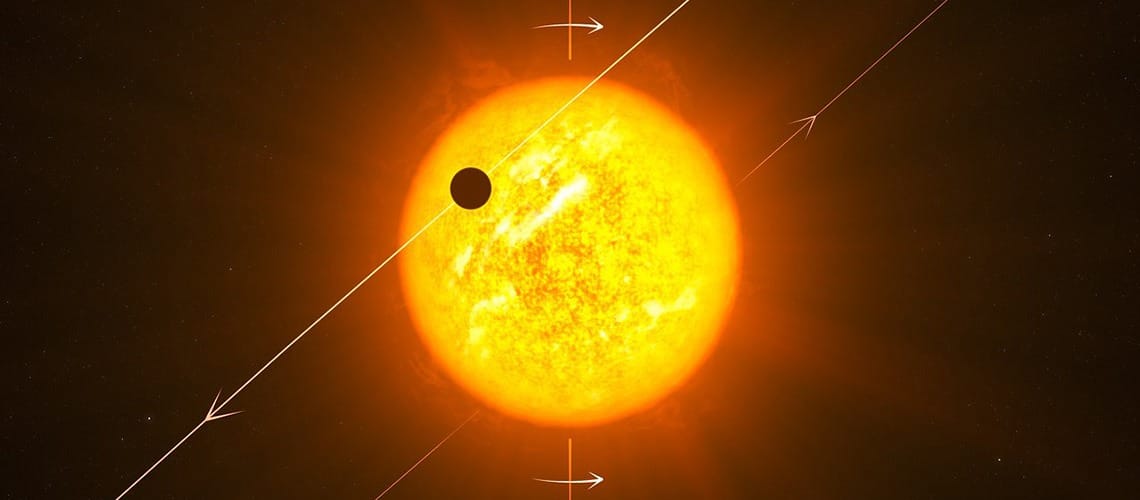
“Whereas highly misaligned orbits are commonly attributed to gravitational interactions with a massive companion, the architecture of the GJ 3090 system instead favors a primordial misalignment of the protoplanetary disk,” said researchers led by Yann Carteret of the University of Geneva.
The discovery is a reminder that star systems take on a wild variety of configurations shaped by countless interactions and factors. Contrary to the proverb, there is something new under every sun.
Eat, or be eaten, or all of the above
From the simplest microbe to the mighty blue whale, all life on Earth has one thing in common—we gotta eat. But given the dazzling complexity of food webs around the world, it can be tough to track what species end up in what bellies (or belly-equivalent) out in the wild.
That’s a problem that scientists are now inviting the public to help solve with the new online database: Who Eats Whom? In a partnership with the popular platform iNaturalist, the tool has catalogued some 14,000 observations of food-web interactions captured by nearly 2,000 observers from more than 100 countries, according to a new study about its progress.

“Who Eats Whom is, to our knowledge, the first attempt to create a global food web derived specifically from verifiable citizen science photographs,” said researchers led by Bradley C. Allf of Colorado State University. “Beyond our scientific goals, we are designing the project as a tool for education and public engagement in science.”
You can search for specific animals in the database (for example, searching for the red fox reveals a brave Australian python-eater, as well as this excruciating picture of the last moments of an Eastern chipmunk in Ontario with the caption: “not a great day”). I was also delighted to learn that coyotes, in addition to chasing down prey, apparently go on persimmon binges that leave behind seed-filled scat.
To get a sense of the bigger picture, you can check out this interactive global food web of species. We are, after all, what we eat—and what we eat eats, and so on forever.
Thanks for reading! See you next week.
