


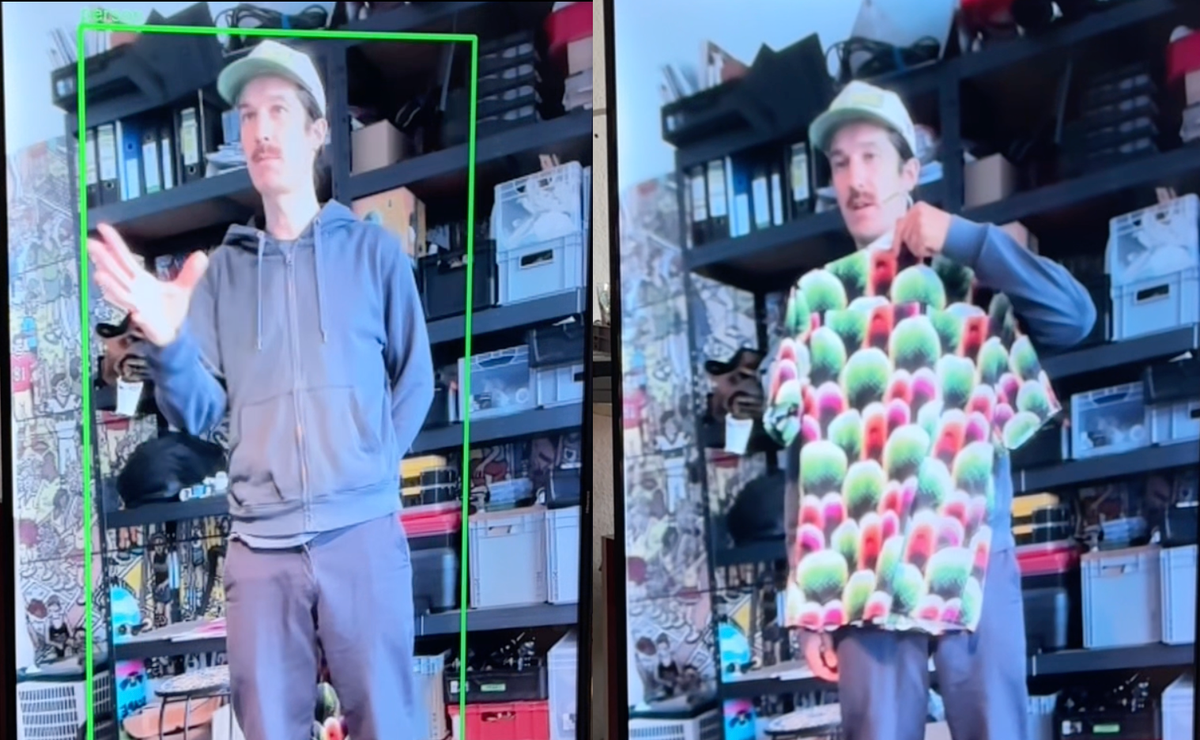
I am standing in front of a camera that’s streaming to a giant video screen. The image recognition AI running on the camera puts a big green box around me. “PERSON,” it says. Artist Simon Weckert hands me his newest creation, a button-down shirt with flowery, blurry globs of green and pink. I put the shirt in front of me. The box and the word “PERSON” disappears. I pull the shirt away. The box pops back up. I put the shirt in front of me. It disappears. This is “digital camouflage,” and it has confused the algorithm.
Weckert designed digital camouflage as a response to the proliferation of AI-powered surveillance cameras that detect people, vehicles, animals, bicycles, and other objects in their field of view. Many of these AI-powered cameras can detect when a person is lying down, “anomalous behavior” such as people loitering, people fighting, or an abandoned package, which can lead to a police response. These cameras are already relatively commonplace around the world, but Weckert created it because police recently deployed these types of cameras outside of Kotbusser Tor, a popular subway stop in Berlin. They are the first police-run object recognition surveillance cameras in the city.
“Obviously people don’t like it because it means that AI is tracking the movements and behaviors of people. It’s one thing to have somebody behind the camera watching you, but now we have AI doing this kind of analysis,” Weckert told me. “It can detect if somebody’s laying on the ground so that means homeless people could be detected and police get triggered.”
This post is for paid members only
Become a paid member for unlimited ad-free access to articles, bonus podcast content, and more.
Sign up for free access to this post
Free members get access to posts like this one along with an email round-up of our week’s stories.
