


Welcome to a special edition of the Abstract! I’m out on vacation for the next two weeks, which means it’s time to break out all of the weird and wild studies that have come out so far in 2026, but that slipped through the cracks for one reason or another. I’ve been saving these gems up for a special occasion and hope you enjoy the roundups this week and next!
So without further delay, here are the studies this year that put aliens on lockdown, bedazzled their axes, undulated spermily, and captured shooting stars.
First, scientists come up with a game plan to protect Earth from invasive extraterrestrial species. Then: a trove of rare decorative tools, GIGANTIC SPERM, and a long-sought solution to a Venusian mystery.
As always, for more of my work, check out my book First Contact: The Story of Our Obsession with Aliens, or subscribe to my personal newsletter the BeX Files.
Stay tuned for another special edition of the Abstract next week!
An island quarantine, but it’s in outer space
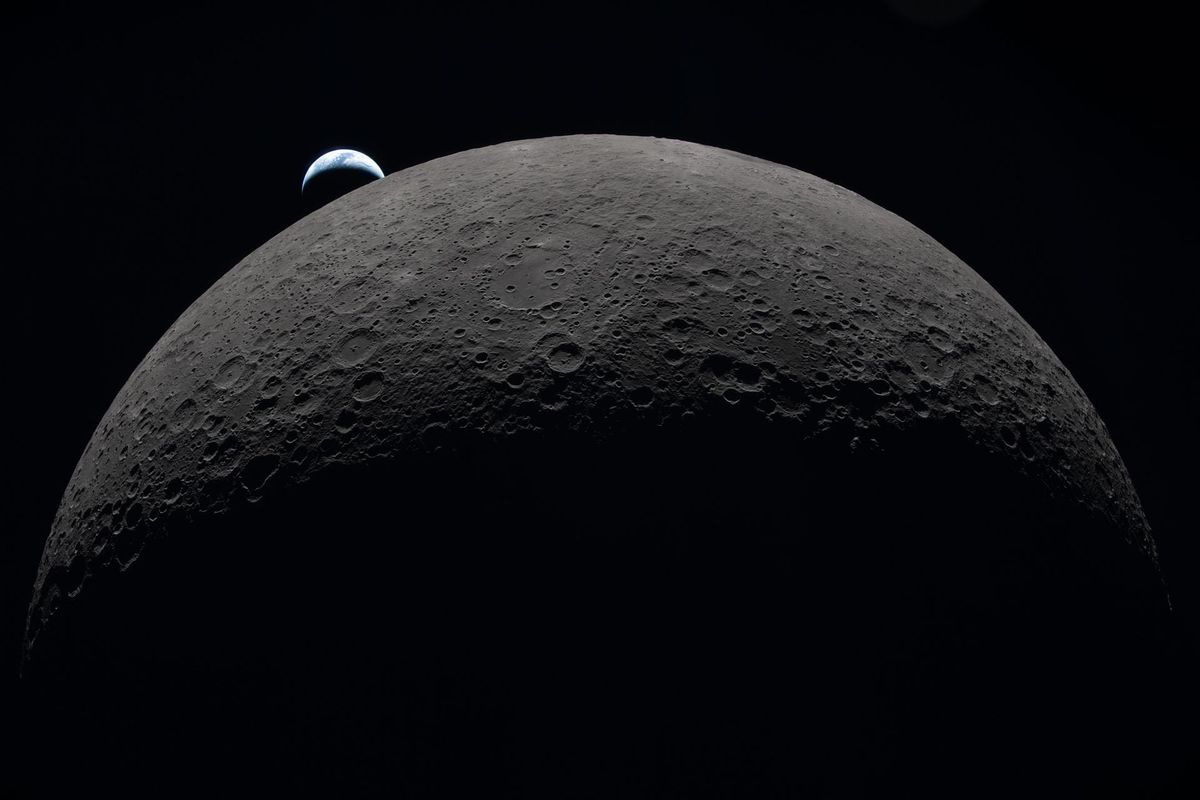
Well, folks: It’s finally time to build a quarantine on the Moon for aliens.
That’s the upshot of a study published in May that argues for the establishment of “a lunar biocontainment facility” to house extraterrestrial samples en route to Earth until they are deemed safe.
The U.S. and China’s space programs both aim to bring back samples from the surface of Mars in the coming years, and many missions have already delivered rocks from asteroids. The new study anticipates a disastrous scenario in which samples from nearby celestial bodies might contain dangerous extraterrestrial life.
“If samples from Mars or other celestial bodies harbor dormant or active biological entities, then Earth’s biosphere could become exposed to a potentially invasive novel organism with unpredictable pathogenicity or ecological effects,” said Frederick I. Moxley of Strategic Threat and Analysis Research Laboratories, LLC, and Anthony Ricciardi of McGill University.
“For example, if extraterrestrial life exists, its molecular architecture could reflect atypical biochemistry (such as chirality reversal or alternative nucleic acid analogs) that is hazardous to Earth’s ecosystems and even to human biology,” the team added.
The team pointed to earthly analogs, such as viral strains that have broken containment or species that thrive in habitats that are completely different from the ones in which they originally evolved. If life on Earth can be this adaptable and unpredictable, why should we expect anything different from life elsewhere?
“The Moon must not merely serve as a stepping stone for exploration, but also as a preemptive shield between Earth and potential forms of extraterrestrial contamination…ensuring that exploration does not come at the expense of Earth’s biosphere” the team said. “The formalization of such precautionary lunar quarantine protocols will not only safeguard our planet, but also affirm humanity’s maturity as an interplanetary civilization.”
Moreover, “the economic cost for a lunar biocontainment facility is negligible compared to the potential ecological devastation of an invasive extraterrestrial organism.”
There you have it: We can’t afford not to build an alien Moon quarantine.
In other news…
Axes of ancients
Some 500,000 years ago, early humans collected fossils and geodes and crafted them into handaxes, according to a study published in March that suggested these decorative tools had symbolic significance to their makers.
From 2024 to 2025, archaeologists discovered an unprecedented trove of ten fossil-bearing handaxes in what is today the Sakhnin Valley in Israel, which were made by the influential early human Homo erectus. While previous digs have unearthed the occasional handaxe containing fossils, this is the first site to yield a whole hoard of them.
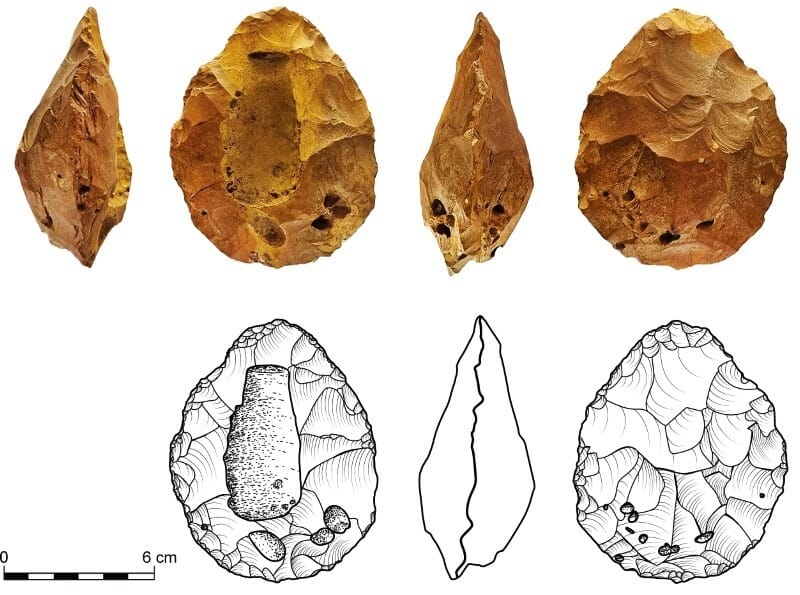
“To our knowledge, no other archaeological context besides Sakhnin Valley has yielded more than a single extraordinary specimen,” said authors Ran Barkai of Tel Aviv University and Muataz Shalala, a local independent researcher who found the site.
“We propose that these handaxes served as tools and mediators between humans and the cosmos, conceived as objects of potency enhanced by the primeval fossil imprints and unique geological features within the stone,” the team said. “The richly embellished rocky landscape of Sakhnin Valley, particularly with its abundant geodes, may have encouraged early humans to express their profound and extraordinary relationships with the cosmos via stones.”
The human appreciation for cool rocks knows no bounds. Given that there’s no obvious functional advantage to the fossil-bearing stones beyond aesthetics, It’s tantalizing to imagine what these geological rarities meant to the bygone humans who selected them.
Go with the (sperm) flow
Here’s a fun fact to share at a party: Fruit flies have the longest sperm in nature. Measuring anywhere from several millimeters to more than two inches depending on the species, these bugs offer an extreme example of “sperm gigantism,” a phenomenon seen across many animal species.
Now, scientists have probed the mystery of how these “ultralong sperm” avoid getting all tangled up in their journey through the female reproductive tract, according to a study published in June.
Using in vivo imagery and mathematical models, researchers revealed how two-millimeter-long sperm from the fruit fly Drosophila melanogaster autonomously organizes themselves en route to prospective fertilization.

“Giant sperm have evolved in several animal taxa for >100 million years—a testament to the enduring success of sperm gigantism as a sexual strategy,” said researchers co-led by Jasmin Imran Alsous of the Flatiron Institute and Brato Chakrabarti of International Centre for Theoretical Sciences in India.
Fruit fly sperm seamlessly forms “collective flows” that are “primarily associated with the dense packing of sperm, rather than the specific geometry of the confining organs,” the team found.
Who knew fruit fly sperm could be so mesmerizing? Nature continues to astonish in the most unexpected places.
Venus gets a cosmic glow-up
Karyu, Hiroki et al. “A cosmic origin of Venus’ lower haze.” Nature Astronomy.
For more than a half-century, scientists have pondered the origin of the so-called “lower haze” on Venus, a particle-rich layer of clouds at about 20 to 30 miles of altitude that was first detected by spacecraft in the 1970s.
In April, a team finally solved the mystery; turns out it’s just a light sprinkling of cosmic dust from bygone shooting stars that broke up and dispersed in the Venusian skies. In addition to providing an ethereal explanation for the phenomenon on Venus, the new results may also inform our understanding of exoplanet atmospheres.
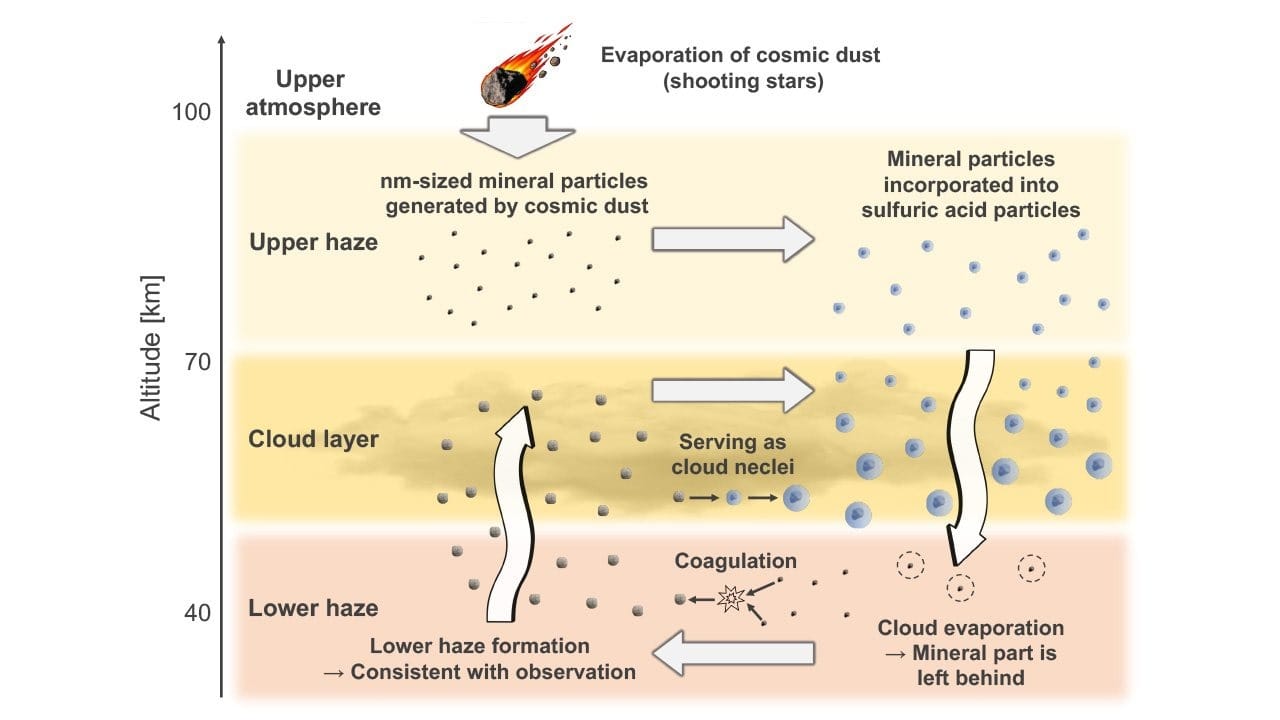
“On planets like Earth, where surface liquid water exists, rain constantly scavenges involatile particles from the air,” said researchers led by Hiroki Karyu of Tohoku University. “However, as observed in our Solar System, planets with surface liquid water are truly unique; most planets possess dry atmospheres where liquid droplets evaporate before reaching the surface.”
“In such worlds, the lower haze originating from cosmic dust can accumulate in the hot lower atmosphere, enhancing cloud formation” and “substantially [impacting] the planet’s climate,” the team added. “These effects establish cosmic dust as an essential component of planetary climates, a role that is also likely to be important for exoplanets.”
No big deal, Venus is just marinating in cosmic crumbs that can shed light on alien skies. Go on with your day.
Thanks for reading! See you next week.
