

Close Menu

    Subscribe to Updates

    Get the latest creative news from FooBar about art, design and business.

    What's Hot

    Fake Claude app promoted by Bing ads pushes SectopRAT malware

    July 23, 2026

    Flock’s CEO Says its ALPRs Don’t Do Video After Repeatedly Announcing They Can

    July 23, 2026

    New Dolphin X malware uses AI to rank high-value targets

    July 23, 2026
    Facebook X (Twitter) Instagram
    • Demos
    • Technology
    • Gaming
    • Buy Now
    Facebook X (Twitter) Instagram Pinterest Vimeo
    Canadian Cyber WatchCanadian Cyber Watch
    • Home
    • News
    • Alerts
    • Tips
    • Tools
    • Industry
    • Incidents
    • Events
    • Education
    Subscribe
    Canadian Cyber WatchCanadian Cyber Watch
    Home»News»Fake Claude app promoted by Bing ads pushes SectopRAT malware
    News

    Fake Claude app promoted by Bing ads pushes SectopRAT malware

    adminBy adminJuly 23, 2026No Comments3 Mins Read
    Share Facebook Twitter Pinterest LinkedIn Tumblr Reddit Telegram Email
    Share
    Facebook Twitter LinkedIn Pinterest Email


    Fake Claude app promoted by Bing ads pushes SectopRAT malware

    A malvertising campaign on the Bing search service is pushing a fake Claude desktop app installer hosted on a legitimate Claude.ai domain to deliver the SectopRAT malware.

    At least 29 organizations were compromised between July 21-22 during the malicious operation, which researchers call FakeAgent.

    The attacker uses a malicious Claude Artifact hosted on Claude’s legitimate domain, which is a common tactic that has been used 

    image

    The attackers used a malicious Claude Artifact hosted on Claude’s legitimate domain, a tactic that has been used at the beginning of the year to push macOS malware via ClickFix lures.

    Researchers at managed security company Huntress found that the malicious Claude Artifact, downloaded 7,100 times before Anthropic removed it, directed visitors to websites that hosted a fake installer named ClaudeDesktop.exe.
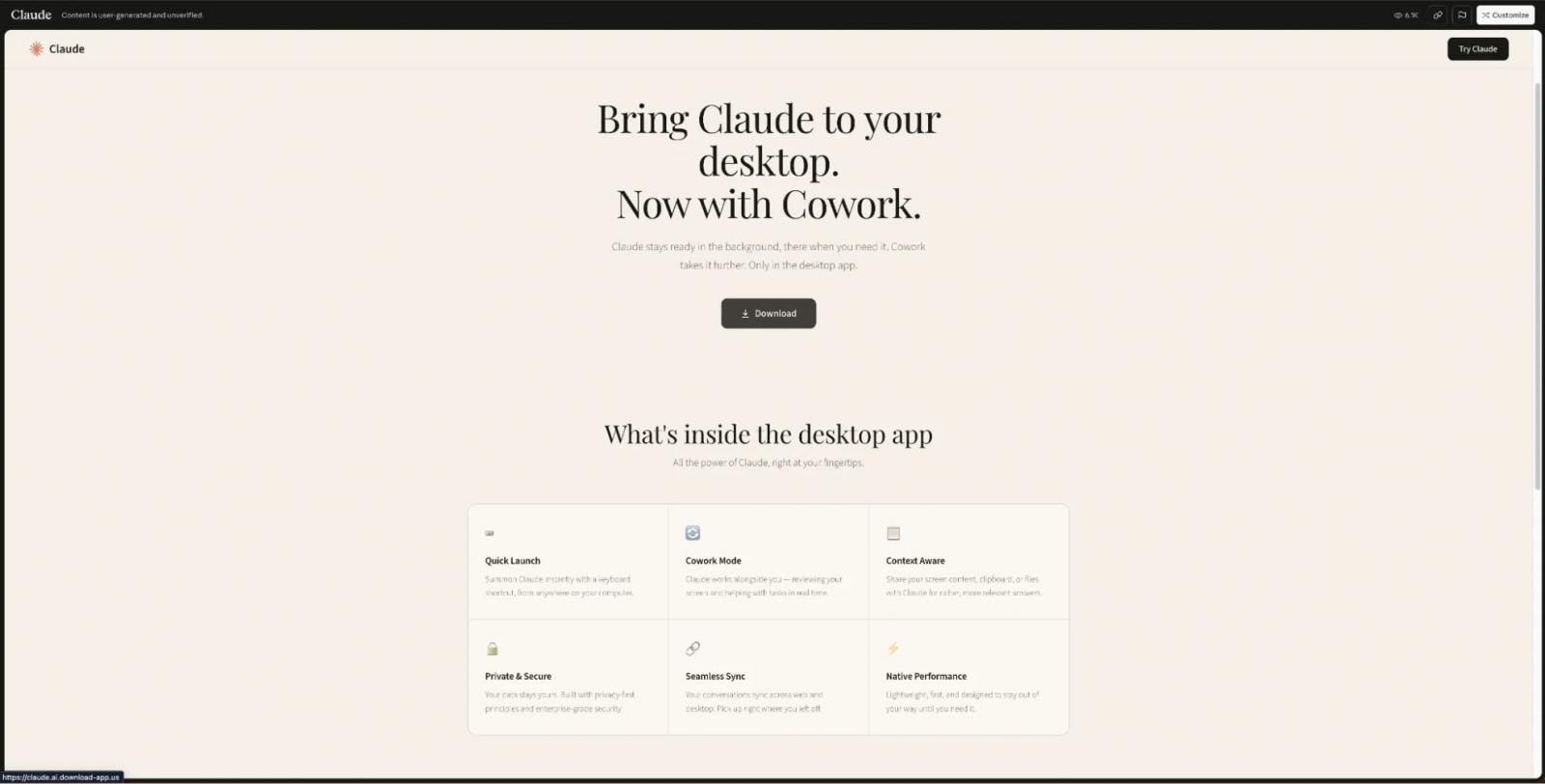
    The malicious artifact resembling a download portal
    Phishing page hosted as a Claude artifact
    Source: Huntress

    However, the file is a legitimate JetBrains Chromium component that sideloads a malicious DLL (libcef.dll) to deliver the SectopRAT remote access trojan with info-stealing capabilities.

    Persistence on the system is achieved through another executable named DockerDesktop.exe, which installs a scheduled task.

    Huntress says that the various loaders and staging components used in the infection chain feature anti-analysis mechanisms, including VMProtect packing, shader timing checks, GPU and VRAM checks, and virtual machine (VM) detection.

    The SectopRAT malware was recently observed being distributed via CastleLoader campaigns and ClickFix attacks.

    The malware uses the EtherHiding technique to retrieve a working command-and-control (C2) address via Ethereum BNB Smart Chain transactions.

    SectopRAT, also known as ArechClient2, has been active since 2019 and is an information-stealer with HVNC (Hidden Virtual Network Computing) functionality. It allows remote hands-on operations and real-time interaction with the compromised system.

    The malware targets user passwords, credit card data, files, browser logins and cookies, FTP credentials, data from various messaging clients, including Discord and Telegram, Steam, and VPN products.

    The malicious Bing search results
    Malicious Bing search results
    Source: Huntress

    In an interesting twist, Huntress reports it used Claude Opus 4.8 to assist with shader emulation, cryptographic reconstruction, and .NET code analysis.

    Analysis of the decrypted .NET payload (SectopRAT) helped attribute the attacks to SectopRAT operations, or a closely related fork, and opened the path to infrastructure analysis.

    At that stage, the researchers found 10 domains registered to the same email address since December 2025, with one of them previously linked to the StealC distribution and seized during Operation Endgame.

    Huntress does not have enough evidence to attribute the FakeAgent campaign to a specific, known threat cluster.

    Users looking for software should trust official websites and download portals, instead of search results, especially sponsored ones.


    article image

    Security teams log 54% of successful attacks and alert on just 14%. The rest move through your environment unseen.

    The Picus whitepaper shows how breach and attack simulation tests your SIEM and EDR rules so threats stop slipping by detection.

    Get the whitepaper


    Source link

    Share. Facebook Twitter Pinterest LinkedIn Tumblr Email
    Previous ArticleFlock’s CEO Says its ALPRs Don’t Do Video After Repeatedly Announcing They Can
    admin
    • Website

    Related Posts

    News

    Flock’s CEO Says its ALPRs Don’t Do Video After Repeatedly Announcing They Can

    July 23, 2026
    News

    New Dolphin X malware uses AI to rank high-value targets

    July 23, 2026
    News

    A Stenographer Submitted AI-Generated Errors in Official Court Transcript, Judge Says

    July 23, 2026
    Add A Comment

    Comments are closed.

    Demo
    Top Posts

    Catchy & Intriguing

    March 17, 202677 Views

    IP Address Investigations and Local OSINT

    March 20, 202636 Views

    The Canadian Password Playbook: Navigating Compliance and Building Strong Passwords

    March 25, 202634 Views
    Stay In Touch
    • Facebook
    • YouTube
    • TikTok
    • WhatsApp
    • Twitter
    • Instagram
    Latest Reviews
    85
    Featured

    Pico 4 Review: Should You Actually Buy One Instead Of Quest 2?

    January 15, 2021 Featured
    8.1
    Uncategorized

    A Review of the Venus Optics Argus 18mm f/0.95 MFT APO Lens

    January 15, 2021 Uncategorized
    8.9
    Editor's Picks

    DJI Avata Review: Immersive FPV Flying For Drone Enthusiasts

    January 15, 2021 Editor's Picks

    Subscribe to Updates

    Get the latest tech news from FooBar about tech, design and biz.

    Demo
    Most Popular

    Catchy & Intriguing

    March 17, 202677 Views

    IP Address Investigations and Local OSINT

    March 20, 202636 Views

    The Canadian Password Playbook: Navigating Compliance and Building Strong Passwords

    March 25, 202634 Views
    Our Picks

    Fake Claude app promoted by Bing ads pushes SectopRAT malware

    July 23, 2026

    Flock’s CEO Says its ALPRs Don’t Do Video After Repeatedly Announcing They Can

    July 23, 2026

    New Dolphin X malware uses AI to rank high-value targets

    July 23, 2026

    Subscribe to Updates

    Get the latest creative news from FooBar about art, design and business.

    Facebook X (Twitter) Instagram Pinterest
    • Home
    • Technology
    • Gaming
    • Phones
    • Buy Now
    © 2026 ThemeSphere. Designed by ThemeSphere.

    Type above and press Enter to search. Press Esc to cancel.