



Close Menu

    Subscribe to Updates

    Get the latest creative news from FooBar about art, design and business.

    What's Hot

    Judge Rules Blacked.com Can Sue Meta for Scraping Its Porn

    June 15, 2026

    Public and Private Medical Community Targeted by China-Nexus Threat Actor Pursuing Artificial Intelligence, Cyber, Medical, and National Defense Research

    June 15, 2026

    New attack turned Microsoft 365 Copilot into 1-click data theft tool

    June 15, 2026
    Facebook X (Twitter) Instagram
    • Demos
    • Technology
    • Gaming
    • Buy Now
    Facebook X (Twitter) Instagram Pinterest Vimeo
    Canadian Cyber WatchCanadian Cyber Watch
    • Home
    • News
    • Alerts
    • Tips
    • Tools
    • Industry
    • Incidents
    • Events
    • Education
    Subscribe
    Canadian Cyber WatchCanadian Cyber Watch
    Home»News»The ‘Miasma’ worm source code briefly leaked on GitHub
    News

    The ‘Miasma’ worm source code briefly leaked on GitHub

    adminBy adminJune 10, 2026No Comments3 Mins Read
    Share Facebook Twitter Pinterest LinkedIn Tumblr Reddit Telegram Email
    Share
    Facebook Twitter LinkedIn Pinterest Email


    Hacker

    The Miasma credential-stealing attack framework, which has recently targeted open-source ecosystems through supply-chain attacks, was briefly open-sourced on GitHub.

    Miasma appears to be an evolution of the earlier Shai-Hulud worm, which was previously leaked on GitHub and shares much of the same features, techniques, and even code.

    The malware infects a developer machine, steals the build environment and cloud credentials, and then uses those to compromise legitimate repositories and packages, publishing trojanized versions to infect downstream developers and repeat the cycle.
    image

    This autonomous, worm-like self-propagation mechanism can quickly expand its reach, potentially turning a single breach into a widespread supply chain attack.

    The malware has previously been linked to high-profile attacks against Red Hat npm packages and, more recently, 73 Microsoft repositories on GitHub.

    Researchers at SafeDep reported yesterday that the Miasma source code was leaked on GitHub via numerous compromised developer accounts. In each of those accounts, the threat actors leaked the source code in a repo named “Miasma-Open-Source-Release.”

    This indicates that the threat actors deliberately released the source code, rather than it being an accidental leak, similar to how the Shai-Hulud code was published earlier.
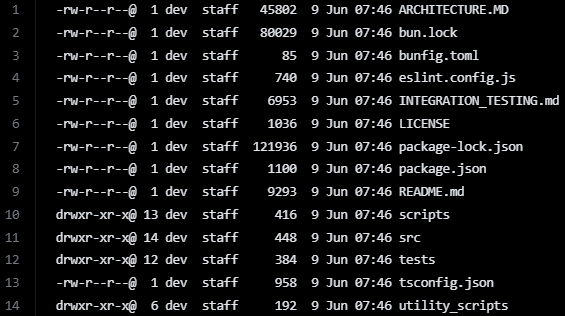
    The published source code files
    The published source code files
    Source: SafeDep

    Analysis of the code showed that the toolkit requires no command-and-control (C2) infrastructure to operate, as it uses GitHub for that purpose.
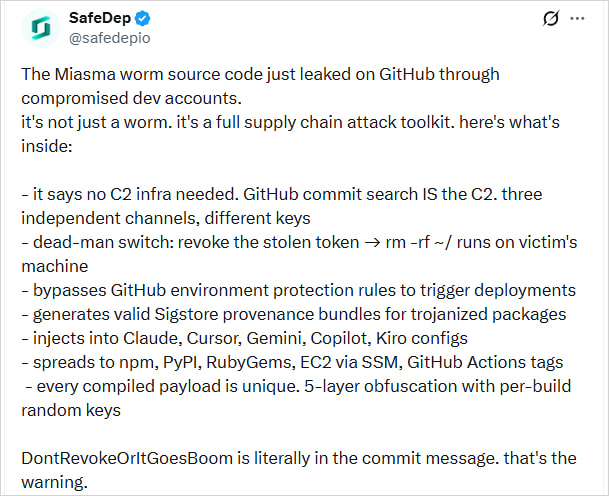
    Tweet

    The framework harvests credentials from cloud providers, CI/CD systems, password managers, Kubernetes, and secret stores, and abuses them to compromise npm, PyPI, and RubyGems packages, as well as GitHub repositories, Actions workflows, and JFrog Artifactory instances.

    It can also move laterally through SSH and AWS Systems Manager (SSM), and poison configurations of AI coding tools such as Claude, Gemini, Cursor, Copilot, Kiro, and Cline.
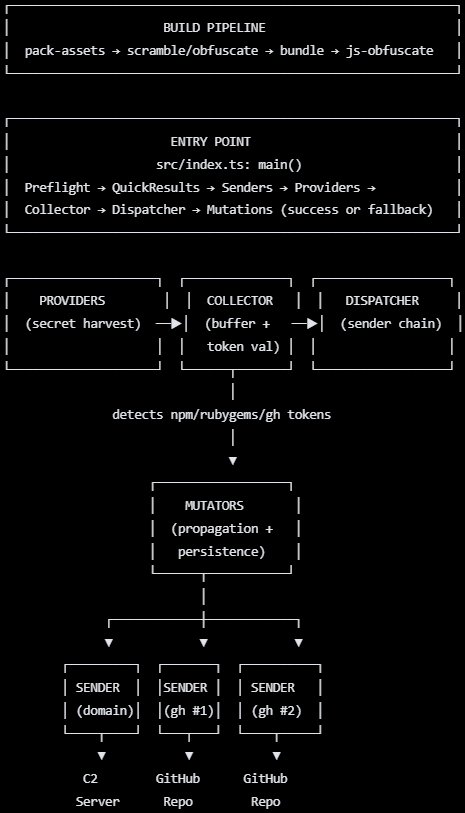
    Architecture diagram
    Architecture diagram
    Source: SafeDep

    One interesting feature revealed in the leaked Miasma source code is a “dead-man switch” that is installed when the malware uses a victim’s stolen GitHub token as an exfiltration channel.

    The component monitors the token’s validity every minute and, if it’s revoked, executes a destructive command (rm -rf ~/; rm -rf ~/Documents), recursively deleting files and directories in the user’s home and Documents folders.

    The monitor runs as a systemd user service on Linux or a LaunchAgent on macOS, and remains active for up to 72 hours.

    Another interesting aspect revealed is a five-stage build pipeline that generates unique payloads for each build.

    SafeDep reports that the process combines per-file AES-256-GCM encryption of embedded assets, randomized string obfuscation, source transformations, JavaScript obfuscation, and a self-extracting loader that wraps the final payload in three layers of encryption.

    Random keys and a randomized outer encoding layer ensure that each generated sample differs from previous builds, making signature-based detection and static analysis harder.

    The leak of Shai Hulud led to the release of more advanced variants, such as Miasma, and to increased attack rates. Similarly, the leak of Miasma’s source code is expected to have a similar effect as threat actors adopt the code and further adjust it.

    This could have significant consequences for the security of the open-source ecosystem, as supply-chain attacks continue to target it at an unprecedented pace.

    Software developers are advised to pin project dependencies, introduce multi-day delays before adopting newly released package updates, and validate new builds in isolated test environments.


    article image

    Security teams log 54% of successful attacks and alert on just 14%. The rest move through your environment unseen.

    The Picus whitepaper shows how breach and attack simulation tests your SIEM and EDR rules so threats stop slipping by detection.

    Get the whitepaper


    Source link

    Share. Facebook Twitter Pinterest LinkedIn Tumblr Email
    Previous ArticleZDI-26-355: Adobe Acrobat Reader DC Annotation Use-After-Free Remote Code Execution Vulnerability
    Next Article SSA-750274 V1.1 (Last Update: 2024-07-09): Impact of CVE-2024-3400 on RUGGEDCOM APE1808 devices configured with Palo Alto Networks Virtual NGFW
    admin
    • Website

    Related Posts

    News

    Judge Rules Blacked.com Can Sue Meta for Scraping Its Porn

    June 15, 2026
    News

    Public and Private Medical Community Targeted by China-Nexus Threat Actor Pursuing Artificial Intelligence, Cyber, Medical, and National Defense Research

    June 15, 2026
    News

    New attack turned Microsoft 365 Copilot into 1-click data theft tool

    June 15, 2026
    Add A Comment

    Comments are closed.

    Demo
    Top Posts

    Catchy & Intriguing

    March 17, 202674 Views

    IP Address Investigations and Local OSINT

    March 20, 202633 Views

    Defending Canada’s Digital Frontier: Combating Phishing, Social Engineering, Ransomware, and Malware

    March 23, 202631 Views
    Stay In Touch
    • Facebook
    • YouTube
    • TikTok
    • WhatsApp
    • Twitter
    • Instagram
    Latest Reviews
    85
    Featured

    Pico 4 Review: Should You Actually Buy One Instead Of Quest 2?

    January 15, 2021 Featured
    8.1
    Uncategorized

    A Review of the Venus Optics Argus 18mm f/0.95 MFT APO Lens

    January 15, 2021 Uncategorized
    8.9
    Editor's Picks

    DJI Avata Review: Immersive FPV Flying For Drone Enthusiasts

    January 15, 2021 Editor's Picks

    Subscribe to Updates

    Get the latest tech news from FooBar about tech, design and biz.

    Demo
    Most Popular

    Catchy & Intriguing

    March 17, 202674 Views

    IP Address Investigations and Local OSINT

    March 20, 202633 Views

    Defending Canada’s Digital Frontier: Combating Phishing, Social Engineering, Ransomware, and Malware

    March 23, 202631 Views
    Our Picks

    Judge Rules Blacked.com Can Sue Meta for Scraping Its Porn

    June 15, 2026

    Public and Private Medical Community Targeted by China-Nexus Threat Actor Pursuing Artificial Intelligence, Cyber, Medical, and National Defense Research

    June 15, 2026

    New attack turned Microsoft 365 Copilot into 1-click data theft tool

    June 15, 2026

    Subscribe to Updates

    Get the latest creative news from FooBar about art, design and business.

    Facebook X (Twitter) Instagram Pinterest
    • Home
    • Technology
    • Gaming
    • Phones
    • Buy Now
    © 2026 ThemeSphere. Designed by ThemeSphere.

    Type above and press Enter to search. Press Esc to cancel.