




A threat actor is using an AI-built ransomware attack toolkit that automates Active Directory discovery and helps evade endpoint detection and response (EDR) solutions.
Tool and payload development was assisted by Cursor and Claude Opus agents in various stages, including initial coding, analysis, and revisioning. Additionally, some agents were tasked with checking security research posts for various bypass techniques.
Some of the malware created this way was tested in virtual environments against EDR tools from Sophos, CrowdStrike, and Microsoft.

Despite the malware research and development orchestrated using AI technology, the researchers note that the workflow is entirely human-driven.
Rapid EDR-bypass development
Researchers at cybersecurity company Sophos detected activity from the toolkit on a system at a customer environment that triggered alerts for payloads stored in C:\Users\User\Documents\test.
The malicious files suggested they were part of an attack framework that focused on evading detection:
- Cobalt Strike profiles designed to make beacon traffic resemble legitimate web requests
- A Telegram bot API–based external command and control (C2) mechanism that routed communication through Telegram’s infrastructure rather than using direct connections
- Python-based malware development scripts for injecting shellcode into legitimate Windows executables while preserving original functionality
- A Cloudflare Worker acting as a front-end redirector to obscure the actual backend C2 server
The researchers say that while the tool may appear as a “red team” post-exploitation framework, it is used in cybercriminal activity related to ransomware.
“Our initial assessment included the possibility that a legitimate Red Team was engaged, but our investigation revealed further artifacts that indicated malicious and criminal activity,” Sophos told BleepingComputer.
The discovery in Cobalt Strike operator logs of entries pointing to a ransom note and details on multiple organizations listed on a ransomware data leak site clarified that the framework was used for cybercrime operations.
Agentic malware development
In a report published today, Sophos says that multiple Python scripts on the compromised host were written in Russian and generated with the help of AI tools.
During the investigation, the researchers found a Git repository with components related to “an automated Active Directory (AD) discovery panel and a lab that uses an iterative approach to developing and testing malware against the Sophos, CrowdStrike, and Windows Defender endpoint detection and response (EDR) agents.”
They say that AD discovery is driven by collecting observations from completed tasks and selecting the next action from predefined choices. The next step is delegated to remote agents, with results being reassessed.
The framework has multiple AI agents, each with a distinct role and function. For instance, a Claude Opus 4.5 agent acts as the coordinator of the R&D process, while others handle testing, OPSEC hardening, documentation, proxy stress testing, VM deployment, and other related tasks.
For the development stage, some agents documented bypass techniques in research from Kaspersky, Palo Alto Networks, Bishop Fox, and SpecterOps, as well as details published in social media posts.
The agents extracted the techniques, mapped them to the MITRE ATT&CK knowledge base of adversary behaviors, identified what was needed for reproduction, prepared a test lab, executed the technique, and reported the outcome.
The main component in the malicious framework is a Python tool that generates payloads, mostly in Rust and Go, based on an evasion technique. Close to 80 modules were generated and tested against more than 70 techniques.
“This modular Windows payload loader generator wraps a raw payload in layers of encryption, evasion, and alternative execution techniques, producing custom-built executables or DLLs intended to resist sandboxing, antivirus, and EDR detection” – Sophos
While the agents initially suggested a high failure rate, the modules appeared to bypass almost all EDR solutions after several iterations. However, Sophos noticed discrepancies between the test output and the framework’s internal reporting in some instances, although the reasons are unclear.
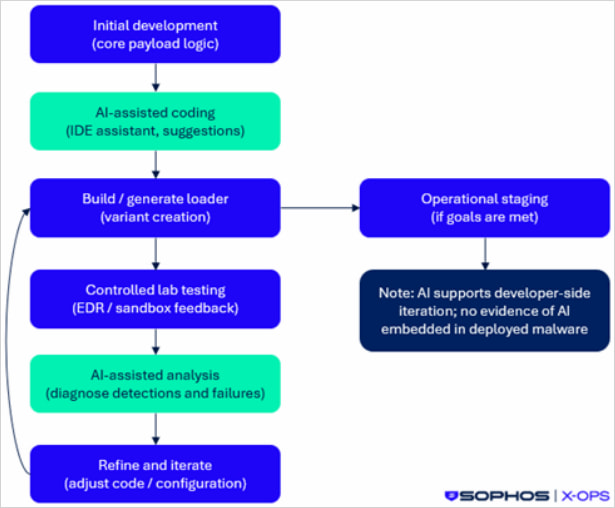
Source: Sophos
Sophos found no evidence that AI was embedded in deployed malware or operating independently in victim environments. Instead, the technology was used to accelerate the iterative process of developing, testing, and refining payloads against security products.
AI tools are shortening the period between the publication of offensive security research and its practical implementation by threat actors.
Automated pentesting tools deliver real value, but they were built to answer one question: can an attacker move through the network? They were not built to test whether your controls block threats, your detection rules fire, or your cloud configs hold.
This guide covers the 6 surfaces you actually need to validate.
