



Close Menu

    Subscribe to Updates

    Get the latest creative news from FooBar about art, design and business.

    What's Hot

    US charges Google security engineer with Polymarket insider trading

    May 30, 2026

    CVE-2026-10152 | THREATINT

    May 30, 2026

    SSA-645131 V1.0: Multiple WRL File Parsing Vulnerabilities in Teamcenter Visualization

    May 30, 2026
    Facebook X (Twitter) Instagram
    • Demos
    • Technology
    • Gaming
    • Buy Now
    Facebook X (Twitter) Instagram Pinterest Vimeo
    Canadian Cyber WatchCanadian Cyber Watch
    • Home
    • News
    • Alerts
    • Tips
    • Tools
    • Industry
    • Incidents
    • Events
    • Education
    Subscribe
    Canadian Cyber WatchCanadian Cyber Watch
    Home»News»US and Canada arrest and charge suspected Kimwolf botnet admin
    News

    US and Canada arrest and charge suspected Kimwolf botnet admin

    adminBy adminMay 22, 2026No Comments3 Mins Read
    Share Facebook Twitter Pinterest LinkedIn Tumblr Reddit Telegram Email
    Share
    Facebook Twitter LinkedIn Pinterest Email


    Arrest

    U.S. and Canadian authorities arrested and charged a Canadian man with operating the KimWolf distributed denial-of-service (DDoS) botnet, which infected nearly two million devices worldwide.

    23-year-old Jacob Butler (also known online as “Dort”) was arrested by Canadian authorities in Ottawa on Wednesday pursuant to an extradition warrant.

    According to a criminal complaint unsealed on Thursday in the District of Alaska, Butler was taken into custody based on IP address and online account information, transaction records, and online messaging records that exposed his links to the KimWolf botnet.

    Butler now awaits extradition to the U.S. and is facing one count of aiding and abetting computer intrusions, which carries a maximum sentence of 10 years in prison. 

    As detailed in court documents, KimWolf operated as a DDoS-for-hire service and was used by cybercriminals to launch attacks reaching nearly 30 terabits per second, the largest DDoS attack publicly disclosed at the time.

    Using a cybercrime-as-a-service model, Butler sold access to a massive network of compromised enslaved systems (ranging from digital photo frames and web cameras to Android-based TV boxes and streaming devices).

    The botnet was used in more than 25,000 attacks targeting computers and servers worldwide (including Department of Defense Information Network IP addresses) and caused financial losses exceeding $1 million for some victims.

    Researchers at cybersecurity firm Synthient, who have been tracking KimWolf’s rapid expansion, noted in January that KimWolf grew to almost 2 million after compromising Android devices in attacks exploiting vulnerabilities in residential proxy networks, and that it generated approximately 12 million unique IP addresses each week.
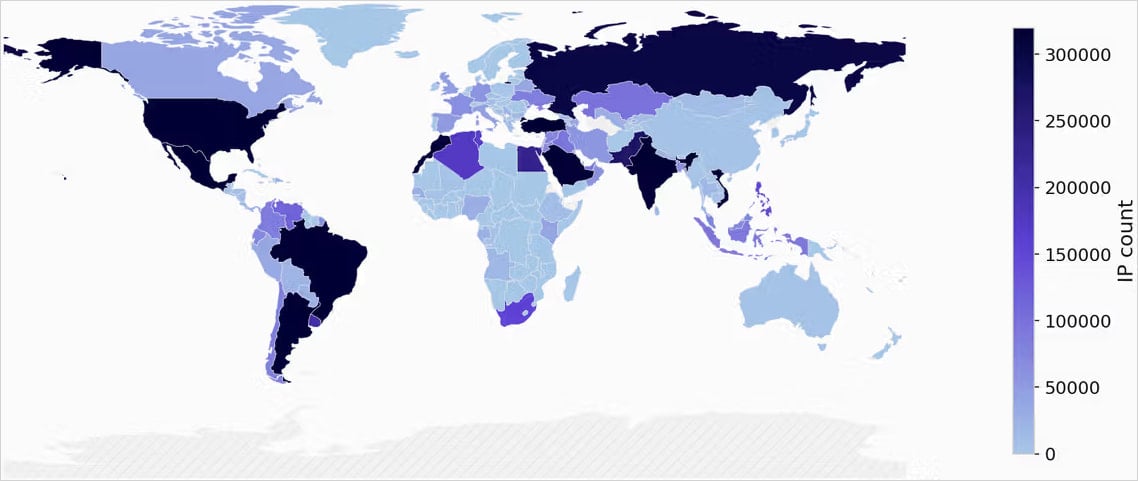
    Kimwolf infections heatmap
    Kimwolf infections heatmap (Synthient)

    Separately, the Central District of California unsealed seizure warrants targeting 45 DDoS-for-hire platforms, which disrupted multiple DDoS platforms, including at least one that collaborated with the KimWolf botnet.

    “These seizures broadly disrupted the DDoS platforms, including at least one that collaborated with Butler’s KimWolf botnet,” the Justice Department said yesterday.

    “U.S. authorities also seized domain records associated with many of these services, redirecting them to an authorized ‘splash page,’ which displays a warning to potential visitors that DDoS services are illegal.”

    Butler’s arrest follows a March 2026 international operation in which U.S., German, and Canadian authorities seized command-and-control infrastructure used by KimWolf and three related botnets (Aisuru, JackSkid, and Mossad), which collectively infected over 3 million IoT devices.

    As the U.S. Justice Department said at the time, the four botnets collectively infected more than 3 million IoT devices, including web cameras, digital video recorders, and Wi-Fi routers, many of them in the United States.


    article image

    Automated pentesting tools deliver real value, but they were built to answer one question: can an attacker move through the network? They were not built to test whether your controls block threats, your detection rules fire, or your cloud configs hold.

    This guide covers the 6 surfaces you actually need to validate.

    Download Now


    Source link

    Share. Facebook Twitter Pinterest LinkedIn Tumblr Email
    Previous ArticleSSA-672923 V1.0: Out of Bounds Write Vulnerability in Solid Edge
    Next Article ABB B&R Automation Studio | CISA
    admin
    • Website

    Related Posts

    News

    US charges Google security engineer with Polymarket insider trading

    May 30, 2026
    News

    Palo Alto GlobalProtect VPN auth bypass flaw now exploited in attacks

    May 30, 2026
    News

    New CIFSwitch Linux flaw gives root on multiple distributions

    May 30, 2026
    Add A Comment

    Comments are closed.

    Demo
    Top Posts

    Catchy & Intriguing

    March 17, 202674 Views

    Defending Canada’s Digital Frontier: Combating Phishing, Social Engineering, Ransomware, and Malware

    March 23, 202629 Views

    The Essential Guide to Removing Computer Infections: Step-by-Step Remedies

    March 20, 202627 Views
    Stay In Touch
    • Facebook
    • YouTube
    • TikTok
    • WhatsApp
    • Twitter
    • Instagram
    Latest Reviews
    85
    Featured

    Pico 4 Review: Should You Actually Buy One Instead Of Quest 2?

    January 15, 2021 Featured
    8.1
    Uncategorized

    A Review of the Venus Optics Argus 18mm f/0.95 MFT APO Lens

    January 15, 2021 Uncategorized
    8.9
    Editor's Picks

    DJI Avata Review: Immersive FPV Flying For Drone Enthusiasts

    January 15, 2021 Editor's Picks

    Subscribe to Updates

    Get the latest tech news from FooBar about tech, design and biz.

    Demo
    Most Popular

    Catchy & Intriguing

    March 17, 202674 Views

    Defending Canada’s Digital Frontier: Combating Phishing, Social Engineering, Ransomware, and Malware

    March 23, 202629 Views

    The Essential Guide to Removing Computer Infections: Step-by-Step Remedies

    March 20, 202627 Views
    Our Picks

    US charges Google security engineer with Polymarket insider trading

    May 30, 2026

    CVE-2026-10152 | THREATINT

    May 30, 2026

    SSA-645131 V1.0: Multiple WRL File Parsing Vulnerabilities in Teamcenter Visualization

    May 30, 2026

    Subscribe to Updates

    Get the latest creative news from FooBar about art, design and business.

    Facebook X (Twitter) Instagram Pinterest
    • Home
    • Technology
    • Gaming
    • Phones
    • Buy Now
    © 2026 ThemeSphere. Designed by ThemeSphere.

    Type above and press Enter to search. Press Esc to cancel.