

Close Menu

    Subscribe to Updates

    Get the latest creative news from FooBar about art, design and business.

    What's Hot

    InfoSec News Nuggets 04/08/2026

    April 8, 2026

    Yearly Breach Reports Summary 2023

    April 8, 2026

    Top Cybersecurity Certifications in Canada: Essential Credentials, Costs & Career ROI

    April 8, 2026
    Facebook X (Twitter) Instagram
    • Demos
    • Technology
    • Gaming
    • Buy Now
    Facebook X (Twitter) Instagram Pinterest Vimeo
    Canadian Cyber WatchCanadian Cyber Watch
    • Home
    • News
    • Alerts
    • Tips
    • Tools
    • Industry
    • Incidents
    • Events
    • Education
    Subscribe
    Canadian Cyber WatchCanadian Cyber Watch
    Home»News»Traffic violation scams switch to QR codes in new phishing texts
    News

    Traffic violation scams switch to QR codes in new phishing texts

    adminBy adminApril 5, 2026No Comments3 Mins Read
    Share Facebook Twitter Pinterest LinkedIn Tumblr Reddit Telegram Email
    Share
    Facebook Twitter LinkedIn Pinterest Email


    QR Code phishing

    Scammers are sending fake “Notice of Default” traffic violation text messages impersonating state courts across the U.S., pressuring recipients to scan a QR code that leads to a phishing site demanding a $6.99 payment while stealing personal and financial information.

    This is a new variation of the widely sent toll violation and unpaid parking ticket scams that users received in 2025, which claimed to be from state toll agencies.

    This new campaign started a few weeks ago, with someone sharing a text targeting New York residents with BleepingComputer, and many other people reporting similar texts online for other states, including California, North Carolina, Illinois, Virginia, Texas, Connecticut, and New Jersey.

    Unlike the previous campaign, which included a text message and links to phishing sites, this new variation instead includes an image of an alleged court notice with an embedded QR code.

    “This notice constitutes a final and urgent warning regarding an outstanding traffic violation involving your registered vehicle within the State of New York,” reads the fake court notice.

    “This matter has now entered the formal enforcement stage.”
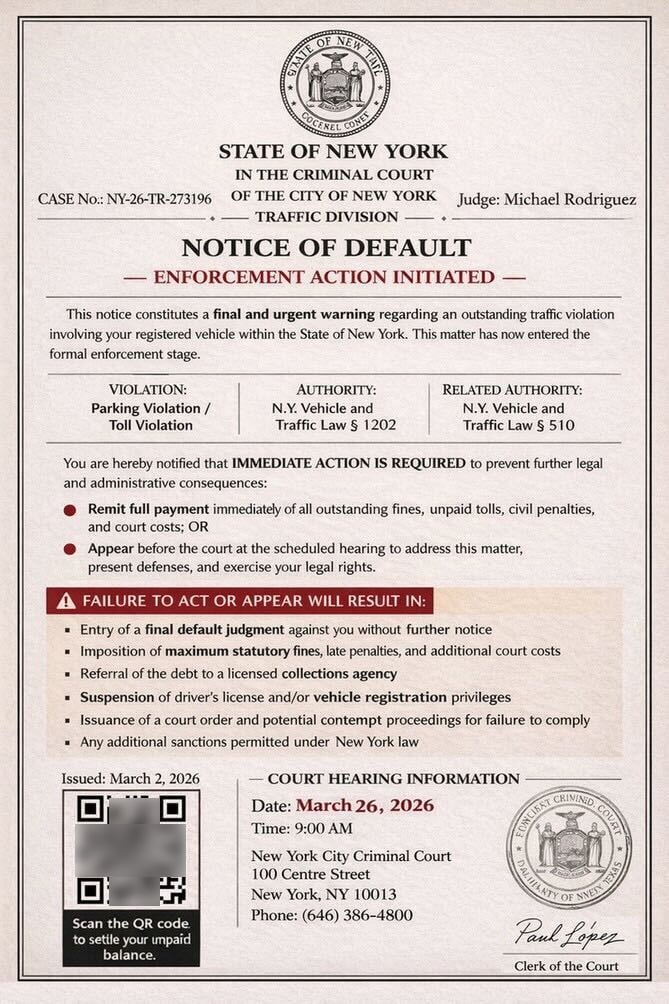
    Fake court notice about traffic violations
    Fake court notice about traffic violations
    Source: BleepingComputer

    The text message shared with BleepingComputer claims to be from the “Criminal Court of the City of New York”, stating that there is an unpaid parking or toll violation that must be paid immediately or the person must appear in court. Included are instructions to scan a QR code to settle the unpaid balances.

    Scanning the QR code brings the targeted person to an intermediary site that first prompts you to solve a captcha to prove you are human. The QR codes and CAPTCHA are used to make it harder for automated security software and researchers to analyze the phishing campaign.

    Solving the CAPTCHA redirects you to another phishing site that impersonates the state’s DMV or another agency, claiming there is an unpaid toll or parking ticket. In all examples seen by BleepingComputer, this outstanding balance is $6.99.

    For example, phishing sites that impersonate the New York DMV use the hostname “ny.gov-skd[.]org” or “ny.ofkhv[.]life”.
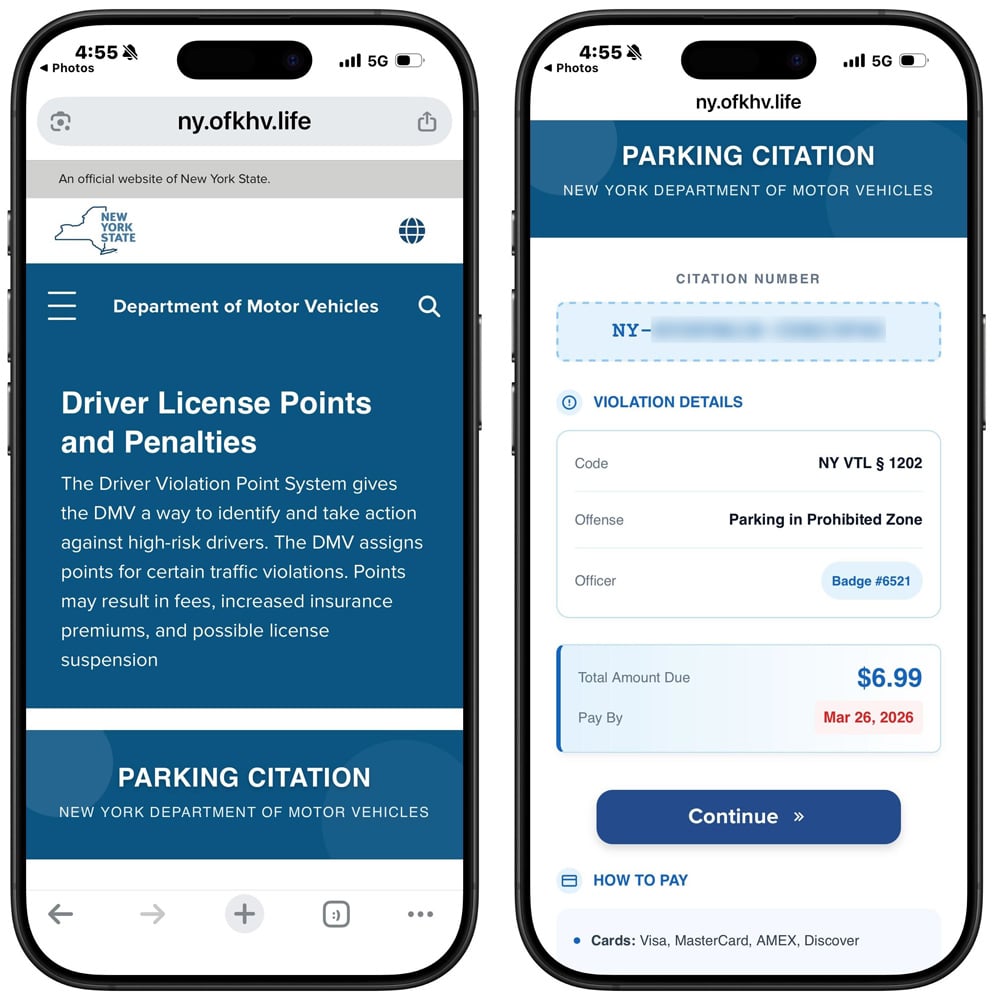
    Fake NY Department of Motor Vehicles phishing site
    Fake NY Department of Motor Vehicles phishing site
    Source: BleepingComputer

    Clicking continue will take you to a page where you can enter your personal and credit card information to pay the alleged charge.

    This form is used to steal your data, including your name, address, phone number, email address, and, eventually, your credit card information.

    This information can then be used for a wide variety of malicious activities, including follow-on phishing attacks, financial fraud, identity theft, and the sale of your data to other threat actors.

    As a general rule, if you receive a text from an unknown phone number or email address requesting payment of a bill, ignore it.

    State agencies have repeatedly stated in response to these scams that they do not use text messages requesting personal information or payment information.


    tines

    Automated pentesting proves the path exists. BAS proves whether your controls stop it. Most teams run one without the other.

    This whitepaper maps six validation surfaces, shows where coverage ends, and provides practitioners with three diagnostic questions for any tool evaluation.


    Source link

    Share. Facebook Twitter Pinterest LinkedIn Tumblr Email
    Previous ArticleEducational & Beginner-Friendly
    Next Article Ubuntu security advisory (AV26-296) – Canadian Centre for Cyber Security
    admin
    • Website

    Related Posts

    News

    InfoSec News Nuggets 04/08/2026

    April 8, 2026
    News

    Microsoft rolls out fix for broken Windows Start Menu search

    April 8, 2026
    News

    How Secure by Design Helps Developers Build Secure Software

    April 8, 2026
    Add A Comment

    Comments are closed.

    Demo
    Top Posts

    Global Takedown of Massive IoT Botnets Halts Record-Breaking Cyberattacks

    March 20, 202619 Views

    Catchy & Intriguing

    March 17, 202619 Views

    The Grandparent Scam: How AI Voice Technology Makes This Old Con Deadlier Than Ever

    March 18, 202617 Views
    Stay In Touch
    • Facebook
    • YouTube
    • TikTok
    • WhatsApp
    • Twitter
    • Instagram
    Latest Reviews
    85
    Featured

    Pico 4 Review: Should You Actually Buy One Instead Of Quest 2?

    January 15, 2021 Featured
    8.1
    Uncategorized

    A Review of the Venus Optics Argus 18mm f/0.95 MFT APO Lens

    January 15, 2021 Uncategorized
    8.9
    Editor's Picks

    DJI Avata Review: Immersive FPV Flying For Drone Enthusiasts

    January 15, 2021 Editor's Picks

    Subscribe to Updates

    Get the latest tech news from FooBar about tech, design and biz.

    Demo
    Most Popular

    Global Takedown of Massive IoT Botnets Halts Record-Breaking Cyberattacks

    March 20, 202619 Views

    Catchy & Intriguing

    March 17, 202619 Views

    The Grandparent Scam: How AI Voice Technology Makes This Old Con Deadlier Than Ever

    March 18, 202617 Views
    Our Picks

    InfoSec News Nuggets 04/08/2026

    April 8, 2026

    Yearly Breach Reports Summary 2023

    April 8, 2026

    Top Cybersecurity Certifications in Canada: Essential Credentials, Costs & Career ROI

    April 8, 2026

    Subscribe to Updates

    Get the latest creative news from FooBar about art, design and business.

    Facebook X (Twitter) Instagram Pinterest
    • Home
    • Technology
    • Gaming
    • Phones
    • Buy Now
    © 2026 ThemeSphere. Designed by ThemeSphere.

    Type above and press Enter to search. Press Esc to cancel.