


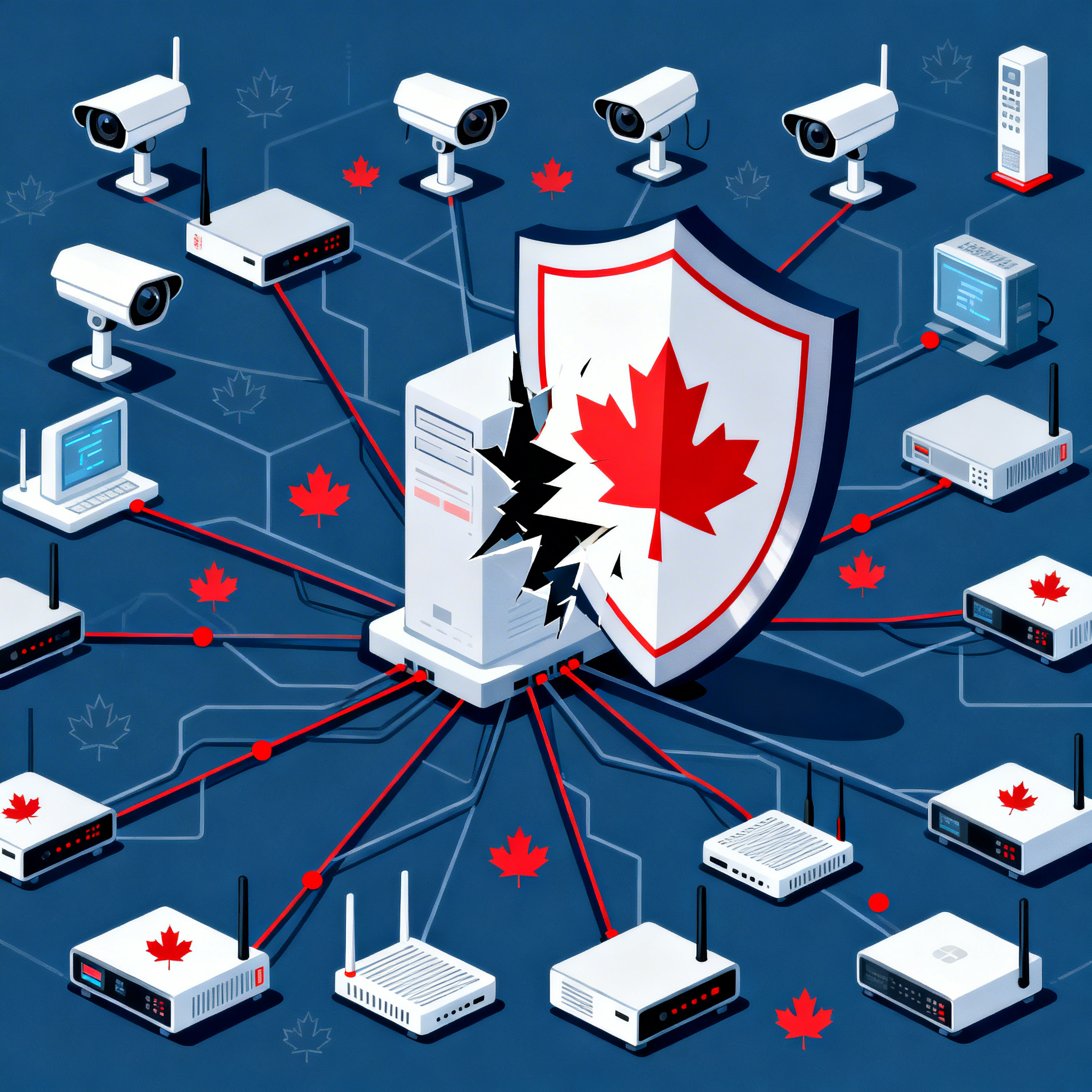
In a landmark international operation, law enforcement agencies from multiple countries have dismantled the command-and-control (C2) infrastructure behind four of the most powerful Internet of Things (IoT) botnets ever seen. This decisive action has effectively stopped a wave of Distributed Denial-of-Service (DDoS) attacks that reached an unprecedented peak of 30 terabits per second (Tbps)—a scale rarely witnessed in cybersecurity history.
What Are IoT Botnets and Why Should Canadians Care?
IoT botnets are networks of compromised internet-connected devices—like security cameras, routers, and digital video recorders—that cybercriminals hijack to launch massive attacks. These devices often have weak security, such as default passwords or outdated firmware, making them easy targets.
For Canadians, the threat is real and growing. With millions of IoT devices in homes and businesses across the country, the risk of becoming part of a global botnet or falling victim to related attacks is significant.
The Botnets Behind the Attacks
The operation targeted four notorious botnets known as Aisuru, KimWolf, JackSkid, and Mossad. Together, these networks had compromised over three million devices worldwide by March 2026.
- Aisuru: Known for flooding targets with massive traffic volumes.
- JackSkid: Used advanced techniques to bypass firewalls, reaching devices typically protected behind network defenses.
- KimWolf: Specialized in infiltrating internal IoT devices, marking a new level of threat sophistication.
- Mossad: Focused on precise disruption attacks.
This campaign stood out not just for its size but also for how attackers evolved their methods. In particular, KimWolf and JackSkid demonstrated the ability to compromise devices inside protected networks—meaning traditional perimeter defenses alone no longer suffice.
How These Botnets Operated: A Cybercrime-as-a-Service Model
According to the U.S. Department of Justice, these botnets were rented out to other criminals in what’s called a “cybercrime-as-a-service” business model. Once devices were compromised, access was leased to launch DDoS attacks on demand.
Victims ranged from private companies to government agencies, including systems linked to the U.S. Department of Defense Information Network (DoDIN). Often, these attacks accompanied extortion attempts where victims were pressured to pay ransom to stop the assault.
For Canadian organizations, such attacks can result in significant downtime, costly incident responses, and damage to reputation—expenses that can easily climb into the tens of thousands of dollars per incident.
The Scale of the Threat
The botnets issued hundreds of thousands of attack commands:
| Botnet | Attack Commands Issued | Key Capability |
|---|---|---|
| Aisuru | 200,000+ | High-volume traffic generation |
| JackSkid | 90,000+ | Firewall evasion techniques |
| KimWolf | 25,000+ | Targeting internal IoT devices |
| Mossad | 1,000+ | Precision disruption attacks |
These figures highlight how these botnets functioned like on-demand cyber weapons, capable of launching simultaneous high-bandwidth attacks against multiple targets globally.
The International Effort Behind the Takedown
The successful disruption came from a coordinated effort involving law enforcement agencies in the U.S., Germany, and Canada:
- In Canada, the Royal Canadian Mounted Police (RCMP), Ontario Provincial Police (OPP), and Sûreté du Québec (SQ) played key roles in targeting individuals linked to these botnets.
- In the U.S., agencies like the FBI and Defense Criminal Investigative Service (DCIS) took down domains and servers controlling the botnets.
- German authorities also executed parallel operations.
Industry partners such as Cloudflare, Akamai, Amazon Web Services, and The Shadowserver Foundation were instrumental in providing threat intelligence and technical support during the operation.
What This Means for Canadians and How We Can Stay Safe
By seizing C2 infrastructure, authorities have cut off communication between attackers and millions of infected devices—neutralizing the immediate threat and preventing further massive attacks from these networks.
However, this incident underscores ongoing vulnerabilities in IoT security. Many devices remain exposed due to weak passwords, outdated software, and insufficient security measures.
Security experts advise Canadians to:
- Change default passwords on all IoT devices.
- Regularly update firmware to patch vulnerabilities.
- Use network segmentation to isolate IoT devices from critical systems.
- Employ continuous monitoring tools to detect unusual activity early.
As attackers develop more sophisticated ways to breach internal networks, improving device-level protections and maintaining vigilance are crucial steps toward safeguarding our digital environment.
Stay informed with Canadian Cyberwatch for ongoing updates on cybersecurity trends and threats impacting Canada’s digital landscape.
