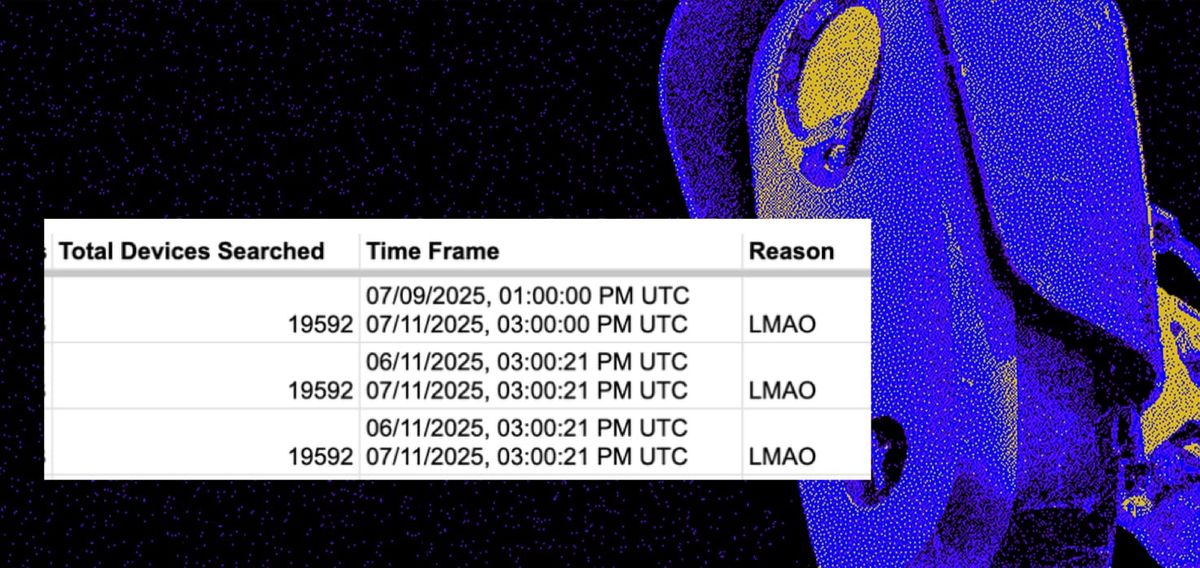
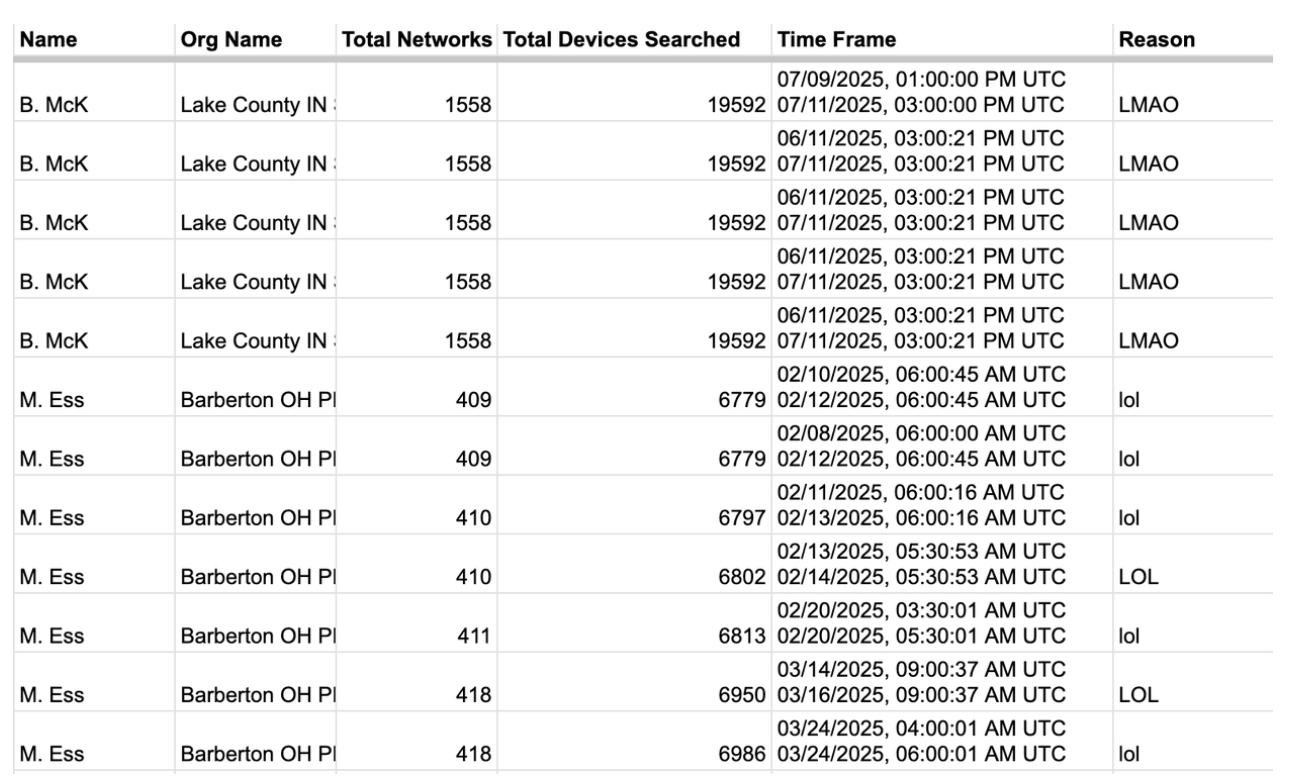
Last summer, a cop with the Lake County, Indiana Sheriff’s Department used Flock’s surveillance search engine to look for a license plate across more than 19,000 cameras in 1,558 cities and towns. The cop’s stated reason for the search, according to a record of Flock’s system, was “LMAO.”
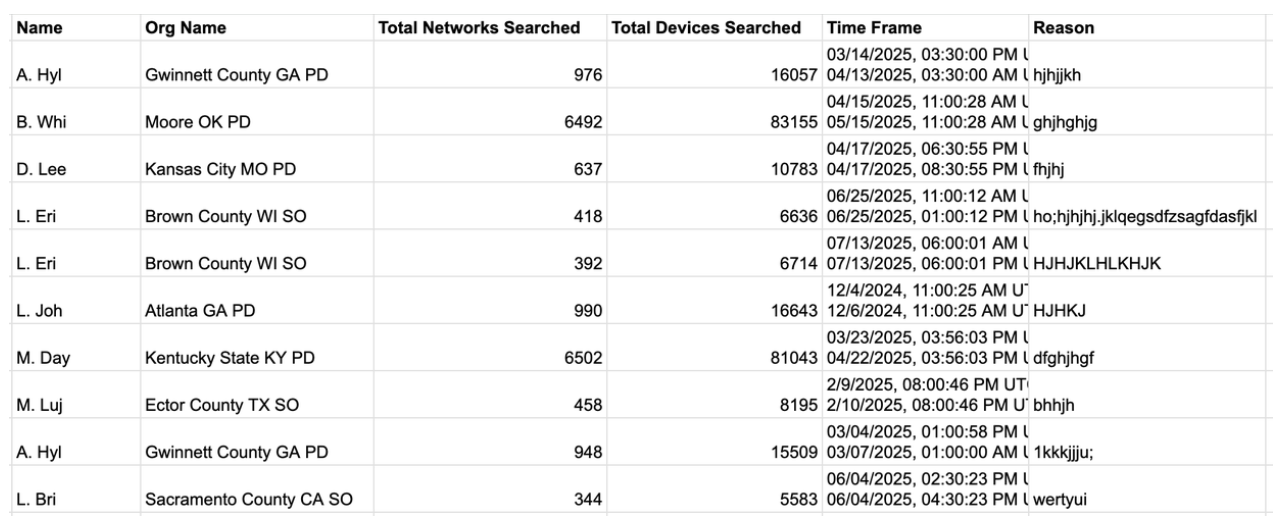
The cop is one of dozens who put gibberish, jokes, or other nonsense into Flock’s “reason” box, highlighting the casualness and lack of care some cops have when searching an incredibly powerful surveillance system. This is on top of the thousands upon thousands of cops who simply wrote something like “investigation,” “test,” or left the box blank as their search “reason,” according to a new analysis by the Electronic Frontier Foundation and shared with 404 Media.
EFF’s investigation found cops across dozens of jurisdictions writing “LMAO,” “LOL,” “Hehe,” “Haha,” “idk,” “blah,” “TBD,” and “robbery I don’t remember the case number leave me alone” in Flock’s “reason” box for searches. They found cops writing “idiot,” “fuck this new search engine,” “dickhead,” “shithead,” and “WEIRD KID” in the reason box. And they found an entire class of police button mashers, who ran searches for reasons of “asdfg,” “gyghkkghghjkghjk,” “jhjhjkhj,” “jkhhkjhjk,” “nmbvcbnm,” and so on and so forth. The searches came from police departments across the country from 2023 through late 2025, when Flock changed how the “reason” box in its search system functions.
As Flock’s automated license plate reader system comes under fire for privacy abuses, the perception of mass surveillance, and cases of police abuse, the company and police departments around the country have tried to paint those who want to limit the technology as wanting to take away a powerful tool that police use to solve very serious crimes. While Flock has been used in high profile cases, the searches published by the EFF and the cases of abuse reported by 404 Media and other news outlets around the country show that police often aren’t taking their responsibilities seriously.
“When law enforcement and tech salespeople pitch ALPRs to city councils, they stick to a familiar script. They trumpet the technology, which is often provided by private companies like Flock Safety, Motorola Solutions, or Axon, as an essential tool for solving high-stakes crimes, such as car jacking, kidnapping, or murder,” the EFF wrote in a blog post about its findings.
“Police are routinely searching the Flock database without providing any legitimate justification, making a mockery of our civil liberties by logging reasons like ‘LOL,’ ‘LMAO,’ ‘sexy,’ and ‘idk’ to access sensitive ALPR location data […] With no warrant requirements, limited guardrails, and deficient audit processes, ALPR databases have fostered a culture of unrestricted access to everyone’s location information. This culture of abuse has allowed police to treat a mass surveillance network like their own personal search engine, permitting the tracking of the movements of everyday citizens for low-level complaints, personal whims, and sometimes, seemingly, for the lols.”
The EFF was able to do this analysis because of the way that Flock documents police use of the system. Each time a search is performed, a record of it is saved in the Flock system, which can be obtained by the public using government records requests. These audit logs show hundreds of thousands of searches of the system; after 404 Media and other news outlets used these types of logs to show police using the Flock system to look for undocumented immigrants on behalf of ICE, a woman in Texas who had an abortion, and protesters, cops were warned by government surveillance centers to be “as vague as permissible” about the reasons for their searches. Late last year, Flock changed its system; rather than having to type in a reason, Flock now has a drop-down list of prepopulated reasons, which the EFF called “a loss for transparency.”
The EFF contacted departments whose cops performed these “joke” searches, and found that many of them did not do anything about cops who button mashed or put jokes. Cops who wrote “hehe” and “idk” were “counseled,” they were told. A cop who wrote “idiot” got away with it because by the time the department learned about it, it had passed a 90-day time period in which the cop’s union contract allowed for internal investigations. Several other police departments said they would investigate the behavior. The Fishers Police Department in Indiana said that a detective who searched Flock for reasons of “blah” only did so “when he has issues with the technology,” or when “the technology is not moving fast enough for him.” A police department said it investigated a cop who wrote “driving around being weird” in the reason field but found it was for “legitimate public safety purposes.”
“The fact that these searches were not only missed by the agency supervising the officer, but by the often thousands of other agencies whose systems were searched, demonstrates how agencies cannot be trusted to oversee themselves,” the EFF wrote. “Mass surveillance is incompatible with a free society, and especially so when the people with access to this data are treating it like a joke.”