



Close Menu

    Subscribe to Updates

    Get the latest creative news from FooBar about art, design and business.

    What's Hot

    Malicious npm packages evade install-script defenses at runtime

    September 20, 2026

    Researchers escape OpenAI Codex sandbox to run commands on host

    September 20, 2026

    Microsoft Teams will let admins block custom file extensions

    September 20, 2026
    Facebook X (Twitter) Instagram
    • Demos
    • Technology
    • Gaming
    • Buy Now
    Facebook X (Twitter) Instagram Pinterest Vimeo
    Canadian Cyber WatchCanadian Cyber Watch
    • Home
    • News
    • Alerts
    • Tips
    • Tools
    • Industry
    • Incidents
    • Events
    • Education
    Subscribe
    Canadian Cyber WatchCanadian Cyber Watch
    Home»News»Hackers exploit Tencent app flaw to deploy GrayRabbit malware
    News

    Hackers exploit Tencent app flaw to deploy GrayRabbit malware

    adminBy adminSeptember 13, 2026No Comments3 Mins Read
    Share Facebook Twitter Pinterest LinkedIn Tumblr Reddit Telegram Email
    Share
    Facebook Twitter LinkedIn Pinterest Email


    Hackers exploit Tencent app flaw to deploy GrayRabbit malware

    Threat actors linked to a China-aligned espionage group are exploiting a critical vulnerability (CVE-2026-51990) in Tencent’s Sogou Input Method for Windows to deploy the GrayRabbit backdoor.

    Researchers at cybersecurity company Gen Digital warn that the security issue is a one-click remote code execution (RCE) flaw.

    “We observed this vulnerability actively exploited in the wild by the UNC3569 threat group to deploy the GRAYRABBIT backdoor through a crafted link,” Gen Threat Labs says.

    Sogou Input Method is a popular Windows application that lets users type Chinese characters using a standard keyboard and also offers a custom link handler and a built-in web browser using an outdated Chromium engine.

    Developed by Chinese tech giant Tencent, Sogou Input Method reportedly has hundreds of millions of installations in China.

    Gen Threat Labs reports that UNC3569 chains three weaknesses in the product:

    1. an unvalidated command-line argument injection in the sgbiz: URI
    2. an unrestricted URL navigation in a CEF-based webview
    3. an outdated, unsandboxed Chromium browser engine

    The attack chain starts with the victim clicking a crafted sgbiz: custom URI, causing Windows to invoke Sogou’s biz_helper.exe protocol handler, which passes attacker-controlled command-line arguments to the legitimate SGMyInput.exe executable without validating them.

    The attacker-injected arguments open Sogou’s skincenter component and instruct its embedded Chromium webview to load an attacker-controlled URL. Sogou does not restrict the URL’s scheme or destination.

    In the third stage, a malicious page exploits a known vulnerability in Sogou’s outdated Chromium 80 engine. Because the browser runs without a sandbox and with important web-security protections disabled, the exploit achieves code execution and installs the GrayRabbit backdoor.
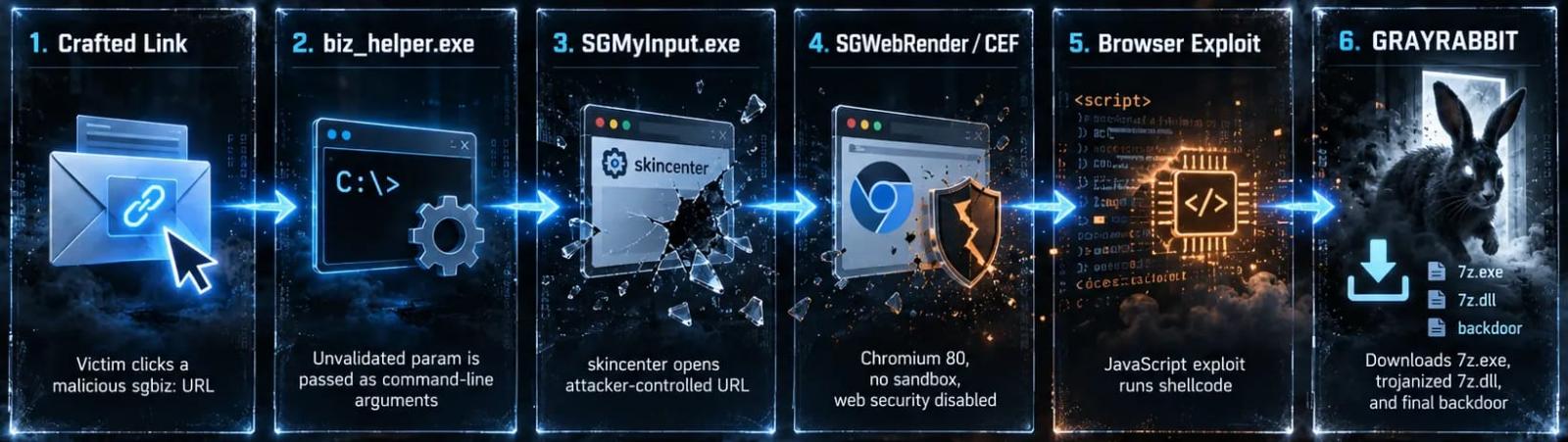
    Attack chain
    The UNC3569 attack chain
    Source: Gen Threat Labs

    In 2024, Google researchers described GrayRabbit as a modular malware family and linked it to UNC3569, a China-based threat actor operating across both the cybercrime and cyber contractor-for-hire ecosystems.

    The malware sample that Gen Threat Labs analyzed is a more mature 64-bit variant with an expanded command set and RC4-encoded command-and-control (C2) configuration.

    Its capabilities include process execution, opening interactive reverse shells, uploading and downloading files, collecting system and user information, and reflectively loading plugins in the host’s memory.

    Gen Threat Labs reported their findings to Tencent on April 9, and the software vendor deployed a fix in Sogou Input Method version 16.3.0.3498, released on April 21.

    The patch validates the URL arguments accepted through the protocol handler, permits only HTTPS, and restricts navigation to approved domains related to Sogou and Tencent.

    However, the researchers warned that the underlying browser remains outdated and still runs without a sandbox, with many web security protections disabled.


    article image

    Join Mikko Hyppönen and security leaders from the NFL, CHANEL, and Atlassian for a two-hour digital summit on what AI-speed attacks change, what defenders should stop doing, and how to validate, decide, fix, and re-validate at machine speed.

    Save your seat


    Source link

    Share. Facebook Twitter Pinterest LinkedIn Tumblr Email
    Previous ArticleBlack Hat Stories | Ryan & Isabella Barnett, Akamai
    Next Article CISA: Hackers now exploit max severity GitLab flaw in attacks
    admin
    • Website

    Related Posts

    News

    Malicious npm packages evade install-script defenses at runtime

    September 20, 2026
    News

    Researchers escape OpenAI Codex sandbox to run commands on host

    September 20, 2026
    News

    Microsoft Teams will let admins block custom file extensions

    September 20, 2026
    Add A Comment

    Comments are closed.

    Demo
    Top Posts

    Catchy & Intriguing

    March 17, 202679 Views

    How fraudsters target credit unions

    May 4, 202644 Views

    IP Address Investigations and Local OSINT

    March 20, 202641 Views
    Stay In Touch
    • Facebook
    • YouTube
    • TikTok
    • WhatsApp
    • Twitter
    • Instagram
    Latest Reviews
    85
    Featured

    Pico 4 Review: Should You Actually Buy One Instead Of Quest 2?

    January 15, 2021 Featured
    8.1
    Uncategorized

    A Review of the Venus Optics Argus 18mm f/0.95 MFT APO Lens

    January 15, 2021 Uncategorized
    8.9
    Editor's Picks

    DJI Avata Review: Immersive FPV Flying For Drone Enthusiasts

    January 15, 2021 Editor's Picks

    Subscribe to Updates

    Get the latest tech news from FooBar about tech, design and biz.

    Demo
    Most Popular

    Catchy & Intriguing

    March 17, 202679 Views

    How fraudsters target credit unions

    May 4, 202644 Views

    IP Address Investigations and Local OSINT

    March 20, 202641 Views
    Our Picks

    Malicious npm packages evade install-script defenses at runtime

    September 20, 2026

    Researchers escape OpenAI Codex sandbox to run commands on host

    September 20, 2026

    Microsoft Teams will let admins block custom file extensions

    September 20, 2026

    Subscribe to Updates

    Get the latest creative news from FooBar about art, design and business.

    Facebook X (Twitter) Instagram Pinterest
    • Home
    • Technology
    • Gaming
    • Phones
    • Buy Now
    © 2026 ThemeSphere. Designed by ThemeSphere.

    Type above and press Enter to search. Press Esc to cancel.