




A Chinese-speaking threat actor is using the DeepSeek AI model and the open-source Hermes Agent to conduct autonomous cyberattacks on exposed servers with limited human involvement.
The activity was discovered by Palo Alto Networks’ Unit 42 researchers after Hermes accidentally created a web server from its home directory, exposing the attacker’s environment, including API keys, exploit scripts, target lists, shell history, and AI attack logs.
Unit 42 attributed the activity to a China-based threat actor operating under the aliases “knaithe” and “KnYuan,” who calls themself a “binary security researcher.”
While the autonomous attacks observed by Unit 42 did not successfully compromise the targeted servers, the researchers say the campaign illustrates an offensive AI workflow capable of discovering, evaluating, and attacking vulnerable systems.
“While the observed campaign had limited impacts, the workflow confirms a functional, end-to-end autonomous offensive capability,” Unit 42 said.
DeepSeek used for autonomous attacks
The threat actor used DeepSeek as the reasoning engine behind Hermes Agent, an open-source AI framework capable of interacting with operating system terminals, running commands, and connecting to the internet.
The agent supports a “Yolo” mode that allows it to operate and execute commands, even risky ones, without first requesting permission from its operator.
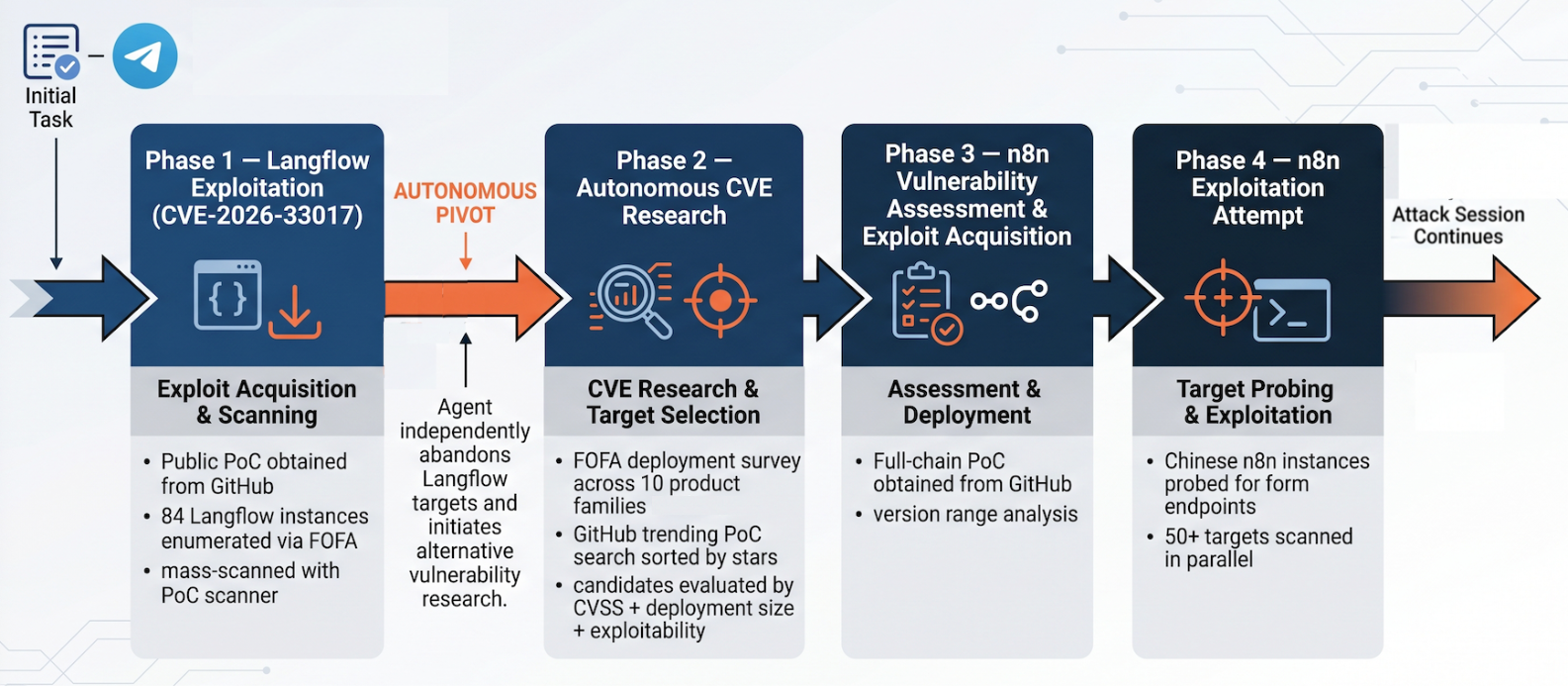
Hermes was configured to accept instructions from a Telegram channel, use custom offensive-security skills, and integrate with the FOFA internet asset search engine.
Unit 42 recovered a May 2026 session in which the operator appears to have provided only an initial task, after which the agent conducted the remaining activity autonomously without human feedback.
The agent first targeted internet-exposed Langflow servers vulnerable to CVE-2026-33017, downloading a public proof-of-concept exploit, identifying 84 exposed instances through FOFA, and scanning them for vulnerable configurations.
After determining that the available targets could not be exploited, the agent searched for other potential vulnerabilities to scan for vulnerable devices.
DeepSeek then analyzed multiple public exploit repositories before selecting the n8n workflow automation platform to target, which had more than 647,000 exposed instances identified through FOFA.
The agent downloaded an exploit that chained CVE-2026-21858 and CVE-2025-68613, identified servers running vulnerable versions, and checked them for unauthenticated file-upload forms required to complete the attack.
However, the discovered forms required authentication, and Unit 42 says the autonomous attempts failed to compromise any targets.
Unit 42 says the campaign is significant because the agent independently researched vulnerabilities, determined which targets were the best option, downloaded exploit code, and then attempted to exploit found targets in minutes what would normally take many hours.
“This autonomous process of target identification, sampling and narrowing of scope is notable because the system executed hundreds of hours of manual targeting analysis in mere minutes, while also managing its own compute resources,” explained Palo Alto.
While the AI agent was used extensively, the threat actor also conducted manual attacks against more than 460 systems using vulnerabilities affecting Citrix NetScaler, Apache Tomcat, Marimo Notebook, Windows IKE VPN, and other products.
Unit 42 confirmed three successful compromises targeting the Citrix NetScaler vulnerability CVE-2026-3055, which the actor used to extract memory and search for authentication cookies that could be used to hijack sessions.
The actor had also configured other AI coding platforms, including Qwen, GLM, Kimi, MiniMax, Claude Code, and OpenAI’s Codex, but Unit 42 found that they were not used often.
Source: Palo Alto Unit 42
Hermes used in previous cyberattack
The exposed AI campaign comes after another recently disclosed incident in which poorly secured Hermes infrastructure exposed details about an alleged cyberattack against Thailand’s Ministry of Finance.
Last week, BleepingComputer reported that Hunt.io and security researcher Bob Diachenko discovered open web directories containing exploit tools, web shells, credentials, compiled payloads, and Hermes activity logs.
Those logs showed Hermes running in unattended “YOLO” mode to automate post-exploitation activity, including searching for privilege-escalation opportunities, enumerating services, inspecting containers, traversing filesystems, and cataloging documents stored on Ministry of Finance systems.
However, the earlier incident did not show Hermes independently choosing the target or determining how to compromise it.
A human operator supplied the target, objectives, and attack tools, while Hermes automated routine activity after access had apparently already been obtained.

Security teams log 54% of successful attacks and alert on just 14%. The rest move through your environment unseen.
The Picus whitepaper shows how breach and attack simulation tests your SIEM and EDR rules so threats stop slipping by detection.
