




Residential proxies are no longer treated as a simple anonymity tool in carding circles. They are increasingly discussed as one component of a broader identity-simulation stack, alongside device fingerprints, browser profiles, billing information, time zones, cookies, and transaction behavior.
To better understand how criminal actors currently use and evaluate this infrastructure, Flare researchers analyzed 2,889 unique underground posts published in the past two years across approximately 545 discussion threads. The conversations include operational guides, troubleshooting requests, provider comparisons, transaction-failure discussions, and advertisements for supposedly “clean” or finance-compatible proxy services.
Together, they show that residential IP addresses remain important to carders but are no longer viewed as a reliable bypass on their own. Instead, actors repeatedly describe a market in which proxy pools become overused, addresses accumulate poor reputations, location data is inaccurate, and financial services block entire ranges. As a result, carders are becoming more selective, attempting to match IP geography with stolen identity data while combining proxies with antidetect browsers and other techniques designed to create a convincing digital identity.
The findings suggest that residential proxies remain a key part of the carding ecosystem, but also one of its increasingly fragile components.
Key points
-
Carders increasingly judge a proxy by its history, not merely whether it belongs to a residential internet provider.
-
Geographic consistency now extends beyond country matching to city, ZIP code, time zone, browser language, and billing information.
-
Residential IPs are rarely considered sufficient alone and are frequently paired with antidetect browsers and fingerprint manipulation.
-
Provider restrictions are creating a secondary market for supposedly “clean” residential IPs capable of reaching financial services.
-
Defenders should treat residential traffic as context—not evidence that a user is legitimate.
What are residential proxies?
A residential proxy routes traffic through an IP address assigned by an internet service provider to a household or consumer device.
To a website, the connection may resemble that of an ordinary home user rather than traffic originating from a hosting provider or commercial VPN.
Residential proxies have legitimate uses, including localization testing, advertising verification, and brand protection. Criminal actors value them because they can make fraudulent sessions appear closer to normal consumer traffic.
“Clean” has replaced “residential”
One of the clearest findings from the dataset is that carders no longer speak about residential proxies as a single trusted category. Instead, they divide them into “clean” and “dirty” pools.
A widely reposted underground guide titled “Getting the Cleanest Possible IPs for Carding” (see screenshot below) argues that even residential pools deteriorate as addresses are repeatedly used for abuse.
Another guide claimed that the important question was not simply whether an IP was residential, but whether it had previously been used against banks, payment processors, or other fraud-sensitive services.

Sign up for the free trial to access if you aren’t already a customer.
This thinking also appears in troubleshooting discussions. Users compare fraud-score services, complain that the same address receives dramatically different reputational ratings, and report that an IP initially considered clean can become high-risk after a short period of activity.
The underlying assumption is significant: carders increasingly believe that proxy reputation is dynamic and influenced by every other customer using the same infrastructure.
From “clean” residential proxies to antidetect browser setups, fraud actors are openly discussing how to build convincing digital identities on criminal forums.
Flare monitors these conversations, so your team is on top of their emerging techniques.
Precision is moving from country to identity consistency
Older carding advice is often focused on selecting an IP in the same country as the stolen card. Recent posts describe a far narrower standard.
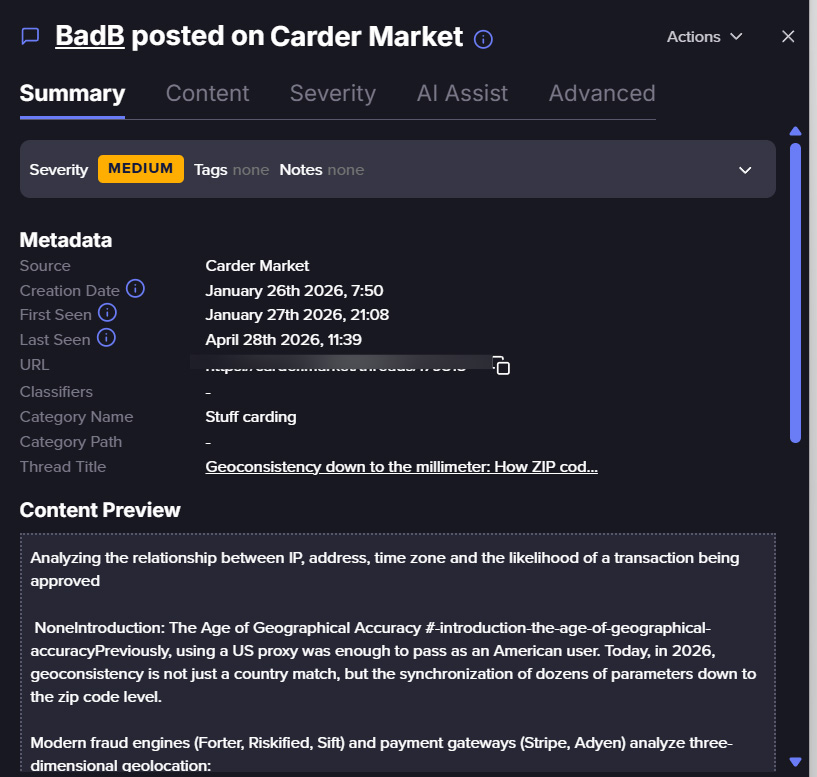
A January 2026 thread about “geoconsistency” (see screenshot below) discussed matching an IP’s approximate location with the billing ZIP code, device time zone, operating-system language, and browser characteristics.
Sign up for the free trial to access if you aren’t already a customer.
In another discussion, a user complained that major residential-proxy providers had removed ZIP-code targeting and now offered only country, state, and city selection.
The actor feared that city-level targeting would no longer provide enough precision to avoid fraud controls.
Not every technical claim made in underground forums is necessarily accurate. However, the discussions clearly demonstrate the actors’ operational mindset: they are trying to construct a coherent digital identity rather than merely concealing their real IP address.
The proxy is only one layer
The dataset repeatedly connects residential proxies with antidetection browsers, isolated devices, cookie history, WebRTC configuration, Canvas and WebGL fingerprints, and user-agent consistency.
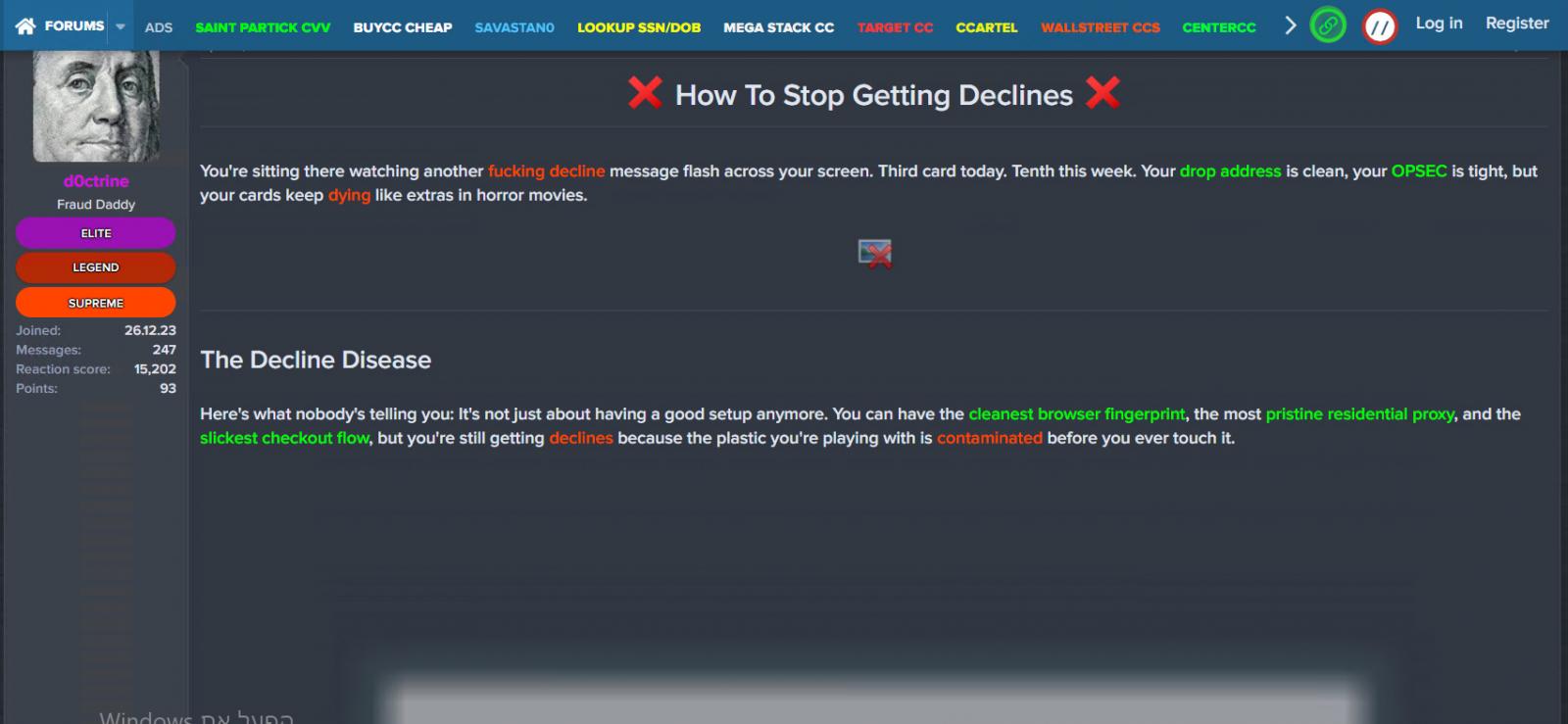
One April 2026 guide warned that a “perfect residential proxy” would still fail if the browser profile exposed contradictory information. Another setup guide argued that copying a fixed configuration was ineffective because the device, proxy, account history, payment information, and target merchant must all be evaluated together.
This reflects the direction of modern fraud detection. Stripe’s documentation describes controls that combine transaction, identity, card, and historical signals rather than relying on one indicator. Its guidance on card testing also highlights velocity, repeated declines, inconsistent billing information, and the reuse of cards or customer details.
Carders are searching for finance-compatible IPs
Several posts complain that established proxy providers restrict access to banks, payment processors, government portals, and other fraud-sensitive services. This creates a practical problem for carders: an IP may appear residential and have a low fraud score yet still be unusable against the intended target.
Some actors interpret these restrictions as a sign that the provider is protecting its address pool from abuse. One widely circulated guide even suggested that restricted residential pools may contain cleaner IPs precisely because they have not been repeatedly used against financial institutions.
At the same time, the restrictions are creating demand for services advertised as “finance enabled,” “bank compatible,” or capable of accessing specific payment platforms.
Underground users exchange provider recommendations and methods for testing connectivity, although the reliability of these advertisements is difficult to verify and some may be scams.
This search for usable residential infrastructure is taking place within a much larger and increasingly contested proxy ecosystem. In July 2026, the FBI and industry partners seized hundreds of domains associated with the NetNut residential proxy platform and the Popa botnet.
Researchers connected the network to at least two million compromised devices, including smart TVs and streaming boxes, which were converted into residential proxy nodes.
The infrastructure was reportedly used for activities including advertising fraud, account takeover, and other abusive traffic.
A March 2026 FBI alert further warned that criminals can select residential proxy addresses down to the state and city level and specifically cited their use for account takeover, including matching an IP address to the victim’s city to reduce the likelihood of triggering a bank’s geolocation controls.
Together, the underground discussions and recent disruptions show why carders increasingly distinguish between merely obtaining a residential address and obtaining one that is sufficiently clean, precisely located, and permitted to interact with financial services.
What defenders can take
Residential IP addresses should not be treated as inherently trustworthy. The stronger signal is consistency across the entire session: device history, account age, browser fingerprint, payment instrument, billing information, transaction velocity, and behavior after checkout.
Organizations should also look for patterns that proxies do not easily conceal, including repeated identity creation, multiple cards connected to similar devices, abrupt geography changes, mismatched time zones, and clusters of low-value authorization attempts.
The underground discussions suggest that defenders are already raising the cost of fraud. Carders are spending more time searching for uncontaminated infrastructure, debating conflicting reputation scores, and trying to align increasingly granular identity signals.
Residential proxies remain valuable to carders, but they are no longer a universal bypass. Their effectiveness increasingly depends on the credibility of everything surrounding them and that broader identity is a much harder challenge for cybercriminals.
Learn more by signing up for our free trial.
Sponsored and written by Flare.
