



Close Menu

    Subscribe to Updates

    Get the latest creative news from FooBar about art, design and business.

    What's Hot

    Palo Alto GlobalProtect VPN auth bypass flaw now exploited in attacks

    May 30, 2026

    Jinan USR IOT Technology Limited (PUSR) USR-W610 RS232/485 to Wi-Fi/Ethernet Converter

    May 30, 2026

    CVE-2026-10127 | THREATINT

    May 30, 2026
    Facebook X (Twitter) Instagram
    • Demos
    • Technology
    • Gaming
    • Buy Now
    Facebook X (Twitter) Instagram Pinterest Vimeo
    Canadian Cyber WatchCanadian Cyber Watch
    • Home
    • News
    • Alerts
    • Tips
    • Tools
    • Industry
    • Incidents
    • Events
    • Education
    Subscribe
    Canadian Cyber WatchCanadian Cyber Watch
    Home»News»Google Chrome adds session cookie theft protection for all users
    News

    Google Chrome adds session cookie theft protection for all users

    adminBy adminMay 29, 2026No Comments3 Mins Read
    Share Facebook Twitter Pinterest LinkedIn Tumblr Reddit Telegram Email
    Share
    Facebook Twitter LinkedIn Pinterest Email


    Google Chrome

    Google says the Chrome Device Bound Session Credentials (DBSC) security feature is now generally available and is rolling out to all users to prevent account takeovers.

    Available in beta since April, DBSC was first announced in 2024 as a way to cryptographically bind session cookies to a specific device, preventing hackers from using such stolen cookies to bypass multi-factor authentication (MFA) and hijack users’ accounts.

    DBSC works by cryptographically linking user sessions to the hardware, such as their computer’s security chip (e.g., the Trusted Platform Module (TPM) on Windows and the Secure Enclave on macOS).

    Since the unique public/private keys used to encrypt and decrypt sensitive data are generated by the security chip, they cannot be stolen, preventing attackers from using stolen session cookies.

    “DBSC fundamentally changes the web’s capability to defend against this threat by shifting the paradigm from reactive detection to proactive prevention, ensuring that successfully exfiltrated cookies cannot be used to access users’ accounts,” Google said in April.

    “DBSC strengthens account security after users are logged in and helps bind a session cookie — small files used by websites to remember user information — to the device a user authenticated from. Even if malware was present on the user’s device, DBSC reduces the risk of session theft and makes it meaningfully more difficult for malicious actors to exploit stolen session cookies,” it added this week.
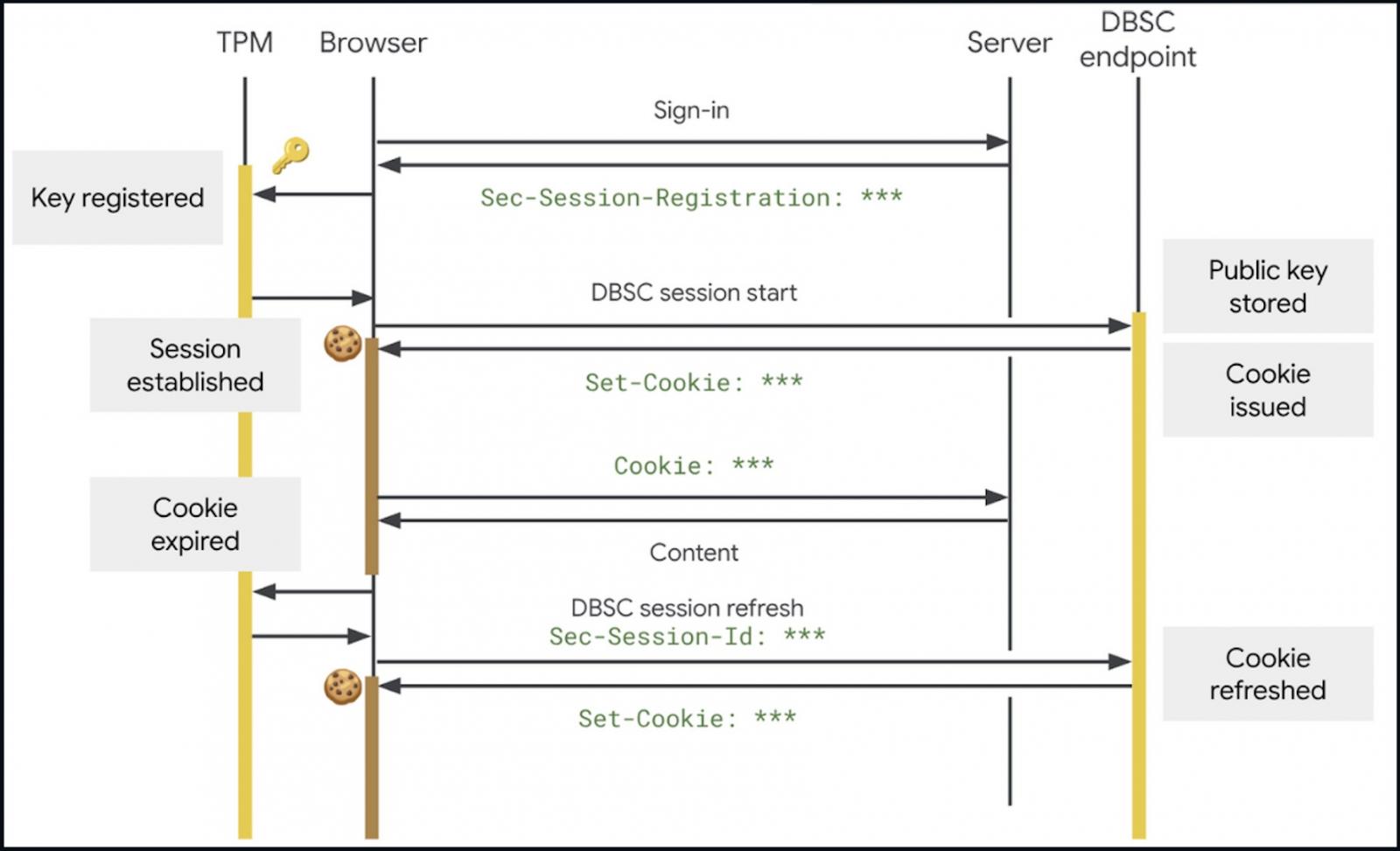
    How DBSC works
    How DBSC works (Google)

    ​The feature is now rolling out to all Google Workspace customers, Workspace Individual subscribers, and users with personal Google accounts.

    Google added that it will be enabled by default for all Google Workspace customers upon rollout and that administrators cannot disable it.

    In the past, threat actors have abused the undocumented Google OAuth “MultiLogin” API endpoint to generate new authentication cookies after stolen ones expired.

    The Lumma and Rhadamanthys information-stealing malware operations have also claimed that they could restore expired Google authentication cookies stolen in attacks to gain access to infected users’ Google accounts.

    At the time, Google advised customers to remove malware from their devices and recommended enabling Chrome’s Enhanced Safe Browsing security mode to defend against phishing and malware attacks.

    However, the new Chrome Device Bound Session Credentials (DBSC) security feature should effectively block malicious actors from abusing such stolen cookies, as they will not have access to the cryptographic keys required to use them.


    article image

    Automated pentesting tools deliver real value, but they were built to answer one question: can an attacker move through the network? They were not built to test whether your controls block threats, your detection rules fire, or your cloud configs hold.

    This guide covers the 6 surfaces you actually need to validate.

    Download Now


    Source link

    Share. Facebook Twitter Pinterest LinkedIn Tumblr Email
    Previous ArticleCVE-2026-9558 | THREATINT
    Next Article Zimbra security advisory (AV26-520) – Canadian Centre for Cyber Security
    admin
    • Website

    Related Posts

    News

    Palo Alto GlobalProtect VPN auth bypass flaw now exploited in attacks

    May 30, 2026
    News

    New CIFSwitch Linux flaw gives root on multiple distributions

    May 30, 2026
    News

    ‘Highly Plausible’ Aliens on Europa Are Earthlings’ Descendants, Study Says

    May 30, 2026
    Add A Comment

    Comments are closed.

    Demo
    Top Posts

    Catchy & Intriguing

    March 17, 202674 Views

    Defending Canada’s Digital Frontier: Combating Phishing, Social Engineering, Ransomware, and Malware

    March 23, 202629 Views

    The Essential Guide to Removing Computer Infections: Step-by-Step Remedies

    March 20, 202627 Views
    Stay In Touch
    • Facebook
    • YouTube
    • TikTok
    • WhatsApp
    • Twitter
    • Instagram
    Latest Reviews
    85
    Featured

    Pico 4 Review: Should You Actually Buy One Instead Of Quest 2?

    January 15, 2021 Featured
    8.1
    Uncategorized

    A Review of the Venus Optics Argus 18mm f/0.95 MFT APO Lens

    January 15, 2021 Uncategorized
    8.9
    Editor's Picks

    DJI Avata Review: Immersive FPV Flying For Drone Enthusiasts

    January 15, 2021 Editor's Picks

    Subscribe to Updates

    Get the latest tech news from FooBar about tech, design and biz.

    Demo
    Most Popular

    Catchy & Intriguing

    March 17, 202674 Views

    Defending Canada’s Digital Frontier: Combating Phishing, Social Engineering, Ransomware, and Malware

    March 23, 202629 Views

    The Essential Guide to Removing Computer Infections: Step-by-Step Remedies

    March 20, 202627 Views
    Our Picks

    Palo Alto GlobalProtect VPN auth bypass flaw now exploited in attacks

    May 30, 2026

    Jinan USR IOT Technology Limited (PUSR) USR-W610 RS232/485 to Wi-Fi/Ethernet Converter

    May 30, 2026

    CVE-2026-10127 | THREATINT

    May 30, 2026

    Subscribe to Updates

    Get the latest creative news from FooBar about art, design and business.

    Facebook X (Twitter) Instagram Pinterest
    • Home
    • Technology
    • Gaming
    • Phones
    • Buy Now
    © 2026 ThemeSphere. Designed by ThemeSphere.

    Type above and press Enter to search. Press Esc to cancel.