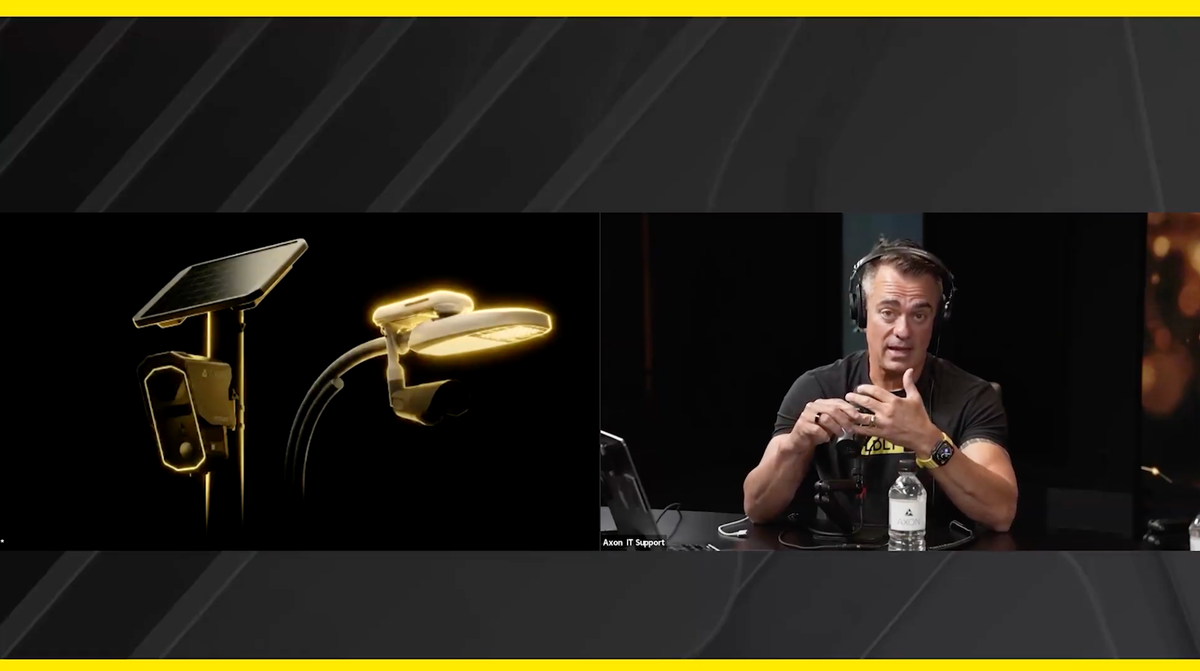
Axon says cops are asking it to make its automatic license plate readers (ALPRs) look different from Flock cameras because Flock vandalism has become so widespread, according to comments Axon’s CEO made in a now deleted webinar.
The comments highlight how Axon is trying to take advantage of sustained opposition against Flock’s license plate cameras, with one law enforcement customer suggesting a camera redesign would “help with the optics while we batten down the hatches” as the backlash spreads.
💡
Do you work at Axon or Flock? I would love to hear from you. Using a non-work device, you can message me securely on Signal at joseph.404 or send me an email at joseph@404media.co.
As 404 Media has reported, some towns and cities are switching from Flock to Axon’s cameras after cops did lookups for ICE in Flock, tracked a woman who self-administered an abortion, and have repeatedly abused their access to stalk ex-spouses. ALPRs constantly scan the license plate, brand, model, and other identifying features of all vehicles that drive past the camera and then make this timestamped log of activity searchable by law enforcement without a warrant.
In an August 26 webinar that was hosted on Axon’s official Vimeo page called “From backlash to trust,” Axon Chief Customer Officer Mike Wagers took a question from the remote audience and asked, “is there any talk — and there has been talk — to redesign Outpost, our fixed ALPR camera, to not look exactly like a Flock camera?”
“We are looking at […] do we change the general shape,” Rick Smith, Axon’s CEO, replied.
At another point in the webinar, Smith brought up Axon’s Lightpost product, which is an ALPR and AI-powered camera that attaches to an existing streetlight. “Frankly, we’ve had a lot of customers saying, hey, we’d like something that looks different because there is all this blowback. It’s harder to vandalize because it’s up higher,” he said.
Smith also said, “We’ve had some people say they’d like to see us make just a different camera, because our ALPR camera looks like an ALPR camera.” Another idea Smith brought up, pending customer feedback, is to go in the other direction and make ALPRs more explicit, with signs showing where they are located and a description of the city’s ALPR policies.
MegaraMedia, a YouTuber, downloaded a copy of the webinar before it was removed and shared it with 404 Media.
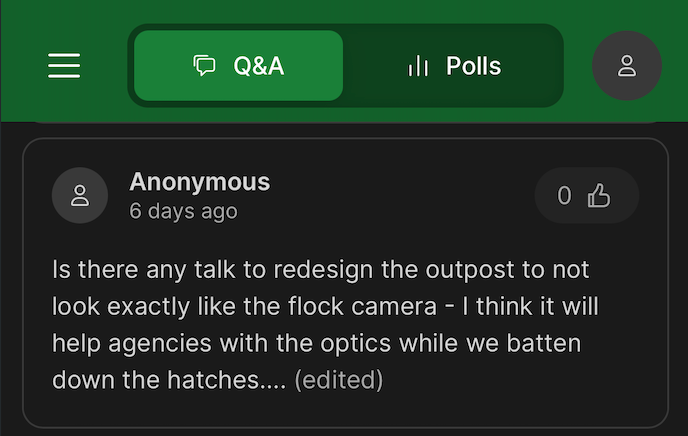
During the webinar, Axon asked its law enforcement customers to chime in with questions and answer a customer survey. 404 Media scanned the QR code displayed during the webinar to view those questions. One, which appears to be the one Wagers paraphrased, read, “Is there any talk to redesign the Outpost to not look exactly like the Flock camera — I think it will help agencies with the optics while we batten down the hatches…”
Around the country people have destroyed Flock cameras, including tearing them down, backing trucks into them, or spray painting over their lenses. Authorities have arrested and charged multiple people in connection with that vandalism. In one case, a cop made a fake, 3D-printed Flock camera to essentially act as bait; authorities then charged a man who broke the fake camera with three felonies.
One explicit reason some cities have ditched Flock for Axon is Flock’s national network. This allows a cop on one side of the country to search cameras not only in their own jurisdiction or state, but in another state entirely. When reporting on how local cops were performing Flock lookups for ICE, 404 Media found that some police departments did not know or understand their cameras were accessible by other agencies.
Smith said of the backlash against Flock and ALPR more generally: “This has been a hell of a storm.”