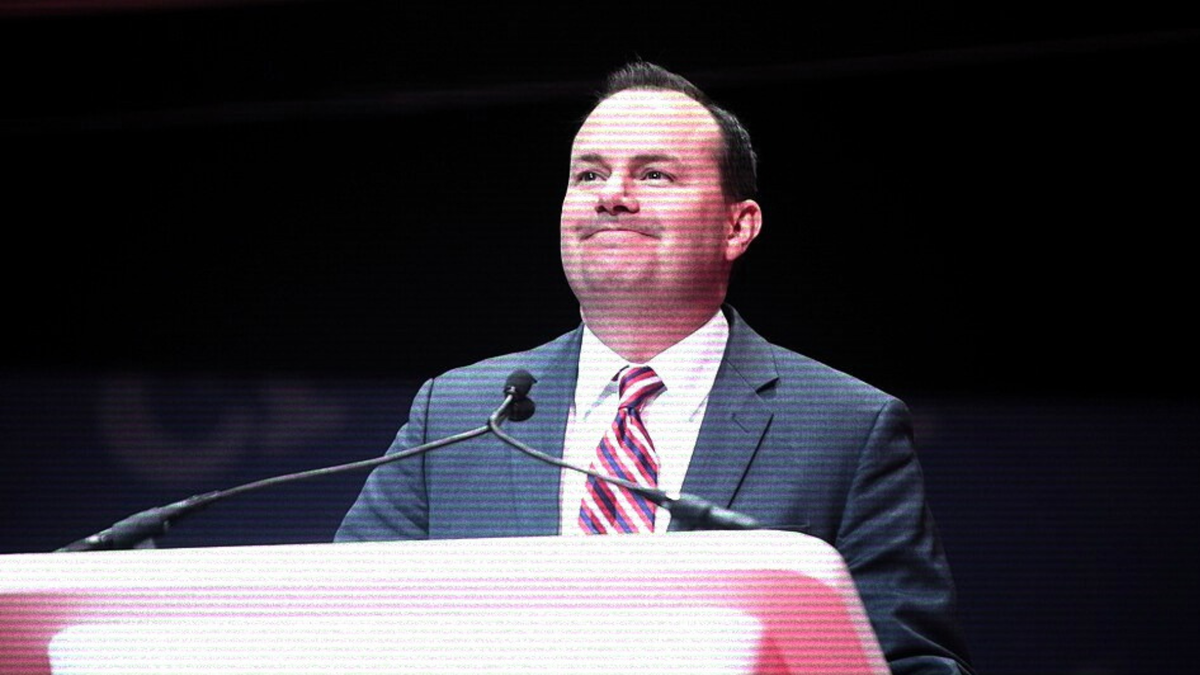
On Wednesday morning, Ted Cruz’s Senate Commerce Committee will convene on five bills aimed at age verification and “child safety.” The bills each have their own issues when it comes to privacy, data collection, parental rights, and free speech. But one bill, the partisan Republican SCREEN Act, is a Christian nationalist nightmare.
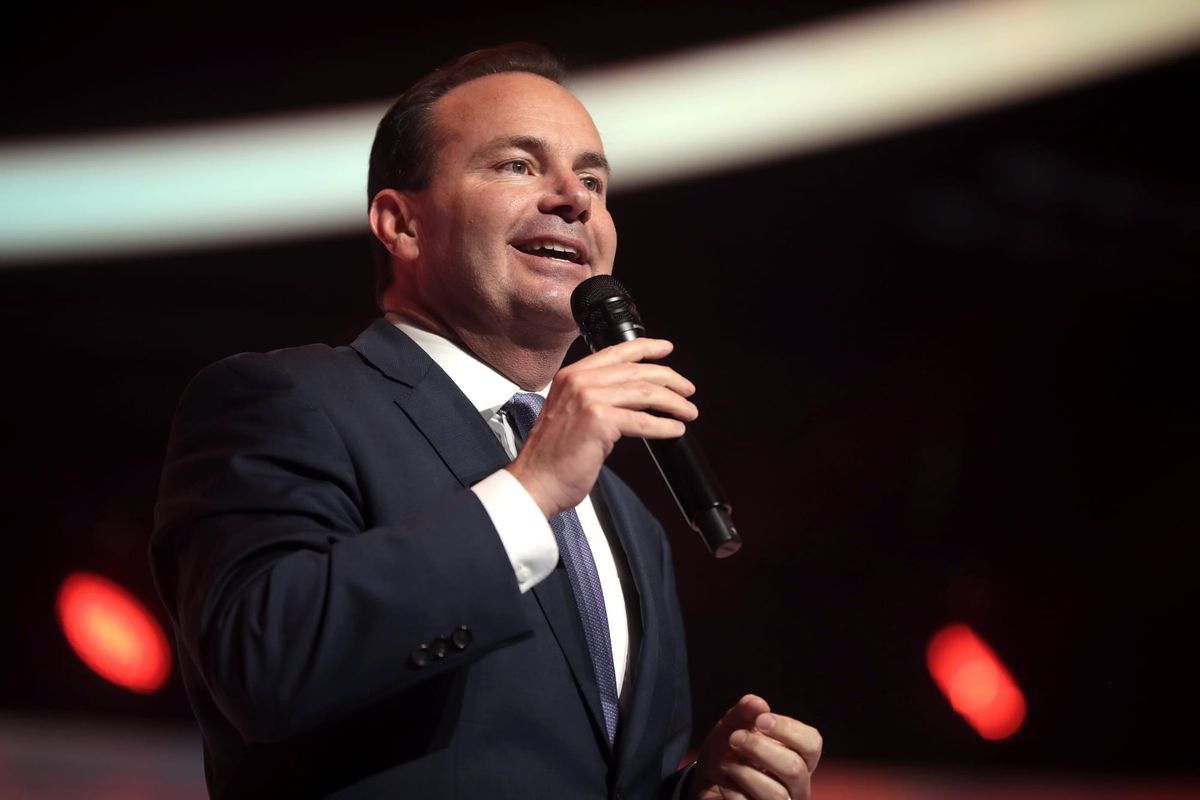
Utah Senator Mike Lee introduced the Shielding Children’s Retinas from Egregious Exposure on the Net (SCREEN) Act in February 2025, alongside exclusively Republican cosponsors and supporters Senators John Curtis, Jim Banks, and Representative Mary Miller.
The SCREEN Act would require every website that includes even one piece of what the legislation describes as “harmful to minors” to verify visitors’ ages. It defines “harmful to minors” as content that “depicts, describes, or represents, in a patently offensive way with respect to what is suitable for minors, an actual or simulated sexual act or sexual contact, actual or simulated normal or perverted sexual acts, or lewd exhibition of the genitals;” is “obscene” or “child pornography;” or “appeals to the prurient interest in nudity, sex, or excretion.”
Unlike the many laws now in place around the U.S. that apply to sites made up of at least one third adult content, like porn sites and some social media platforms, SCREEN would place the burden and risk of verifying users’ ages to every website on the internet that falls under the law, which would be most sites with user-generated content and also mainstream entertainment platforms like Netflix. It also attacks virtual private networks (VPNs) by requiring sites to verify based on IP addresses; many people in states that have age verification laws in place use VPNs to get around submitting sensitive personal data like ID and biometrics to a smattering of third-party websites in use today. Critics say the SCREEN Act would be a privacy and free speech disaster.
And the agenda of its sponsors is clear: “Internet pornography has infected our culture and corroded the vulnerable minds of America’s kids, with the average age of initial exposure being 12 years old. That’s appalling,” Banks said in Lee’s press release.
A number of religious, conservative, Christian nationalist, and anti-pornography groups are in support of the bill, according to the press release from Lee’s office. They include the National Center on Sexual Exploitation (which recently represented a Kansas mother who sued multiple porn sites because her son found her old laptop and used it to watch Chaturbate), the National Decency Coalition, the Ethics and Public Policy Center (which is “working to apply the riches of the Jewish and Christian traditions to contemporary questions of law, culture, and politics,” according to its website), the Family Policy Alliance (whose stated mission is to “advance biblical values through civic engagement”), the Family Research Council (whose “mission is to serve in the kingdom of God by championing faith, family, and freedom in public policy and the culture from a biblical worldview”), and many more.
Heritage Action, a conservative lobbying group and one of the organizations Lee lists in support of the SCREEN Act, is a sister organization to the Heritage Foundation, which authored Project 2025. Heritage Action “works with lawmakers to implement Heritage Foundation solutions,” according to the Heritage Foundation website. This is important because of how Project 2025, the playbook for right-wing and extremist conservative leadership, has influenced policies and lawmaking in America in the last few years of the Trump Administration. That stretches from attacks on programs that promote diversity, equity and inclusion, to attacks on trans and queer people, to turning the FBI into a political entity.
Half of the US Now Requires You to Upload Your ID or Scan Your Face to Watch Porn
Missouri’s age verification law, enacted on November 30, is the halfway mark for the sweep of age verification laws across the country.
One of Project 2025’s stated goals is to redefine and eradicate pornography: “Pornography, manifested today in the omnipresent propagation of transgender ideology and sexualization of children, for instance, is not a political Gordian knot inextricably binding up disparate claims about free speech, property rights, sexual liberation, and child welfare. It has no claim to First Amendment protection,” the playbook says, calling for imprisonment of pornographers but also educators and librarians. “And telecommunications and technology firms that facilitate its spread should be shuttered.”
The Senate Commerce Committee will also debate and mark up the text of the Youth AI Privacy Act which would require chatbots to disclose they’re not human among other features like limiting data retention; the CHATBOT Act which would require AI companies to build “family account” systems where parents can monitor kids’ activity; the Children’s Artificial Intelligence Toy Safety Act which would create a federal study into toys that include AI components; and the Kids Online Safety Act (KOSA).
KOSA would impose a legal “duty of care” on social media platforms to prevent and mitigate promotion of suicide, eating disorders, substance abuse, sexual exploitation, and advertisements for products like tobacco. KOSA has been introduced, and failed, multiple times since its first introduction in 2022; it has bipartisan lawmaker support but is extremely unpopular across all sides of the political spectrum among groups that care about freedom of speech because of its potential to increase censorship.
New Bill Would Make All Pornography a Federal Crime in the U.S.
Republican Senator Mike Lee introduced Interstate Obscenity Definition Act (again) last week, which would criminalize porn at the federal level.
“Whatever disclaimers and exceptions the bill includes, the practical effect is unchanged,” the Electronic Freedom Foundation recently wrote about KOSA. “When platforms face liability for content that someone later claims contributed to harms like anxiety, eating disorders, or substance use, the safest response is to remove lawful speech or shut down forums discussing those topics altogether.”
Unlike KOSA and many of the other age verification laws that have spread across the country, the SCREEN Act does not have bipartisan support. It’s the latest in Lee’s repeated attempts to criminalize content he and his co-sponsors personally consider immoral. Last year, Lee introduced the now-stalled Interstate Obscenity Definition Act (IODA) for the third time. IODA would change the 1973 “Miller Test” for determining what qualifies as obscene, and seeks to make all pornography illegal at the federal level. “Obscenity isn’t protected by the First Amendment, but hazy and unenforceable legal definitions have allowed extreme pornography to saturate American society and reach countless children,” Lee said in a press release. “Our bill updates the legal definition of obscenity for the internet age so this content can be taken down and its peddlers prosecuted.”