


🌘
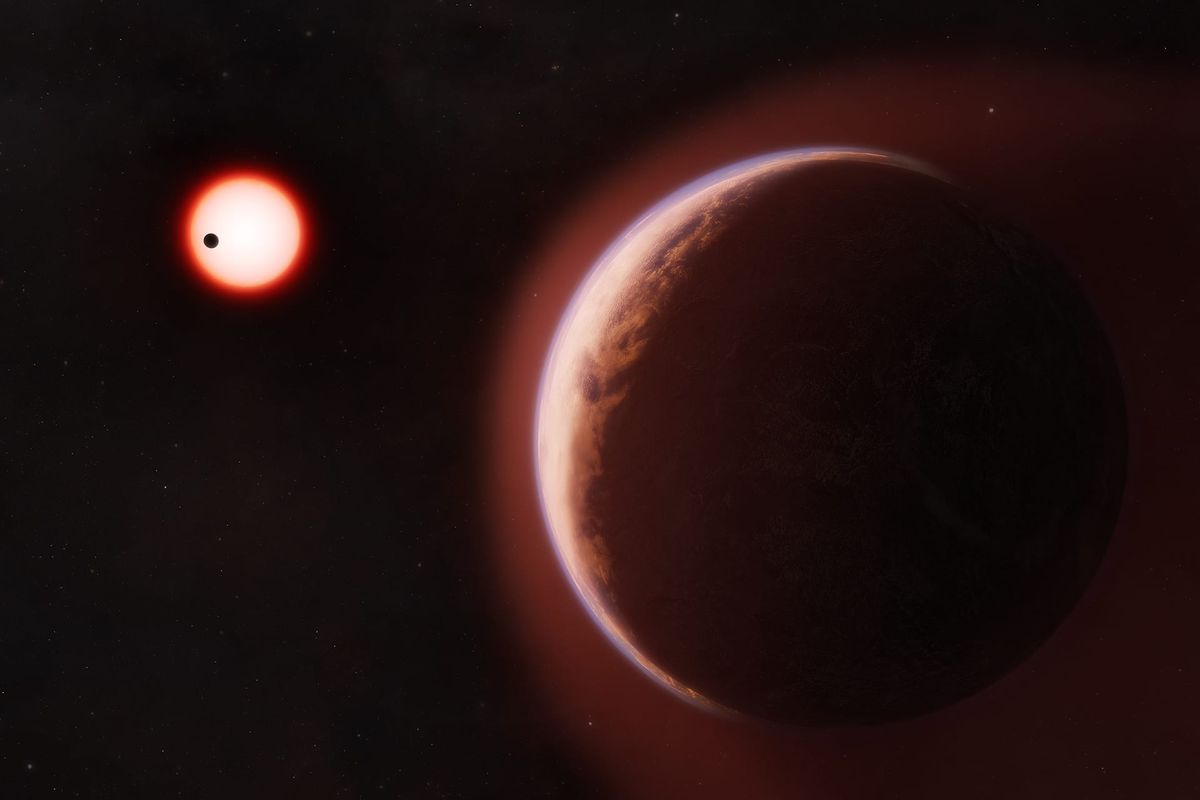
Astronomers have detected an atmosphere around a rocky exoplanet in the habitable zone of its star for the first time in history, signalling a major breakthrough in the search for alien life, according to a study published on Thursday in Science.
The planet, known as LHS 1140-b, is about 5.6 times more massive than Earth and orbits a small dwarf star about 48 light years from our solar system. While scientists have discovered atmospheres around many giant gas planets in our galaxy—and even a few rocky exoplanets outside the habitable zone—the new detection of helium in the skies of LHS 1140-b marks the first direct evidence that a habitable-zone rocky world can host an atmosphere, which is a critical factor for assessing their potential to support life.
“For rockier Earth-like planets, it has been a huge challenge in the field to detect any atmospheres at all,” said Collin Cherubim, a NASA Hubble Fellow at the University of Chicago, in a call with 404 Media. “This has been a huge question in the field that so much time and energy has been devoted to answering.”
The new discovery “is really the first claim ever of any rocky exoplanet atmosphere in the habitable zone that could potentially have liquid water and really support life,” added Cherubim, who conducted the research while he was a PhD student at Harvard University. “That’s what sets it apart and makes it really exciting.”
Scientists have previously inferred that some rocky exoplanets in the habitable zone might have atmospheres based on indirect evidence, such as measurements that show that their day and night temperatures are more moderate than expected, which could be explained either by an atmosphere, or other planet-wide effects. However, spotting an atmosphere around these rocky worlds is tricky because they tend to be so small compared to their stars, which is a challenge for precision observations.
Cherubim came at the problem with a new approach: He first developed theoretical models of rocky exoplanets that focused on mass fractionation, a process by which lighter molecules and atoms in the atmosphere escape into space, while heavier ones are left behind. These simulations predicted a new type of planet with thick skies closer to the surface, and a thinner upper atmosphere that allows helium to escape to space.
“Hydrogen is the lightest element and it’s the easiest to blow off into space,” Cherubim explained. “My model was predicting that if your planet is in this sweet spot where you’re blowing enough hydrogen away, but not too much that you’re dragging helium, which is a bit heavier, along with it, then you can actually create a helium-dominated atmosphere over time.”
“This is a newly-predicted class of planets, which should have very unique chemistry,” he added.
Cherubim realized that this escaping helium might be detectable from Earth, and that the LHS 1140 system would be a prime candidate to test out the hypothesis. To that end, the team observed LHS 1140-b and another planet in the system, LHS 1140-c, over the course of 2024 and 2025 with the Warm Infrared Echelle (WINERED) Spectrograph on the Magellan Observatory in Chile.
The 2024 results revealed a strong signal of helium at LHS 1140-b, but no detection in 2025, which may mean that the helium escape varies over time. The team predicts that the planet has probably had its atmosphere for billions of years. The other planet, LHS 1140-c, did not show any signs of an atmosphere, which was also expected based on its orbit and characteristics.
The momentous discovery proves that atmospheres can exist around rocky worlds, including around dwarf stars, which are far more common than more massive stars like the Sun. Cherubim and his colleagues think it’s quite likely that LHS 1140-b has large amounts of liquid water on its surface, another key ingredient for life as we know it on Earth.
“When we think about habitability, we think about three high-level things,” Cherubim said. “We think the planet needs to be rocky for the most part. It can’t be a gas-rich thing where the surface is molten, or like Jupiter where it’s just all gas. It’s got to be the right temperature to support surface liquid water, at least for Earth-like life, and it needs an atmosphere to hold that water in and to shield the surface from radiation.”
“With this discovery, we now know LHS 1140-b has all three of those things, which is really exciting,” he added. “And it just happens to be a very nearby system to Earth, so it’s very accessible.”
Whether alien life exists on LHS 1140-b remains an open question, but scientists have already been looking for signs of life, known as biosignatures, in its skies using the Hubble Space Telescope and the James Webb Space Telescope. So far, the search hasn’t turned up any obvious signs of life, but future efforts may be able to peer at this world in more detail.
“I think this is the best place to be looking for biosignatures,” Cherubim concluded. “We’re really excited to see what comes out of that.”
🌘
