



Close Menu

    Subscribe to Updates

    Get the latest creative news from FooBar about art, design and business.

    What's Hot

    Turning Secure Software Development into a Measurable Practice

    July 13, 2026

    LAPD Regularly Pulled Over Innocent People Because License Plate Readers Flagged Their Cars As Stolen

    July 13, 2026

    Podcast: Liberation, Eroticism, and Sex in Public (with Angela Jones)

    July 13, 2026
    Facebook X (Twitter) Instagram
    • Demos
    • Technology
    • Gaming
    • Buy Now
    Facebook X (Twitter) Instagram Pinterest Vimeo
    Canadian Cyber WatchCanadian Cyber Watch
    • Home
    • News
    • Alerts
    • Tips
    • Tools
    • Industry
    • Incidents
    • Events
    • Education
    Subscribe
    Canadian Cyber WatchCanadian Cyber Watch
    Home»News»RedHook Android malware now uses Wireless ADB for shell access
    News

    RedHook Android malware now uses Wireless ADB for shell access

    adminBy adminJuly 12, 2026No Comments3 Mins Read
    Share Facebook Twitter Pinterest LinkedIn Tumblr Reddit Telegram Email
    Share
    Facebook Twitter LinkedIn Pinterest Email


    Android

    A new version of the RedHook Android malware abuses the Android Wireless Debugging (Wireless ADB) mechanism in a novel way to gain shell-level privileges without requiring a computer connection.

    Researchers at cybersecurity company Group-IB analyzed the new release of the mobile malware and say that it significantly expands its capabilities compared to the previous variant documented in 2025.

    At the same time, the malware retains its remote access trojan (RAT) features, allowing it to stream the screen, intercept keystrokes, automate UI interactions, and steal credentials.

    image

    Autonomous Wireless ADB abuse

    ADB (Android Debug Bridge) is Google’s debugging interface that lets a user control an Android device from a command line.

    The system, which runs on an Android device as an ADB daemon, enables executing shell commands from a computer running the ADB client.

    Wireless ADB, first introduced in Android 11, provides the same capability wirelessly, without requiring the devices to be linked via a USB cable.

    RedHook essentially turns the phone into its own ADB client by tricking the victim into granting it Accessibility permissions, which let it automatically manipulate Settings, enable Developer Options, and activate Wireless Debugging.

    After that, the malware retrieves the pairing code displayed on the screen and connects to the phone’s ADB service via the loopback interface (127.0.0.1).

    Once paired, the malware gains shell (UID 2000) privileges, which are significantly more powerful than those available to normal Android apps, though not root-level.

    The entire attack chain does not require the device to be rooted, so it works across all Android devices as long as the user is tricked into approving the Accessibility Service permission request.

    Next, the malware deploys a Shizuku-based framework to execute shell commands, grant itself additional permissions, modify protected Android settings, silently install or remove applications, and perform various operations without displaying user dialogs.

    Shizuku is a legitimate Android utility popular among power users and developers, and does not require a rooted device.

    RedHook executes Shizuku code as part of its attack chain, using it as a privileged server (libmx.so) to invoke privileged Android APIs as UID 2000.
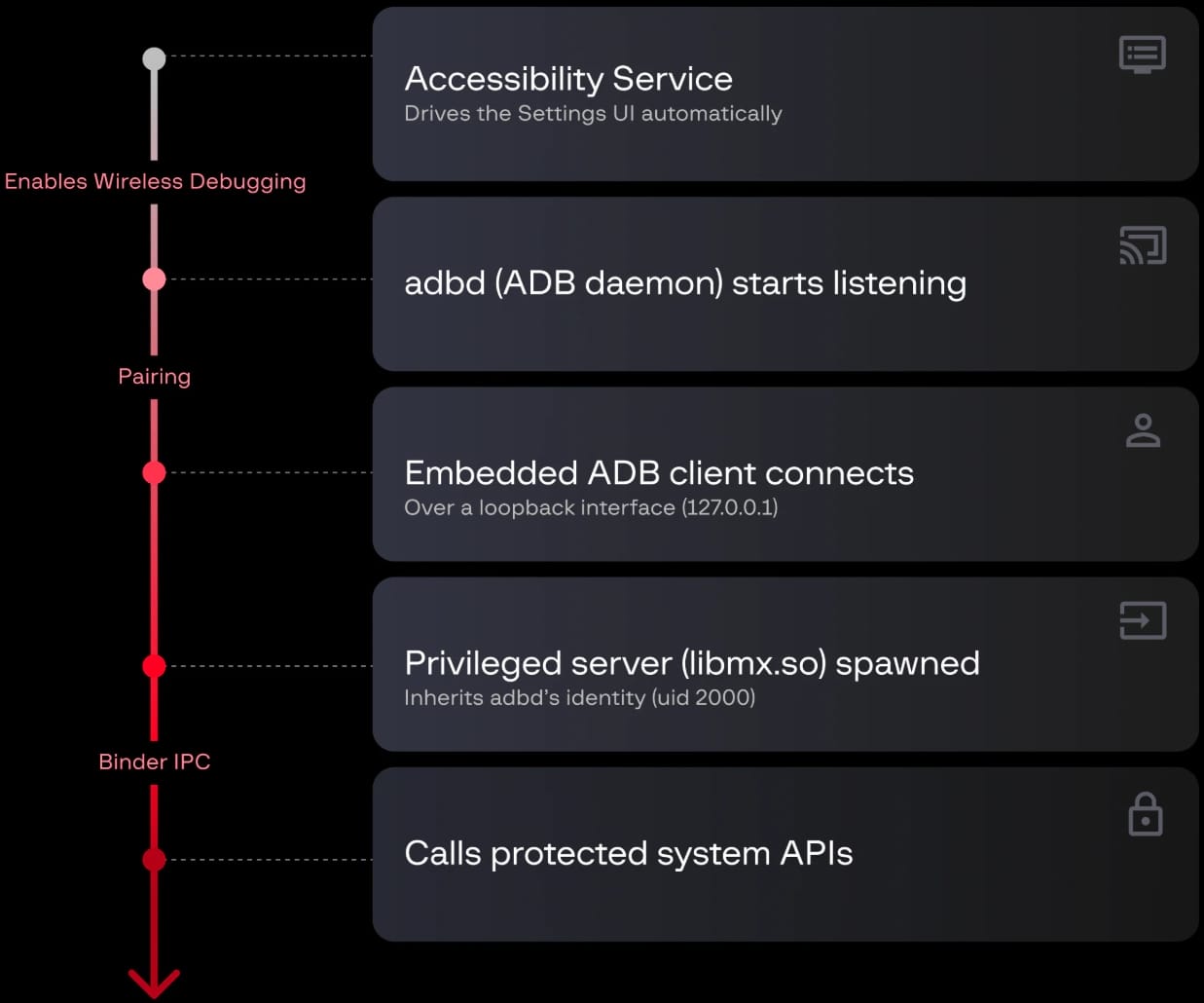
    Attack chain
    RedHook malware attack chain
    Source: Group-IB

    According to Group-IB’s report, the current version of the malware supports 53 server-issued commands, which include:

    • Screen streaming and screenshot capturing
    • Simulate taps, swipes, gestures, dragging, and long clicks
    • Device locking/unlocking
    • Install, launch, and uninstall apps
    • Collect contacts, SMS, and applications
    • Create overlays or fake verification dialogs
    • Activate the camera
    • Reboot the device

    The malware’s multiple persistence mechanisms are also highlighted in Group-IB’s report.

    RedHook uses silent audio playback to increase process priority, WakeLocks to prevent CPU sleep, and two services that restart each other when one is terminated.

    Other mechanisms include a five-minute watchdog alarm, automatic restart after device boot, and setting oom_score_adj to -1000 to reduce the likelihood of being killed when available system memory is low.

    The latest version of RedHook is distributed through social engineering, via messages and phone calls where attackers impersonate government agencies or financial institutions to direct victims to fake Google Play sites.

    Android users are advised to install apps only from Google Play, scrutinize requested permissions at installation, and ensure that Play Protect is active on the device.


    article image

    Security teams log 54% of successful attacks and alert on just 14%. The rest move through your environment unseen.

    The Picus whitepaper shows how breach and attack simulation tests your SIEM and EDR rules so threats stop slipping by detection.

    Get the whitepaper


    Source link

    Share. Facebook Twitter Pinterest LinkedIn Tumblr Email
    Previous ArticleHackTheBox – CCTV
    Next Article Claude Fable 5 stays free for paid users until July 19 as Anthropic buys more time
    admin
    • Website

    Related Posts

    News

    Turning Secure Software Development into a Measurable Practice

    July 13, 2026
    News

    LAPD Regularly Pulled Over Innocent People Because License Plate Readers Flagged Their Cars As Stolen

    July 13, 2026
    News

    Podcast: Liberation, Eroticism, and Sex in Public (with Angela Jones)

    July 13, 2026
    Add A Comment

    Comments are closed.

    Demo
    Top Posts

    Catchy & Intriguing

    March 17, 202677 Views

    The Canadian Password Playbook: Navigating Compliance and Building Strong Passwords

    March 25, 202634 Views

    IP Address Investigations and Local OSINT

    March 20, 202633 Views
    Stay In Touch
    • Facebook
    • YouTube
    • TikTok
    • WhatsApp
    • Twitter
    • Instagram
    Latest Reviews
    85
    Featured

    Pico 4 Review: Should You Actually Buy One Instead Of Quest 2?

    January 15, 2021 Featured
    8.1
    Uncategorized

    A Review of the Venus Optics Argus 18mm f/0.95 MFT APO Lens

    January 15, 2021 Uncategorized
    8.9
    Editor's Picks

    DJI Avata Review: Immersive FPV Flying For Drone Enthusiasts

    January 15, 2021 Editor's Picks

    Subscribe to Updates

    Get the latest tech news from FooBar about tech, design and biz.

    Demo
    Most Popular

    Catchy & Intriguing

    March 17, 202677 Views

    The Canadian Password Playbook: Navigating Compliance and Building Strong Passwords

    March 25, 202634 Views

    IP Address Investigations and Local OSINT

    March 20, 202633 Views
    Our Picks

    Turning Secure Software Development into a Measurable Practice

    July 13, 2026

    LAPD Regularly Pulled Over Innocent People Because License Plate Readers Flagged Their Cars As Stolen

    July 13, 2026

    Podcast: Liberation, Eroticism, and Sex in Public (with Angela Jones)

    July 13, 2026

    Subscribe to Updates

    Get the latest creative news from FooBar about art, design and business.

    Facebook X (Twitter) Instagram Pinterest
    • Home
    • Technology
    • Gaming
    • Phones
    • Buy Now
    © 2026 ThemeSphere. Designed by ThemeSphere.

    Type above and press Enter to search. Press Esc to cancel.