


By Maril Vernon, GRC Engineering Evangelist, Anecdotes.
Every vendor on every panel right now is saying the word “agentic.” But most of them can’t explain what actually changes when you stop treating GRC like a filing cabinet and start treating it like a fluid system.
I spent years on the offensive side, red and purple teaming, breaking the controls that GRC teams swore were working. Same findings, same gaps, different quarters. So when I tell you agentic AI is about to reshape how GRC operates, I’m not selling you a buzzword. I’m telling you what I’d be paying attention to if I were still trying to get past your controls.
Here is the honest version of where this goes, and what one of these agents actually looks like when you build it.
What “Agentic” Actually Means Here
Automation is not new to GRC. We have been scripting evidence collection and bolting RPA onto workflows for years. The problem is that most of it just moved the busywork around faster. It still produced static artifacts, still ran on a schedule, still answered the only question legacy GRC knows how to ask: “Did this control pass?”
An agent is different in three specific ways. It has autonomy, so it acts when a condition is met instead of waiting for a human to kick off a task. It has context, so it works against the actual state of your program rather than a screenshot from last quarter. And it executes multiple steps, so it can analyze, decide, and act in sequence rather than dumping a row into a report for you to deal with later.
The systems we are governing have already gone agentic. Cloud is elastic, identity is fluid, infrastructure is ephemeral, AI is non-deterministic, and CI/CD never stops. Attackers figured that out a long time ago but too many compliance programs are still trying to govern real-time systems with point-in-time assumptions.
Now, agentic does not mean handing judgment to a stochastic parrot, in fact most of the work should remain deterministic. The model provides reasoning, summarization, and orchestration. Your controls, thresholds, and policy decisions should still come from humans.
Frankly, this is one of the best use cases for AI in cybersecurity. GRC is full of high-volume, repeatable work performed against known baselines. That’s exactly the kind of problem machines excel at. We already trust AI to help us detect anomalies, prioritize alerts, and sift through mountains of telemetry.
Using it to help analysts identify evidence gaps or trace control drift is hardly the radical leap some people make it out to be.
Bottom line: AI should not replace judgment. It should give practitioners more opportunities to creatively apply it.
Agent Studio is the no-code builder for custom GRC agents. Pick a trigger, describe the task in plain English, and deploy with a full audit trail.
Join the early-access program and build your first agent in minutes.
Three Things That Actually Change
The analyst’s job shifts from collecting to managing. Nobody gets into GRC because they dream of chasing screenshots and manually updating spreadsheets. The analyst’s job changes, but not in the way people fear.
Agents don’t turn practitioners into passive supervisors. Agents don’t replace practitioners; they give them back the time to apply judgment where it actually matters.
Compliance moves from periodic to continuous. Historically, annual and quarterly cycles existed because humans couldn’t continuously evaluate every control and every change. Agents dramatically expand that capability, making continuous assessment practical where periodic reviews once were the only option.
The moment that constraint goes away, “are we compliant right now” becomes a question you can actually answer, not a snapshot you defend three months after it stopped being true.
Trust becomes the bottleneck. Keep in mind: pass/fail is a compliance outcome. Confidence is a security outcome.
People underestimate this one because once effort is cheap, the hard question is whether you trust what the agent did and can prove it, or did you simply shift the manual work to the verification tax? That is a governance problem, and it is the one worth your attention.
What It Looks Like to Build One
Theory is easy to consume and file away. Here is the concrete version, using Anecdotes Agent Studio, which is the no-code builder my team put into early access. The mechanics are the point, so follow the structure even if you use something else.
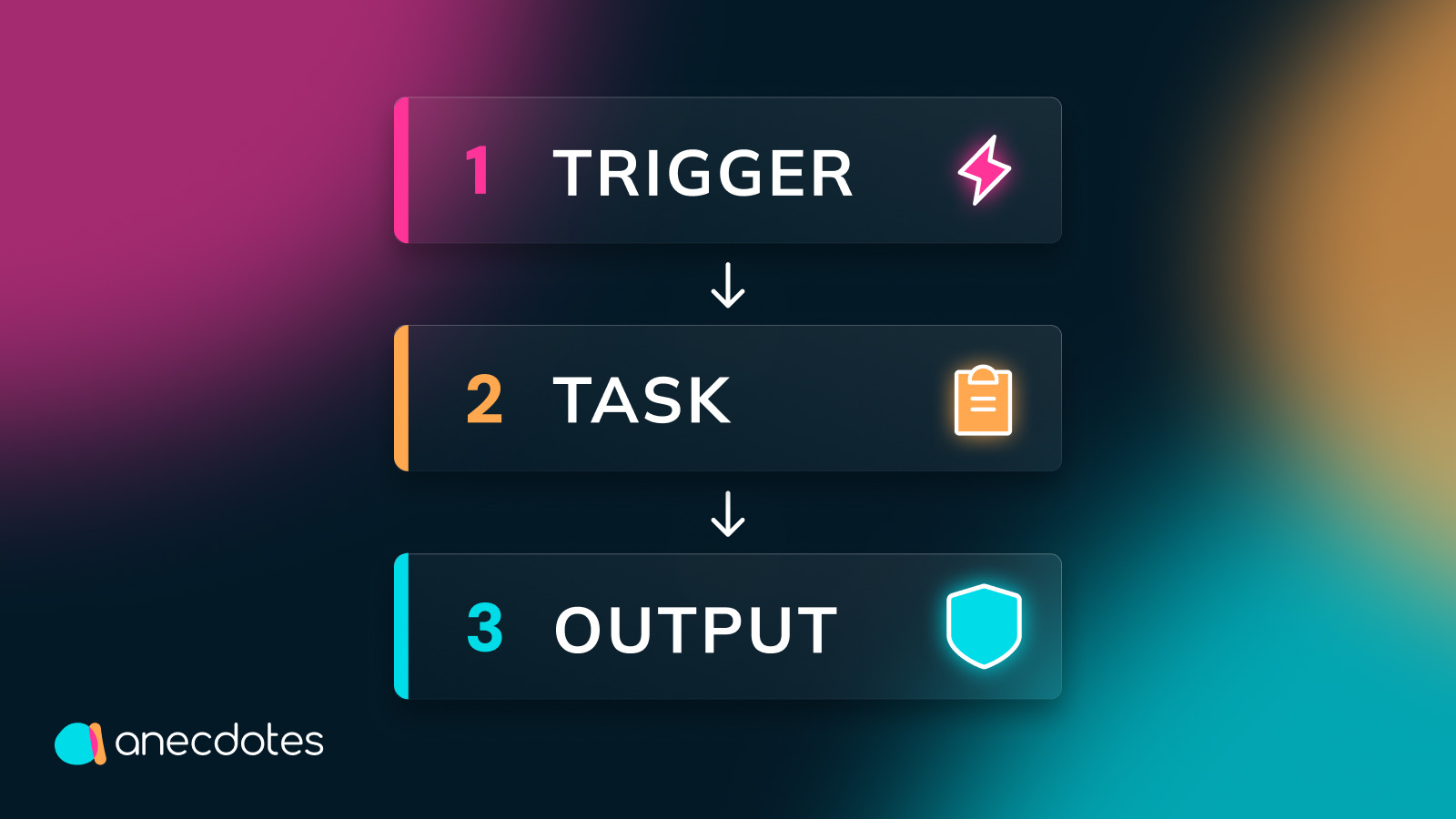
Agent development comes down to three decisions:
Pick a trigger. This is the condition that wakes the agent up. It might be a schedule (run every Monday), or it might be an event in your program (a risk level changes, or evidence for a control goes stale past a freshness threshold you set). I prefer event triggers, because they fire the moment something changes instead of waiting for the next scheduled run, which is what makes the monitoring continuous rather than periodic.
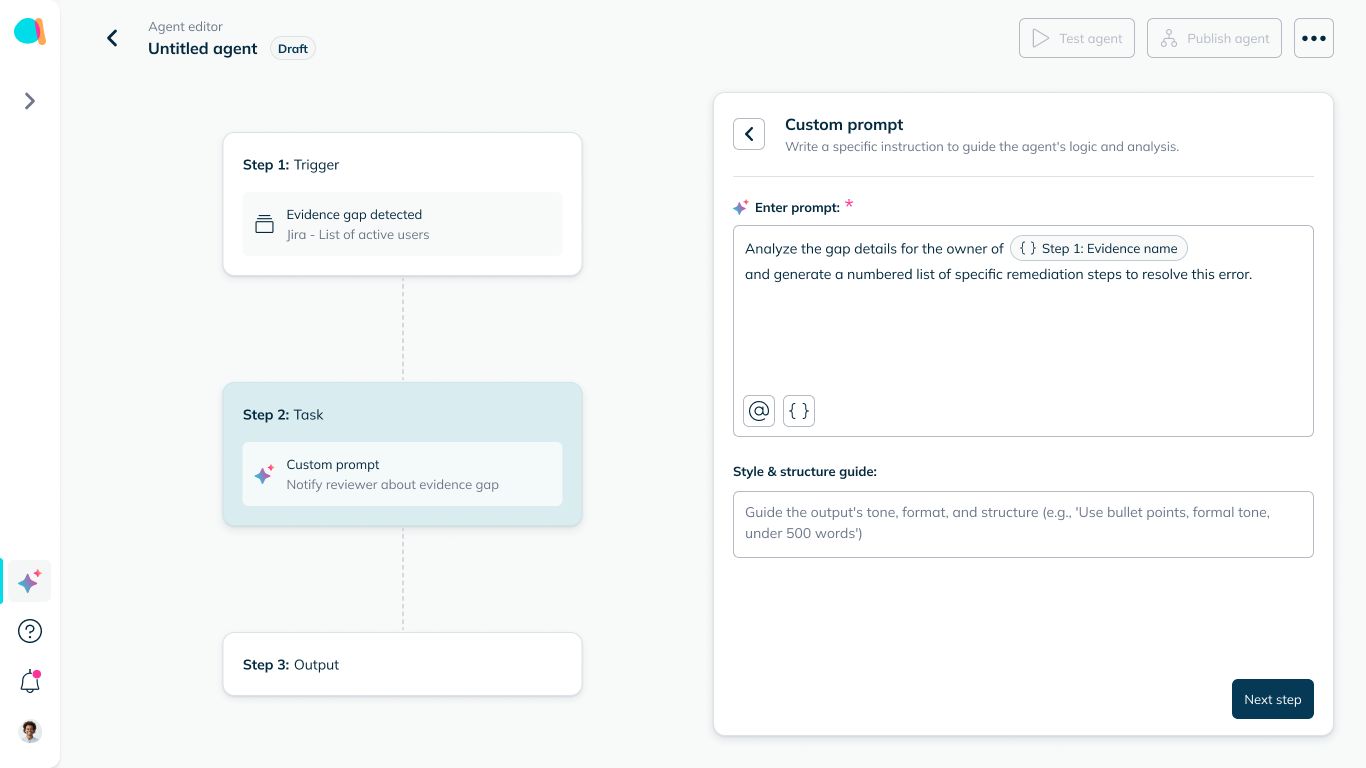
Describe the work in plain English. You write the instruction the way you would brief a junior analyst, no code needed. Take ISO 27001:2022 control A.8.5, secure authentication.
The instruction might read: “When the MFA evidence for A.8.5 is older than 24 hours, query the identity provider for the current MFA enforcement policy, compare it against the organization’s required MFA baseline, and if any group has fallen out of enforcement, open a finding and assign a remediation task to the control owner.” Start from a prebuilt recipe or write your own.
Deploy and watch. Now trace what the agent actually does when that trigger fires.
It reads the live MFA policy from your identity provider through the connected plugin (Okta, Entra ID, whatever you run), pulls the current enforcement state for each group, compares it to the A.8.5 baseline you defined, and finds that a newly provisioned admin group was created without an MFA policy attached. It opens a finding, attaches the policy snapshot it pulled as evidence, links it to A.8.5, and assigns remediation to the IAM owner.
Each of those steps lands in an execution log: the trigger event, the data it read, the comparison it ran, the decision it reached, and the action it took.
That single run is the difference between “we passed A.8.5 at the last assessment” and “A.8.5 is enforced right now, and here is the timestamped evidence.”
The Part Security People Will Push On (Correctly)
If your instinct reading this was “I am not handing compliance decisions to a black box,” good. Keep that.
Agentic GRC is defensible for one reason: the work is observable. A useful execution log captures the trigger that fired, the exact inputs the agent read, the rule or baseline it evaluated against, the decision it reached and why, the action it took, and the evidence it touched; all timestamped. That record is what lets you reconstruct any decision after the fact and hand it to an assessor without taking the agent’s word for anything.
Two scoping rules keep it safe. Give the agent least privilege: read-only access to the systems it evaluates, and write access only to the GRC objects it is allowed to create, like findings and tasks. Then gate anything consequential behind a person. Detecting drift and opening a finding can run unattended; closing a risk or marking a control effective should route to a human for sign-off.
Plan for the agent being wrong, because a non-deterministic model sometimes will be. If it opens a finding on A.8.5 that turns out to be a false positive, the log shows exactly what it read and concluded, so you fix the instruction instead of guessing.
An action you can trace is an action you can reverse, and that is why the log matters more than the model.
Where to Start
Don’t start with your highest-stakes control. Start with the task that is high-toil and low-judgment, the one your team does the same way every week and hates.
Think evidence gap detection, extracting findings from audit reports, or generating analysis rules for evidence that has no testing procedure. Prove the pattern there, read the logs, build the trust, then expand.
If you want to go deeper on this, it’s the whole agenda at the GRC Data & AI Summit 2026 on August 12, a free virtual event where security, risk, and compliance leaders work through what being agent-ready actually requires. Save your spot here.
I did not come back to GRC because it was comfortable. I came back because it was unfinished. Agents are the first time the tooling has started to match the speed, scale, and interconnected nature of the systems we’re trying to govern. If you want to see what building one feels like, Agent Studio is in early access now.
My advice? Build the boring one first. Then tell me what changed.
Maril Vernon is a former red and purple team operator and the Principal GRC Engineering Evangelist at Anecdotes. She writes and speaks on GRC Engineering, continuous controls monitoring, and pushing compliance into the same decade as the systems it governs.
Sponsored and written by Anecdotes.
