



Close Menu

    Subscribe to Updates

    Get the latest creative news from FooBar about art, design and business.

    What's Hot

    KMW CCTV Security Cameras | CISA

    May 30, 2026

    US charges Google security engineer with Polymarket insider trading

    May 30, 2026

    CVE-2026-10152 | THREATINT

    May 30, 2026
    Facebook X (Twitter) Instagram
    • Demos
    • Technology
    • Gaming
    • Buy Now
    Facebook X (Twitter) Instagram Pinterest Vimeo
    Canadian Cyber WatchCanadian Cyber Watch
    • Home
    • News
    • Alerts
    • Tips
    • Tools
    • Industry
    • Incidents
    • Events
    • Education
    Subscribe
    Canadian Cyber WatchCanadian Cyber Watch
    Home»News»Popular node-ipc npm package compromised to steal credentials
    News

    Popular node-ipc npm package compromised to steal credentials

    adminBy adminMay 16, 2026No Comments3 Mins Read
    Share Facebook Twitter Pinterest LinkedIn Tumblr Reddit Telegram Email
    Share
    Facebook Twitter LinkedIn Pinterest Email


    Popular node-ipc npm package compromised to steal credentials

    Hackers have injected credential-stealing malware into newly published versions of node-ipc, a popular inter-process communication package, in a new supply chain attack targeting npm.

    The node-ipc package is a Node.js module that enables various processes to communicate through all forms of sockets, including Unix, Windows, UDP, TLS, and TCP.

    Despite the maintainer publishing in March 2022 weaponized versions that targeted Russia and Belarus-based systems with a data-overwriting module, in protest to the Russian invasion of Ukraine, the package still has more than 690,000 weekly downloads on npm.

    The recent supply-chain attack was detected by multiple application security companies, including Socket, Ox Security, and Upwind, who confirmed the following three versions as malicious:

    • node-ipc@9.1.6
    • node-ipc@9.2.3
    • node-ipc@12.0.1

    The malicious code hides inside the CommonJS entrypoint (node-ipc.cjs) and executes automatically whenever applications are loaded.

    The malware is heavily obfuscated and fingerprints infected systems, collects environment variables and sensitive local files, compresses the stolen data into archives, and exfiltrates it through DNS TXT queries.

    The latest compromise appears to be the work of an external actor who compromised the account of an inactive maintainer named ‘atiertant.’

    According to the researchers, the infostealer injected in the new node-ipc versions collects the following types of information from compromised systems:

    • Cloud credentials from AWS, Azure, GCP, OCI, DigitalOcean, and others
    • SSH keys and SSH configs
    • Kubernetes, Docker, Helm, and Terraform credentials
    • npm, GitHub, GitLab, and Git CLI tokens
    • .env files and database credentials
    • Shell histories and CI/CD secrets
    • macOS Keychain files and Linux keyrings
    • Firefox profile and key database files (on macOS)
    • Microsoft Teams local storage and IndexedDB paths

    The malware skips files larger than 4 MiB and avoids scanning .git and node_modules directories to increase efficiency and reduce operational noise on the host.
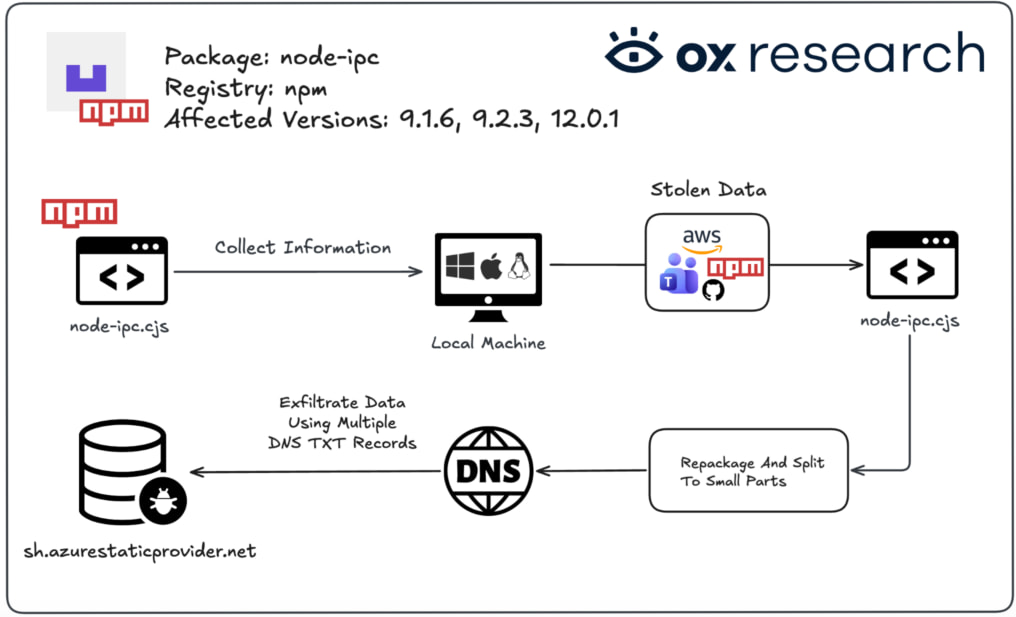
    Attack overview
    Attack overview
    Source: Ox Research

    A notable operational characteristic is the use of DNS TXT queries instead of conventional HTTP-based command-and-control (C2) traffic for data exfiltration. The attackers use a fake Azure-themed domain (sh[.]azurestaticprovider[.]net:443) as a bootstrap resolver, transmitting the data to ‘bt[.]node[.]js’ with query prefixes like xh, xd, and xf.

    According to Socket, exfiltrating a 500 KB compressed archive could generate roughly 29,400 DNS TXT requests, helping the traffic blend into normal DNS activity.

    Prior to submission, the malware stores collected data in temporary compressed tar.gz archives, which are deleted after exfiltration to reduce forensic traces.

    The malware does not establish persistence or download any secondary payloads, so the operation appears focused on rapid credential theft and exfiltration.

    Potentially impacted developers should immediately remove the affected versions, rotate exposed secrets and credentials, and inspect lockfiles and npm caches.


    article image

    Automated pentesting tools deliver real value, but they were built to answer one question: can an attacker move through the network? They were not built to test whether your controls block threats, your detection rules fire, or your cloud configs hold.

    This guide covers the 6 surfaces you actually need to validate.

    Download Now


    Source link

    Share. Facebook Twitter Pinterest LinkedIn Tumblr Email
    Previous ArticleDebian FFmpeg Critical Arbitrary Code Exec Denial Service DSA-6276-1
    Next Article CVE-2026-8657 | THREATINT
    admin
    • Website

    Related Posts

    News

    US charges Google security engineer with Polymarket insider trading

    May 30, 2026
    News

    Palo Alto GlobalProtect VPN auth bypass flaw now exploited in attacks

    May 30, 2026
    News

    New CIFSwitch Linux flaw gives root on multiple distributions

    May 30, 2026
    Add A Comment

    Comments are closed.

    Demo
    Top Posts

    Catchy & Intriguing

    March 17, 202674 Views

    Defending Canada’s Digital Frontier: Combating Phishing, Social Engineering, Ransomware, and Malware

    March 23, 202629 Views

    The Essential Guide to Removing Computer Infections: Step-by-Step Remedies

    March 20, 202627 Views
    Stay In Touch
    • Facebook
    • YouTube
    • TikTok
    • WhatsApp
    • Twitter
    • Instagram
    Latest Reviews
    85
    Featured

    Pico 4 Review: Should You Actually Buy One Instead Of Quest 2?

    January 15, 2021 Featured
    8.1
    Uncategorized

    A Review of the Venus Optics Argus 18mm f/0.95 MFT APO Lens

    January 15, 2021 Uncategorized
    8.9
    Editor's Picks

    DJI Avata Review: Immersive FPV Flying For Drone Enthusiasts

    January 15, 2021 Editor's Picks

    Subscribe to Updates

    Get the latest tech news from FooBar about tech, design and biz.

    Demo
    Most Popular

    Catchy & Intriguing

    March 17, 202674 Views

    Defending Canada’s Digital Frontier: Combating Phishing, Social Engineering, Ransomware, and Malware

    March 23, 202629 Views

    The Essential Guide to Removing Computer Infections: Step-by-Step Remedies

    March 20, 202627 Views
    Our Picks

    KMW CCTV Security Cameras | CISA

    May 30, 2026

    US charges Google security engineer with Polymarket insider trading

    May 30, 2026

    CVE-2026-10152 | THREATINT

    May 30, 2026

    Subscribe to Updates

    Get the latest creative news from FooBar about art, design and business.

    Facebook X (Twitter) Instagram Pinterest
    • Home
    • Technology
    • Gaming
    • Phones
    • Buy Now
    © 2026 ThemeSphere. Designed by ThemeSphere.

    Type above and press Enter to search. Press Esc to cancel.