



Close Menu

    Subscribe to Updates

    Get the latest creative news from FooBar about art, design and business.

    What's Hot

    SSA-921111 V1.1 (Last Update: 2026-05-13): Two File Parsing Vulnerabilities in Solid Edge Before Version SE226 Update 5

    May 13, 2026

    At Least We Know the Washington Post Isn’t Buying Views

    May 13, 2026

    aria2c Improper Certificate Validation – Research Advisory

    May 13, 2026
    Facebook X (Twitter) Instagram
    • Demos
    • Technology
    • Gaming
    • Buy Now
    Facebook X (Twitter) Instagram Pinterest Vimeo
    Canadian Cyber WatchCanadian Cyber Watch
    • Home
    • News
    • Alerts
    • Tips
    • Tools
    • Industry
    • Incidents
    • Events
    • Education
    Subscribe
    Canadian Cyber WatchCanadian Cyber Watch
    Home»News»Instructure confirms hackers used Canvas flaw to deface portals
    News

    Instructure confirms hackers used Canvas flaw to deface portals

    adminBy adminMay 11, 2026No Comments3 Mins Read
    Share Facebook Twitter Pinterest LinkedIn Tumblr Reddit Telegram Email
    Share
    Facebook Twitter LinkedIn Pinterest Email


    Instructure says hackers used Canvas flaw for extortion message on login portals

    Education technology giant Instructure has confirmed that a security vulnerability allowed hackers to modify Canvas login portals and leave an extortion message.

    BleepingComputer has learned that both the breach and defacements involved multiple cross-site scripting (XSS) vulnerabilities that enabled the attacker to obtain authenticated admin sessions.

    The second hack was to draw attention and to pressure Instructure into entering negotiations to pay a ransom following an initial breach disclosed a week before.

    Instructure is the developer of Canvas, a popular learning management system (LMS) used by schools and universities around the world to handle assignments and coursework.

    On April 29, the company discovered that its network had been breached and “immediately revoked the unauthorized party’s access, started an investigation, and engaged outside forensic experts.”

    A few days later, the company confirmed that data was stolen in the cyberattack, and ShinyHunters published Instructure on their data leak site, stating that they stole more than 3.6 terabytes of uncompressed data.

    In an attempt to coerce Instructure into paying a ransom, the threat actor hacked Instructure again on May 7 using the same vulnerability used in the initial intrusion.

    ShinyHunters injected malicious JavaScript exploiting XSS bugs within user-generated content features, which gave them access to authenticated admin sessions and allowed them to perform privileged actions.

    In an email to BleepingComputer on Sunday, Instructure confirmed that the exploited security issue affected the Free-for-Teacher environment, the free, limited version of Canvas LMS for individual educators.

    “The unauthorized actor made changes to the pages that appeared when some students and teachers were logged in through Canvas” – Instructure

    At the time, the organization added that it temporarily took Canvas offline to prevent the malicious activity from spreading, determine the cause, and to “apply additional safeguards.”

    ShinyHunters used the flaw to add a message to Canvas login portals, warning that the company, as well as schools using its platform, had until May 12 to reach out and negotiate a ransom.
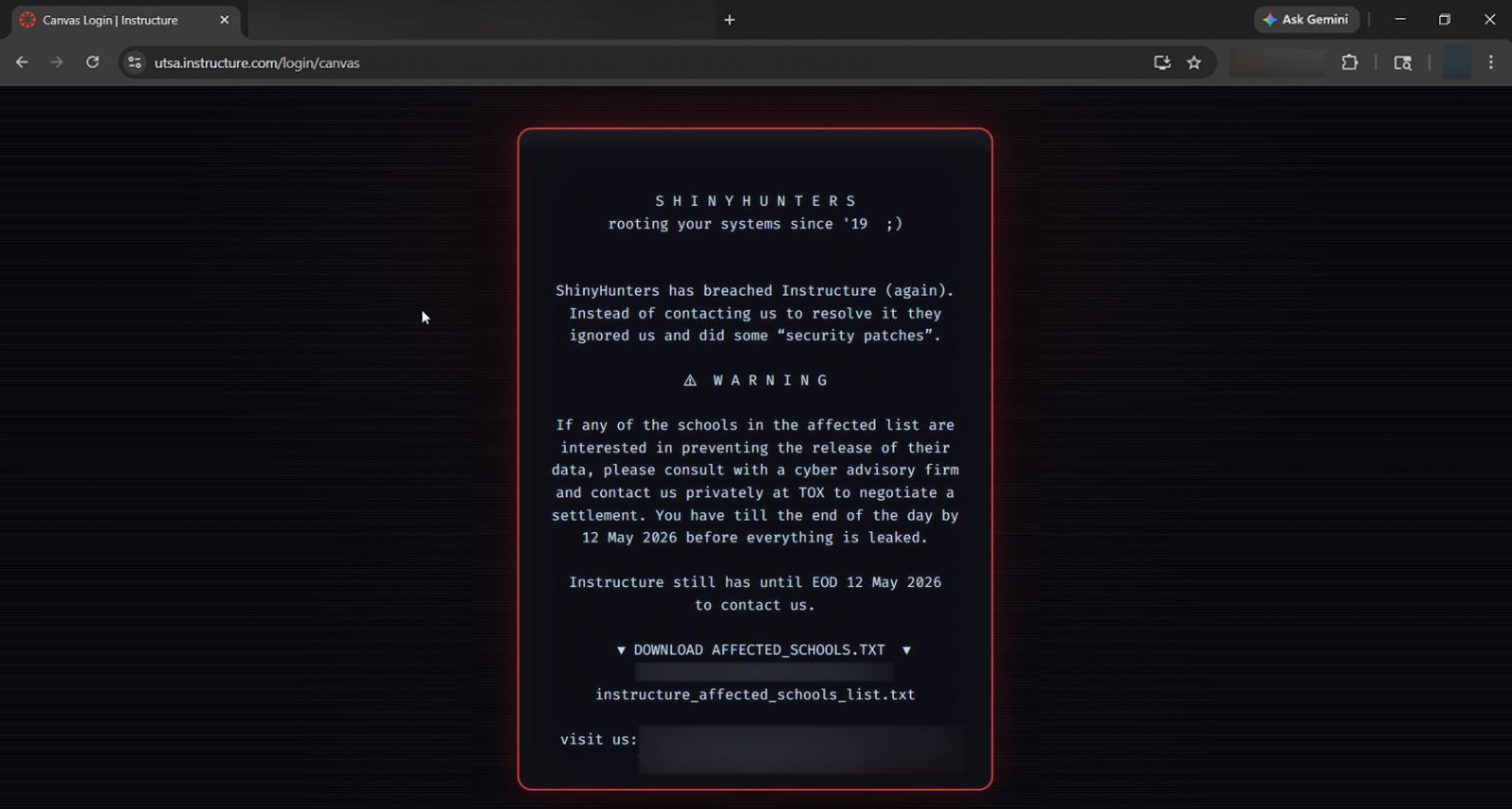
    ShinyHunters message left on University of Texas San Antonio Canvas login page
    Hackers’ message on the Canvas login page of the University of Texas San Antonio

    ​​​​

    Instructure has shut down Free-For-Teacher accounts until the issues have been resolved. However, Canvas has been restored and is available for use since May 9th.

    While no data was compromised when defacing Canvas login portals, the data that ShinyHunters exfiltrated in the first breach likely includes usernames, email addresses, course names, enrollment information, and messages.

    According to ShinyHunters, the Instructure breach impacts 8,809 educational organizations (schools, universities, colleges, online platforms) and the hackers claim to have stolen 275 million records belonging to students, teachers, and other staff members.


    article image

    AI chained four zero-days into one exploit that bypassed both renderer and OS sandboxes. A wave of new exploits is coming.

    At the Autonomous Validation Summit (May 12 & 14), see how autonomous, context-rich validation finds what’s exploitable, proves controls hold, and closes the remediation loop.

    Claim Your Spot


    Source link

    Share. Facebook Twitter Pinterest LinkedIn Tumblr Email
    Previous ArticleVU#471747: dnsmasq contains several vulnerabilities, including attacker DNS redirect, privilege escalation, and heap manipulation
    Next Article SSA-340240 V1.2 (Last Update: 2025-06-10): Denial of Service Vulnerability in SIRIUS 3RV2921-5M
    admin
    • Website

    Related Posts

    News

    At Least We Know the Washington Post Isn’t Buying Views

    May 13, 2026
    News

    Windows BitLocker zero-day gives access to protected drives, PoC released

    May 13, 2026
    News

    War and Data Centers Are Driving Up the Cost of Fiber-Optic Cable

    May 13, 2026
    Add A Comment

    Comments are closed.

    Demo
    Top Posts

    Catchy & Intriguing

    March 17, 202674 Views

    Defending Canada’s Digital Frontier: Combating Phishing, Social Engineering, Ransomware, and Malware

    March 23, 202624 Views

    IP Address Investigations and Local OSINT

    March 20, 202624 Views
    Stay In Touch
    • Facebook
    • YouTube
    • TikTok
    • WhatsApp
    • Twitter
    • Instagram
    Latest Reviews
    85
    Featured

    Pico 4 Review: Should You Actually Buy One Instead Of Quest 2?

    January 15, 2021 Featured
    8.1
    Uncategorized

    A Review of the Venus Optics Argus 18mm f/0.95 MFT APO Lens

    January 15, 2021 Uncategorized
    8.9
    Editor's Picks

    DJI Avata Review: Immersive FPV Flying For Drone Enthusiasts

    January 15, 2021 Editor's Picks

    Subscribe to Updates

    Get the latest tech news from FooBar about tech, design and biz.

    Demo
    Most Popular

    Catchy & Intriguing

    March 17, 202674 Views

    Defending Canada’s Digital Frontier: Combating Phishing, Social Engineering, Ransomware, and Malware

    March 23, 202624 Views

    IP Address Investigations and Local OSINT

    March 20, 202624 Views
    Our Picks

    SSA-921111 V1.1 (Last Update: 2026-05-13): Two File Parsing Vulnerabilities in Solid Edge Before Version SE226 Update 5

    May 13, 2026

    At Least We Know the Washington Post Isn’t Buying Views

    May 13, 2026

    aria2c Improper Certificate Validation – Research Advisory

    May 13, 2026

    Subscribe to Updates

    Get the latest creative news from FooBar about art, design and business.

    Facebook X (Twitter) Instagram Pinterest
    • Home
    • Technology
    • Gaming
    • Phones
    • Buy Now
    © 2026 ThemeSphere. Designed by ThemeSphere.

    Type above and press Enter to search. Press Esc to cancel.